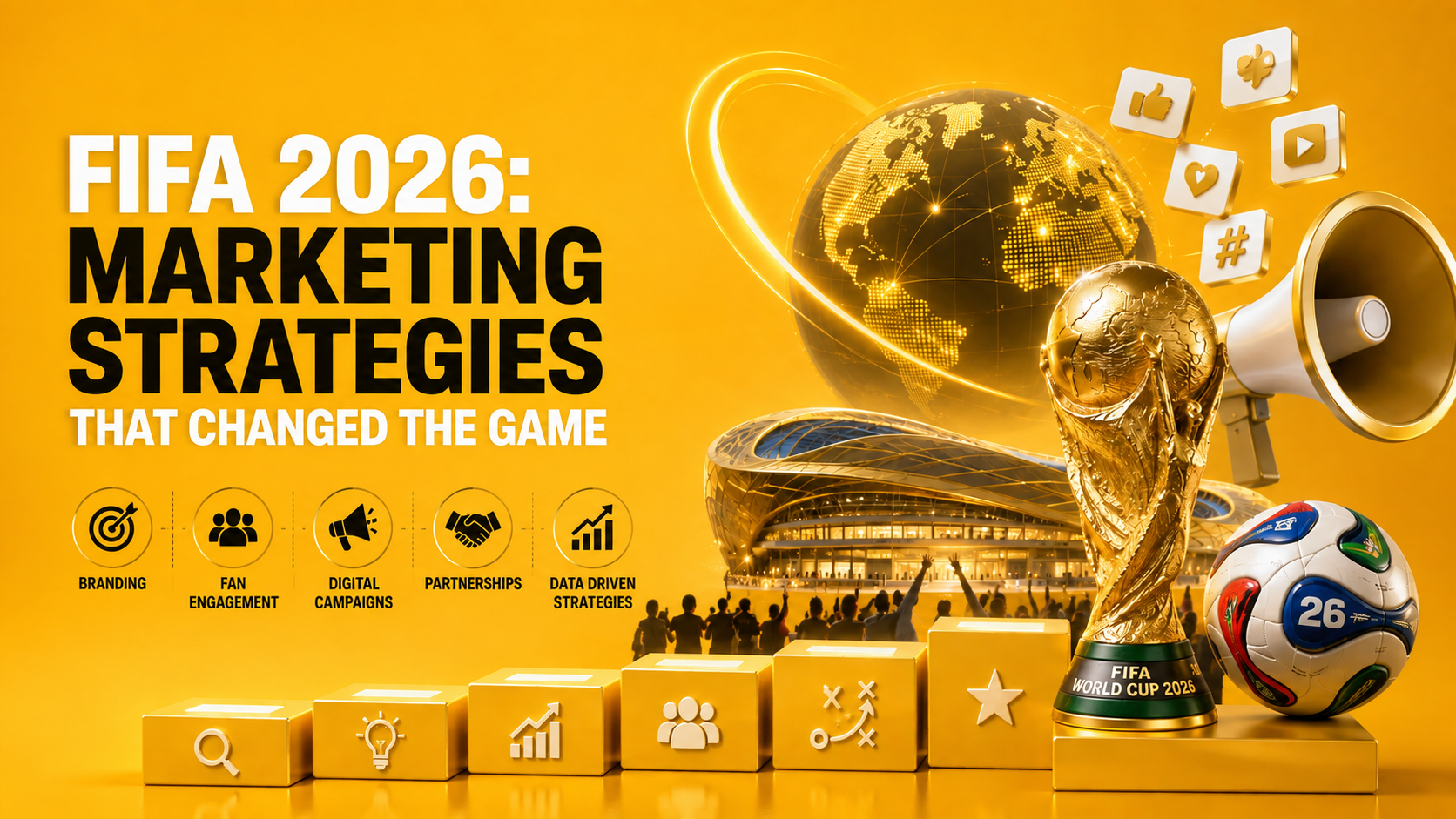
As a business owner, if you think FIFA 2026 is just another World Cup, you’re looking at it from the wrong angle.
For football fans, it’s the biggest sporting event on the planet. For marketers, it’s one of the greatest marketing case studies ever created.
And here’s the interesting part.
Most businesses assume that these opportunities are meant for only official sponsors such as Adidas, Coca-Cola, Visa, or Hyundai.
The event may belong to FIFA, but the attention belongs to anyone capable of earning it. That’s why FIFA 2026 matters far beyond football.
It’s becoming a live laboratory for digital marketing, creator collaborations, AI-driven personalization, real-time interaction, community-building, and immersive fan experiences. Each campaign from the tournament revealed how modern consumers discover brands, consume content, and make purchasing decisions.
This guide will take a look at the marketing tactics behind this unique tournament, and most importantly, how any organization could adopt them to draw its audience.
Understanding FIFA 2026: What Makes This Tournament Different?
Every World Cup makes history. In Brazil 2014, the legacy was celebrating the culture of football; in Russia 2018, the tournament was expanding its geographical footprint, while in Qatar 2022, the World Cup changed the game in terms of experience for fans thanks to innovations.
FIFA 2026 is different. The tournament is created by scale. Having 48 teams, 104 matches, 16 hosting cities, and three hosting countries, including Canada, Mexico, and the United States, FIFA 2026 became the largest FIFA World Cup in history.
For marketers, such characteristics mean not only additional matches but also more dialogues, viral stories, creators’ content, and more chances to reach an audience.
For the first time in history, the World Cup is held simultaneously in three countries, each providing their own market and audience. The USA boasts a huge media and advertising infrastructure, Mexico represents one of the most passionate football communities, and Canada, a rapidly growing one.
This way, brands do not need to target just one country but are able to address different markets using the same global approach.
The Audience Is No Longer Sitting in Front of a Television
One of the biggest mistakes businesses make is imagining World Cup audiences the way they existed twenty years ago. Nowadays, World Cup fans engage with it on various screens simultaneously.
While watching the game, they post memes, share reactions on X, browse Instagram, follow influencers on TikTok, track their fantasy football applications, and talk to friends. Indeed, 77% of sports fans use their second screens while viewing live sports.
Every goal becomes not only a highlight but also the source for reaction videos, memes, podcasts, livestreaming, news articles, and user-generated content, which can keep audiences interested long after the final whistle blows.
That’s why successful marketers today do not simply promote their products during the World Cup; they join the conversation.
Football Has Become a Creator Economy
Football used to belong to broadcasters. Today, creators shape how millions of fans experience the game. Some supporters never watch post-match television analysis.
Instead, they look at YouTube breakdowns, TikTok reactions, Twitch watch-alongs, Instagram reels, or football podcasts.
Creators aren’t competing with broadcasters anymore. They’re extending the conversation. That’s incredibly valuable for marketers.
Instead of buying expensive television spots, brands can collaborate with niche creators whose audiences trust their opinions. The result often feels more authentic, and frequently delivers stronger engagement.
So, FIFA understands this shift. The tournament isn’t simply broadcast anymore. It’s remixed, reacted to, discussed, clipped, and shared across thousands of independent communities.
Behind all these creator-driven conversations lies something even more valuable than content: attention.
Attention Is the Real Currency
The World Cup isn’t valuable because football is popular. It’s valuable because attention has become scarce.
Consumers scroll through thousands of marketing messages every day. Most disappear instantly. But when the World Cup begins, people willingly stop to watch. That level of voluntary attention is incredibly rare.
Brands aren’t paying millions for logos inside stadiums. They’re paying to become part of conversations that people genuinely care about. That’s a completely different type of marketing.
Instead of interrupting attention, they join it.
Business Takeaway
The biggest lesson from FIFA 2026 isn’t “go bigger.” It’s build bigger moments. Consumers don’t remember advertisements. They remember experiences.
Businesses should stop asking, “How can we advertise more?” and start asking, “How can we create moments people actually want to talk about?” and that’s exactly what FIFA has mastered.
Why FIFA Has Become One of the World’s Greatest Marketing Machines
The FIFA World Cup doesn’t become the world’s biggest sporting event every four years by accident.
Behind every sold-out stadium, viral celebration, and iconic campaign is one of the most sophisticated marketing ecosystems ever built.
FIFA doesn’t market football. It markets anticipation.
Long before the opening match, millions of fans are already emotionally invested. Qualification campaigns dominate headlines. Fixture announcements trend across social media. Jersey launches become fashion events. Host cities reveal countdown clocks. Sponsors release teaser campaigns months in advance.
By the time the first whistle blows, the tournament already feels like a global celebration. This isn’t coincidence. It’s deliberate.
FIFA Sells Emotion Before It Sells Football
Most brands market products. FIFA markets feelings. Think about the advertisements you remember from past World Cups. Very few focus on tactics or statistics.
Instead, they celebrate childhood dreams, national pride, family traditions, underdog stories, unity, hope, and resilience. The football simply becomes the stage where those emotions unfold.
This approach works because people rarely buy based on information alone. They buy based on emotion and justify it with logic afterward. FIFA understands that better than almost any organization.
When billions of viewers watch a player celebrate a last-minute goal, they’re not just witnessing sport. They feel relief, happiness, amazement, sadness, and pride all at once.
These emotional highs leave behind impressions with which advertisers will be able to relate, unlike any normal advertisement ever would.
Scarcity Creates Demand
Another reason FIFA’s marketing is so successful is that it incorporates the concept of scarcity into its strategies.
In contrast to normal weekly sports events, the FIFA World Cup takes place only once every four years. The difference between the two generates anticipation. Scarcity increases perceived value.
The same principle applies to business. Brands that are constantly shouting often become background noise. Brands that know when to create anticipation often command far greater attention.
Apple product launches, limited-edition sneaker drops, and invitation-only experiences all use this psychological principle.
FIFA has been using it for decades.
Community Is Stronger Than Advertising
The World Cup isn’t consumed individually. It’s experienced collectively. Friends gather for watch parties, families wear team jerseys, and entire cities celebrate victories together.
Even strangers become connected by a shared moment. This sense of belonging is incredibly difficult for businesses to manufacture, but it’s one of the strongest drivers of customer loyalty.
The brands that succeed during FIFA don’t simply advertise to fans. They help fans celebrate together. That’s the difference between an audience and a community. And communities market themselves.
Business Takeaway
FIFA’s greatest competitive advantage isn’t football; it’s psychology.
It creates anticipation before the event, emotion during the event, and memories that last long after the final whistle.
Businesses that aim to achieve more effective marketing strategies must consider going beyond their product or promotional efforts. Campaigns should be designed to provide shared experiences, invite people to participate in them, and give them something worth discussing.
Attention can bring them customers, while emotion keeps them engaged.
That emotional connection didn’t happen by chance. It was powered by a digital marketing ecosystem designed to keep fans engaged before, during, and after every match.
Digital Marketing Strategies Behind FIFA 2026
The biggest myth about FIFA’s marketing is that it is based on billion-dollar sponsorships. Indeed, finances play an important role; however, they are not enough any longer.
Today’s marketing works via attention, relevance, and participation. One creator can get more attention from people than one commercial shown on TV. The reaction of a fan can be more valuable than a professional advertisement. A smart message posted on social media can get millions of views in minutes.
FIFA knows that the World Cup is no longer just a game people watch.
Let’s examine the strategies that made FIFA 2026 one of the strongest marketing case studies in modern sports.
- Social-First Marketing: Winning Where Conversations Happen
The World Cup is no longer seen; it is experienced, discussed, and shared in real time.
Fans have flooded X, Instagram, TikTok, Reddit, and YouTube immediately following a goal being scored. While the match lasts 90 minutes, the discussion continues long after the final whistle blows.
FIFA has realized this change and has been adapting accordingly, making its approach more and more real-time and social-first. During the 2022 FIFA World Cup, FIFA produced 3.6 billion video views, 811 million engagements, and 15 billion impressions on its social media channels, demonstrating that the way people consume the beautiful game has changed from traditional TV broadcasts to social media and bite-sized content.
Leading brands followed the same approach. Throughout FIFA 2026, Adidas made sure to keep fans entertained with live streams of players arriving, training, going through the tunnel, partying in the locker room, and behind-the-scenes content. Instead of advertising its shoes, the company showed fans what goes on behind the lives of their favorite players, making social media an extension of the game-day experience.
In contrast to Adidas, Coca-Cola chose to celebrate its campaign “Believing Is Magic,” where they highlighted friendship, collective wins, and unique fan experiences, not its products. Visa further enhanced the fan experience via contactless payment in the stadiums, fan engagement activities, and women’s football. The best FIFA 2026 campaigns became part of the tournament rather than interrupting it.
Business Takeaway
Do not use your social media pages as platforms for announcements. Consider them as a real-life conversation. Those brands that respond quickly, entertain the audience, and join trending discussions receive the most recognition.
- Short-Form Video Dominance: The New Highlight Reel
FIFA 2026 is not just watched for full games, but rather seen through many short-form videos.
Since there are 104 matches, each minute of action has a chance to become the talk of the day, and fans do not need to wait for highlights, as they can learn about what is happening on the football field using TikTok, Instagram Reels, YouTube Shorts, and even through creators’ posts.
FIFA 2026 demonstrated how one sporting event could generate thousands of short-form videos from a single moment, giving brands a blueprint for content marketing.
The scale of this shift was evident throughout FIFA 2026. YouTube has stated that Shorts are now receiving more than 200 billion views on a daily basis, which shows why more and more brands have been focusing on vertical videos in the competition. Nike followed suit and made sure that they released clips and other footage designed specifically for platforms like TikTok, Instagram Reels, and YouTube Shorts.
Why This Matters
Short-form videos suit the way audiences consume content nowadays: fast, mobile-first, and highly shareable. One moment in the game can turn into hundreds of videos posted by creators and brands, becoming viral within a couple of hours.
Business Takeaway
The tournament demonstrated the value of building a content engine instead of relying on a single campaign. Create videos out of every trending moment and become part of the discussion.
- The Creator Economy Is Changing Sports Marketing
FIFA 2026 proved that football is no longer determined by what broadcasters do. The creators have played an important part in delivering content to fans in the form of match reactions, tactical analysis, podcasts, streams, and short-form content.
The change has been evident even in FIFA’s approach. Having seen how effective CazéTV was in the context of Qatar 2022, FIFA extended its partnership with the platform and gave it the right to broadcast all 104 FIFA World Cup 2026 matches in Brazil, taking into account the rising influence of communities created by creators among younger fans.
The industry’s rapid growth reflects this shift. According to Goldman Sachs, the creator economy is currently valued at more than $250 billion and is expected to surpass $480 billion in value by 2027, making creator partnerships significant in digital marketing.
For brands, the key advantage of creators was the authenticity of their promotion. Unlike traditional campaigns where only celebrities were used to promote products, companies started working together with creators who have gained trust in certain football niches. In fact, 69% of people trust influencers’ recommendations rather than information provided by brands.
Key Marketing Lesson
FIFA 2026 once again proved that it is not only the number of followers that defines the influence of a person or a community. The most effective campaigns involved those creators who have earned the trust of their audience.
- User-Generated Content: Turning Fans into Marketers
One of the biggest marketing wins of FIFA 2026 wasn’t created by FIFA. It was created by the fans.
The fans flooded social media feeds with footage from stadiums, selfies at matches, celebrations, watch parties, and travels. In effect, the tournament was a global stream of user-generated content. Each post meant growth for FIFA without the use of classic advertisements.
The scope of involvement was highlighted through statistics. During the tournament, FIFA received 30 billion social media impressions, 1.7 billion interactions, and attracted 187 million unique visitors to FIFA.com, all of which happened thanks to the fan involvement and viral content.
FIFA promoted participation through initiatives like #WeAre26, where supporters could showcase their experiences watching the game, celebrations, trips, and other fan rituals on various social platforms. The best responses would be posted on FIFA’s official page, making fans the ones creating digital content for the competition.
This strategy works effectively because people tend to perceive authentic experiences as more credible. According to Stackla’s Consumer Content Report, consumers are 2.4 times more likely to believe user-generated content is authentic compared to branded content.
Key Marketing Lesson
FIFA 2026 demonstrated once again that the best marketing sometimes happens within the community itself. When people want to share their experience, they turn into brand ambassadors.
Viewed individually, each strategy is powerful. Together, they explain why FIFA’s marketing ecosystem performs at such a massive scale.
Key Lessons from FIFA’s Digital Playbook
Across every strategy we’ve explored, one pattern becomes clear. FIFA isn’t trying to control the narrative. FIFA is giving conditions in which conversation can occur. It’s a small distinction.
Social media lets the game go beyond the stadium. Video lets fans relive moments after the match ends. Content creators make global stories personal. Fan content multiplies the message.
All these strategies make an ecosystem of marketing that doesn’t just depend on advertisements. It depends on participation.
And this is possibly the most important lesson for any business to learn from FIFA 2026.
The brand that succeeds in the coming decade won’t be the one shouting the loudest. They will be the brands with something meaningful to say.
Community, Real-Time & Emotional Marketing: The Final Pieces of FIFA’s Marketing Playbook
All the marketing strategies we have discussed until now have one thing in common.
- They are dependent upon people.
- They aren’t dependent on algorithms.
- They aren’t dependent upon marketing budgets.
- They aren’t dependent on celebrities either.
- They are dependent on people.
But capturing their attention is just the first step.
Holding it and engaging them further is the difficult part. That’s where FIFA’s next three marketing strategies make all the difference.
- Community Marketing: Building a Movement, Not Just an Audience
The FIFA World Cup has billions of viewers all over the world. But the real essence of the tournament does not lie in its popularity but in its communities.
Enter any café while the World Cup is on, and you will see people cheering despite being strangers. Go to a sports bar, and even rival teams engage in tactical discussions like old friends.
Open social media, and you will find thousands of fan communities engaged in debates about team formations, making predictions, creating memes, and celebrating wins.
FIFA didn’t create all these communities. Football did. FIFA simply nurtures them. That’s an important distinction. The best brands don’t build communities from scratch. They create environments where communities can thrive.
Official sponsors strengthened these communities by creating experiences beyond the stadium. Budweiser established fan parks and large-scale public viewings, allowing fans to celebrate among each other. Sponsorship initiatives ensured the participation of fans in engaging with the event. Rather than just branding their companies, they provided an environment where football communities could flourish.
Community Is Marketing That Doesn’t Feel Like Marketing
Traditional marketing asks customers to pay attention. Community marketing gives them a reason to stay. Instead of speaking to people, it encourages people to speak with each other.
During FIFA tournaments, communities form around:
- National teams
- Local clubs
- Fantasy football leagues
- Creator fan bases
- Watch parties
- Football podcasts
- Online forums
- Discord servers
- WhatsApp groups
- Reddit communities
Each one generates conversations that continue long after the final whistle. That’s free attention. And more importantly, it’s sustained attention.
Why Communities Matter More Than Followers
Many businesses obsess over follower counts. FIFA focuses on participation. There’s a huge difference. A page with ten million followers may receive little engagement.
A community of ten thousand passionate fans can influence purchasing decisions every single day.
Communities create:
- Trust
- Loyalty
- Word-of-mouth referrals
- Repeat engagement
- User-generated content
- Customer advocacy
Those are outcomes advertising alone can’t buy.
Business Takeaway
Don’t ask, “How do we grow our followers?” Ask, “How do we bring customers together?”
That could mean:
- Exclusive customer groups
- Events
- Challenges
- Loyalty communities
- Facebook Groups
- Discord servers
- Networking meetups
People rarely stay loyal to products. They stay loyal to communities.
- Real-Time Marketing: Winning the Moment
The World Cup is unpredictable. That’s exactly why it’s a marketer’s dream. A last-minute goal. A shocking upset. An emotional celebration. A referee’s controversial decision.
These aren’t just sporting moments. They’re marketing opportunities.
Brands that respond quickly often receive enormous engagement, not because they spent more money, but because they joined the conversation while people were already paying attention.
This is known as real-time marketing.
The Internet Rewards Speed
Imagine two brands. The first posts about a spectacular goal five minutes after it happens. The second publishes a beautifully designed campaign the next morning.
Which one gets shared? Usually the first.
Because relevance has an expiration date. The internet moves quickly. People want reactions while emotions are still fresh. That’s why many global brands now operate real-time content teams during major sporting events.
Designers, copywriters, video editors, community managers, and data analysts all work together to create content within minutes.
Oreo’s Famous Lesson Still Applies
Although it wasn’t during the FIFA World Cup, Oreo’s iconic “You can still dunk in the dark” tweet during the 2013 Super Bowl remains one of the greatest examples of real-time marketing.
The lesson wasn’t about cookies. It was about preparation. The brands that appear spontaneous are usually the most prepared.
FIFA sponsors operate the same way. They don’t wait for the tournament to begin before planning content. They prepare hundreds of creative scenarios in advance.
Different versions, outcomes, players, and celebrations. When something happens, they publish immediately.
Business Takeaway
You don’t need a global event; you need awareness.
Respond to:
- Industry news
- Customer achievements
- Local events
- Trending conversations
- Cultural moments
The faster your brand becomes part of relevant discussions, the more visible it becomes. Speed creates relevance and relevance creates attention.
- Emotional Storytelling: The Strategy Behind Every Memorable Campaign
If someone asked you to remember your favorite World Cup advertisement, chances are you wouldn’t remember the product.
You’d remember the feeling. That’s intentional. FIFA doesn’t sell football. Its partners don’t sell products; they sell emotions connected to football.
Think about the themes dominating World Cup campaigns: a child dreaming of representing their country, a father watching football with his daughter, friends celebrating together, an underdog nation’s historic victory, or a player overcoming adversity.
Very few advertisements focus on features, but almost all focus on feelings. Because emotions travel further than information.
Emotion Makes Brands Memorable
Psychologists have long shown that emotional experiences are remembered more vividly than purely factual ones. Marketing works the same way.
Customers might forget:
- Your discount.
- Your product specifications.
- Your slogan.
But they’ll remember how your brand made them feel. That’s why Coca-Cola consistently focuses on togetherness, and that’s why Adidas celebrates ambition, and that’s why Visa highlights unforgettable experiences, because football simply becomes the emotional backdrop.
This is why the largest partners of FIFA always started off with emotions before moving to the product. Adidas used its “You Got This” campaign to build self-confidence and perseverance, Nike used the Footballverse campaign to celebrate the culture of football, and Coca-Cola used emotions of being together and celebration in its campaign. In all these cases, football was the emotional background, and the product was an integral part of the story.
Research by the Institute of Practitioners in Advertising (IPA) clearly shows that emotionally led campaigns perform better than rationally led campaigns in building brand effectiveness, making emotional storytelling one of the strongest drivers of lasting consumer loyalty.
The Power of Shared Human Stories
One reason FIFA resonates across cultures is that its stories are universal. Hope, failure, resilience, belonging, triumph, and heartbreak. These emotions don’t require translation.
That’s why a fan in Argentina can celebrate alongside someone in Japan. Or someone in Nigeria can empathize with a player from Croatia.
Great marketing works the same way. The story changes, but the emotions remain universal.
Business Takeaway
Before creating your next campaign, ask, “What emotion do we want people to remember?”
Not, “What message do we want to deliver?”
Emotion creates memory and memory creates loyalty.
8. AI Turned Every Fan Experience into a Personal One
AI-powered translations
FIFA used AI to make content accessible in multiple languages, helping fans across different regions engage with the tournament more naturally.
Personalized content
Fans didn’t all receive the same content. Instead, platforms recommended:
- Highlights
- Goals
- Favorite teams
- Player content
- Match recaps
based on viewing behavior.
AI-generated highlights
Instead of watching an entire match, fans could instantly access
- Goals
- Saves
- Key moments
generated automatically.
Chatbots
Fans could instantly find
- Fixtures
- Tickets
- Stadium information
- Schedules
without waiting for support.
Business lesson
The takeaway isn’t “Use AI.” It’s “Use AI to remove friction and deliver more relevant experiences.”
Marketing Lessons Every Business Should Steal from FIFA 2026
You don’t need FIFA’s budget to apply FIFA’s thinking. In fact, many of its most effective strategies have very little to do with money.
FIFA 2026 highlighted ten marketing principles that businesses of any size can adopt.
- Sell an experience, not a product – People purchase results and feelings before features.
- Build anticipation – Campaigns become more exciting when people are looking forward to them.
- Participate in conversations – Don’t always aim at initiating them.
- Think mobile first – People discover brands through their phones.
- Create moments worth sharing – Marketing becomes less expensive when customers share your story.
- Invest in communities – Communities live longer than campaigns.
- Collaborate with trusted creators – Credibility is more important than fame.
- React quickly – Sometimes timing is more important than perfection.
- Stay consistent – FIFA doesn’t change its identity every four years. It changes while staying the same. Brands should be the same.
Final Thoughts: FIFA Is Teaching Businesses More Than Marketing
FIFA 2026 wasn’t only one of the world’s largest sporting events. It was also one of the most significant case studies for marketers in the entire year.
The event wasn’t only successful due to sponsorship. What really made it a great example is that it created experiences that people would want to watch, tell others about, share, and take part in.
This is what makes a brand for any business. Brands aren’t just about promoting a product or a service; they’re about providing an experience.
What FIFA 2026 showed us business owners is that while attention helps people get to know a brand, participation and emotions help them become loyal customers.