You can rank #1 on Google and still be invisible to an AI-generated answer, and that is the new search problem.
Google now uses AI Overviews and AI Mode, while websites like ChatGPT and Perplexity analyze information from various sources. According to Pew Research, users click on a regular search result if an AI-powered overview was shown only in 8% of cases, while without an AI-generated overview they do it 15%.
Now it is not enough just to ask, “How do I rank?” Instead, you need to ask, “How do I become one of those sources which AI systems trust enough to mention or cite?”
This is where engine optimization strategies, especially Generative Engine Optimization (GEO), play their role.
What Is Generative Engine Optimization?
Generative Engine Optimization is the optimization of your content, website, and brand online in such a way that artificial intelligence-based search engines find, comprehend, rate, and cite or recommend your business.
In traditional SEO, you rank your website for specific keywords. But in GEO, your objective is to make your brand valuable for an AI-based search engine as an information source.
For instance, your traditional SEO campaign would target “best SEO agency USA.” But the user in a generative search could ask, “What are the best SEO agencies in the USA for a SaaS company?”
The additional meaning in the second question has context, intent, and restrictions.
Your AI-driven response would provide a shortlist, reasons why companies are suitable, and credible sources of information for the recommendation.
Your goal is to become that source. And no, not by adding “AI” in the headings of your website.
SEO vs. GEO: What’s the Difference?
SEO and GEO are very similar but differ in the type of optimization they offer.
| Traditional SEO | Generative SEO |
| Optimize for rankings | Optimize for AI visibility |
| Target keywords | Target questions, entities, and intent |
| Earn backlinks | Earn authoritative mentions and citations |
| Improve SERP CTR | Improve mentions, citations, and referrals |
| Optimize individual pages | Build broader digital authority |
| Measure rankings and traffic | Measure AI visibility and source inclusion |
You don’t need to choose between them.
Google’s official guidance says the SEO principles required for pages to succeed in traditional searches are still applicable for AI Overviews and AI Mode. These pages have to be crawlable, indexable, and eligible for regular Google searches.
Consider GEO an extra layer of SEO.
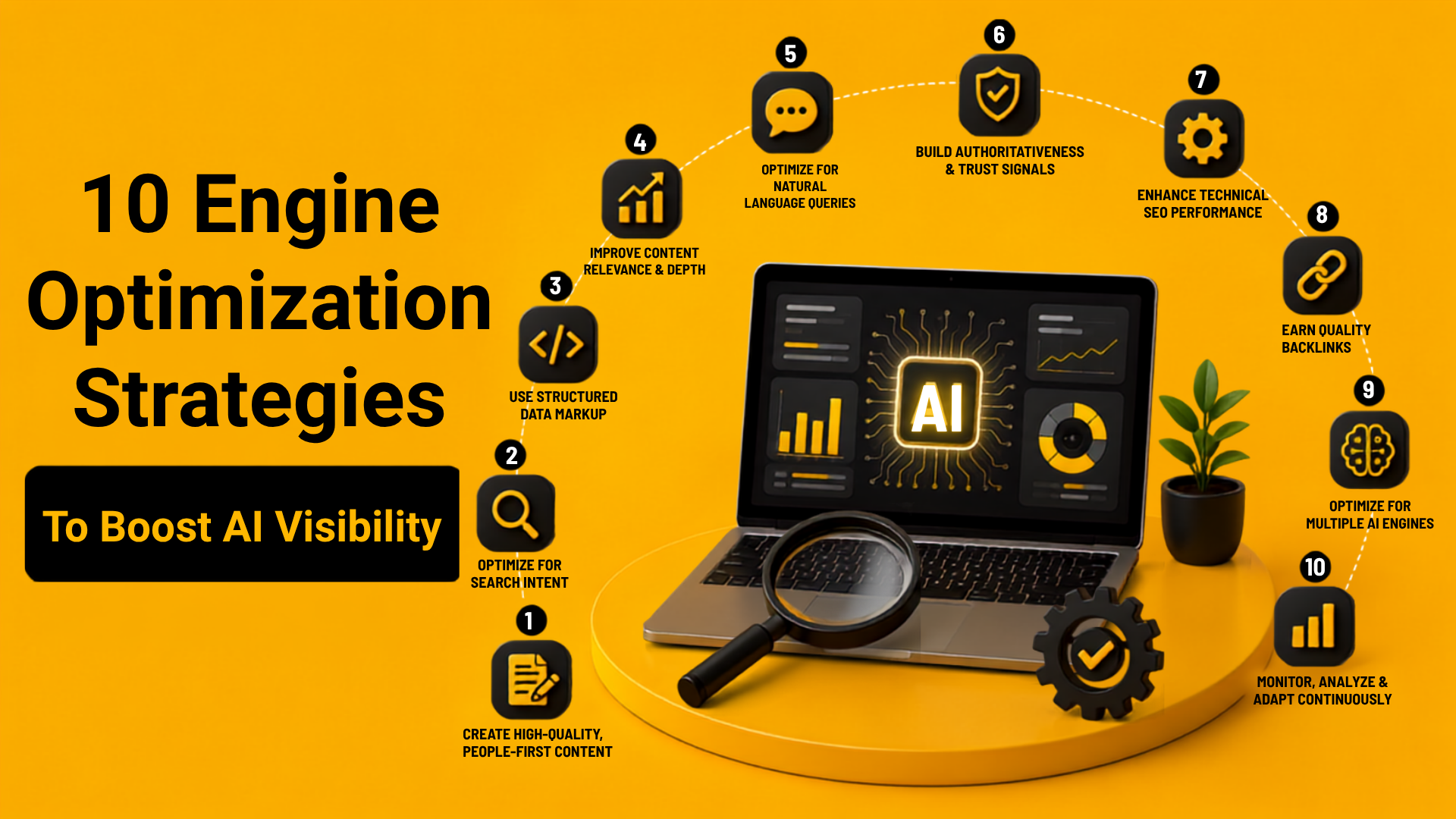
10 Engine Optimization Strategies for AI Visibility
- Build Content Around Search Questions
Keyword optimization is not dead. However, keyword-oriented approaches are becoming less effective. Users ask more complex and long-tailed questions.
According to the Pew Research Center, only 8% of one-word or two-word Google searches conducted in the center’s experiment led to an AI summary. However, 53% of the search queries consisting of 10 words or more generated an AI summary.
This is an important insight for content marketers.
Stop thinking about a single page on:
- “CRM software” and create a content set of questions around:
- What is CRM software?
- How does CRM software work?
- What features should be in CRM software for a small business?
- What is the cost of CRM software?
- What is the best CRM software for a company of 20 people?
- CRM vs spreadsheets, which is better?
- How to implement CRM software?
- CRM implementation pitfalls.
This will help you create a topic cluster rather than a graveyard of keywords.
Practical strategy
Map content by four intents:
- Informational: What is CRM software?
- Commercial: Best CRM software for small businesses
- Comparative: HubSpot vs Salesforce
- Transactional: CRM implementation services
This gives AI systems more opportunities to encounter your expertise.
- Use Answer-First Content Structure
AI systems need information they can retrieve and synthesize quickly.
The reader will appreciate not having to sift through 2,000 words of an introductory discussion on “the rapidly evolving digital landscape” in order to find the answer.
Start with the answer.
Example:
What is GEO?
Generative Engine Optimization is the optimization of a brand’s digital footprint in such a way that AI search engines are able to find, understand, and cite the information of said brand.
Expand from there.
Utilize:
- Short paragraphs
- Concise H2s and H3s
- Bullet points
- Charts
- Definitions
- Processes
- Examples
- Statistics
- FAQs
Doing so will increase the readability of your content for both humans and computers. The point is not to produce robotic content. The point is to provide clear information.
- Create Citation-Worthy Content
Here’s one of the biggest differences between ordinary content and strong GEO content:
Stop merely repeating data and start creating evidence.
Let’s assume that your article states, “Mobile optimization increases conversions.” It is an ordinary piece of information.
But how about this statement: “According to our analysis of 1,500 e-commerce sessions, mobile users showed 23% higher rates of abandonment on checkout pages with more than five form fields.” It is another case.
Because it contains:
- Original information
- Sample size
- Measurable outcome
- Context
It is the type of information that can be used by other websites for citation.
Build assets, such as:
- Research reports
- Industry surveys
- Benchmark reports
- Case studies
- Datasets
- Interviews with experts
- Statistics
- Technical tests
- Price comparison
Try to make the information that other websites would like to cite. Since every third-party citation strengthens your authority ecosystem.
- Strengthen Your Brand Entity
AI systems need to understand what your company actually is.
Your brand shouldn’t consist of five companies that exist all over the web.
Google advises Organization Structured Data, which helps search engines recognize and disambiguate organizations. This may be information such as your name, URL, logo, contact details, and references to external entities by the property “sameAs”.
Make sure your identity is consistent on:
- Website
- About Us page
- Author pages
- Business directories
- Reviews
- Press release
- Partner websites
Clearly establish: Who you are → What you do → Who you serve → Where you operate → What you specialize in
Example: Xparro is a digital marketing agency that provides SEO services, AI marketing, performance marketing, and digital growth for businesses that want to enter Western markets.
That’s far clearer than: “We develop innovative digital solutions for modern businesses.”
The second one sounds cool. But what is it really? Because it says almost nothing.
- Build Expert-Led Content
Visibility is not just about websites; visibility is also about people and expertise. Create recognizable authors and experts in subject matters.
Instead of “Written by Marketing Team”, use “Written by [Name], SEO Strategist with 8+ years of experience in technical SEO and enterprise search strategy.”
Authors’ profiles may contain:
- Professional experience
- Credentials
- Expertise
- Publications
- Relevant projects
- Social profiles
- Areas of specialization
Identifying authors and creating connections to their relevant pages or profiles is also recommended by Google’s Article structured-data guidelines.
And for technical, financial, healthcare, and other subjects, this is particularly important. People want to know who talks, so do search engines.
- Earn Third-Party Authority
Your website isn’t your entire reputation.
An AI system can collect data from many different corners of the web, from publishers, industry sites, reviews, forums, and many more authoritative sources.
Research on generative search revealed that an AI system can have a preference for earned media and third-party authoritative sources over branded content.
This means that the GEO strategy cannot just be limited to creating blog posts.
Develop a digital PR strategy that will focus on:
- Industry publications
- Expert interviews
- Podcasts
- News coverage
- Research collaborations
- Expert roundups
- Industry associations
- Original reports
- Thought leadership
And no need to obsess over link building. Obsess over mentions instead. There is a huge difference between “Click here.” and “According to Xparro’s analysis of U.S. search trends…”
Because the second one gives context to your authority.
- Build Semantically Complete Content
A webpage targeting a single keyword does not imply completeness. If your target is the following keyword phrase: “how to increase website conversion rate.”
A basic article might discuss:
- CTAs
- Headlines
- Landing pages
A stronger resource could cover:
- Conversion rate formula
- Traffic segmentation
- User intent
- Landing page UX
- CTA placement
- Form optimization
- Mobile experience
- Page speed
- Trust signals
- Social proof
- A/B testing
- Heatmaps
- Session recordings
- Funnel analysis
- Statistical significance
Now you’ve covered the information ecosystem around the topic.
A good framework for content creation is:
Definition → Why → How → Examples → Tools → Cost → Problems → Alternatives → Best practices → FAQs
This helps demonstrate topical depth instead of superficial keyword coverage.
- Make Information Easy to Extract
Important information shouldn’t be hidden inside walls of text.
Format clear information blocks.
Example:
What is Generative SEO?
Generative SEO refers to optimizing your content and digital assets so that your brand can have better visibility in AI-driven search and answer engines.
Then add relevant details.
Use:
Key takeaway – GEO complements SEO. This means that search optimization goes beyond just rankings into AI-driven discovery.
Quick comparison
| Factor | SEO | GEO |
| Main goal | Rankings | AI visibility |
| Primary output | SERP position | Mention/citation |
| Core signals | Relevance, links, technical SEO | Relevance, authority, evidence |
| Measurement | Rankings, CTR, traffic | Mentions, citations, referrals |
In this way, important information is presented clearly from the start. Plus, your readers will appreciate that.
- Don’t Ignore Technical SEO
Before thinking of AI citations, ensure search engines are even able to crawl your website.
As per Google, pages should be indexable and suitable for Google Search in order to qualify for being a candidate for citation in AI Overviews and AI Mode.
Audit:
- robots.txt
- noindex directives
- Canonical tags
- XML sitemap
- Internal links
- HTTP status codes
- JavaScript rendering
- Mobile accessibility
- Page speed
- Duplicate pages
- Orphan pages
Remember:
Crawled ≠ Indexed
Indexed ≠ Ranked
Ranked ≠ Cited
Optimization is necessary at each step. If Googlebot isn’t even crawling your page, your GEO efforts are basically shouting in a vacuum.
- Measure AI Visibility
This is where GEO becomes a marketing strategy, not another acronym.
It’s not enough to ask, “Is ChatGPT talking about us?” Be systematic. Build an index of high-potential prompts.
For example:
- 100 informational prompts
- 100 commercial prompts
- 50 comparison prompts
- 50 transactional prompts
- Test them across relevant AI search platforms.
Track:
Brand Mention Rate – Prompts mentioning your brand / total prompts × 100
Citation Rate – Responses citing your domain / total responses × 100
Share of AI Visibility – Compare your appearance against competitors.
| Brand | AI Mention Rate | Citation Rate |
| Brand A | 34% | 22% |
| Brand B | 27% | 18% |
| Brand C | 19% | 13% |
| Your Brand | 11% | 7% |
Now you have yourself a benchmark.
And keep track of:
- Mentions of your competitors
- Sources of citations
- Brand Sentiment
- # of recommendations
- Referral Traffic
- Conversion rate
AI-generated search results are not entirely static. Studies on AI Search visibility have shown variance in citation results when the same query is repeated.
Therefore, don’t assess the success of GEO from one prompt test. Look for patterns, not anecdotes.
How to Build a Generative SEO Strategy
If you’re starting from scratch, use this five-step process.
Step 1: Build a Prompt Map
List the questions that consumers ask at each stage of the buyer’s journey.
Map:
Informational → Commercial → Comparison → Transactional
Step 2: Audit Existing Content
Rank your key pages for:
- Search intent
- Depth of coverage
- Original evidence
- Authoritative credentials
- Clear entity descriptions
- Content quality
- Technical SEO
- Content freshness
Prioritize fixing the low-performing pages.
Step 3: Build Topic Clusters
Create pillar pages along with thorough subtopics.
Example:
Generative Engine Optimization
→ GEO vs SEO
→ AI search optimization
→ AI citations
→ ChatGPT search optimization
→ Google AI Overviews
→ GEO tools
→ AI visibility tracking
→ Generative SEO strategy
This connects the cluster and forms more powerful topical relationships as well as ensures that key pages become more discoverable.
Step 4: Build External Authority
- Publish unique research.
- Have experts quote your content.
- Be featured in industry magazines.
- Make guest appearances in interviews and podcasts.
- Build digital PR opportunities related to your niche.
The objective is to build your brand beyond the walls of your site.
Step 5: Test, Measure and Improve
Run your target prompts every month.
Look for:
- Where you’re appearing
- Where competitors are appearing
- Which sources AI systems cite
- Which topics you’re missing
- How your brand is described
Then optimize based on the gaps.
Common GEO Mistakes
Publishing hundreds of generic AI articles.
Having more content does not necessarily mean more authority. Being unique is key.
Optimizing only your website.
Your website is your base. It’s not all about your reputation.
Stuffing prompts into articles
There’s no need to write “What is the best SEO agency?” fifty times. This is not GEO. This is simply keyword stuffing but in disguise.
Ignoring traditional SEO
Google guidelines explicitly show that traditional SEO elements should be used for AI search features.
Measuring one AI response
AI outputs can vary. Measure repeated prompts and larger datasets.
Final Takeaway
The best engine optimization strategies don’t treat SEO and GEO as competing disciplines. Instead, they use technical SEO, search intent, topical authority, entity optimization, original research, digital PR, and AI visibility to enhance the search visibility of their website.
SEO allows pages to be discovered and ranked, whereas generative SEO allows for their knowledge and expertise to be used in generating AI-powered answers. As the way people search is evolving, companies will need to go beyond search visibility and become credible, clear, quotable, and consistent throughout the web.
It is not about producing more content and targeting all of the emerging AI platforms. The key is building an online presence that is reliable and understood by the search engines and the AI system itself. Be not just discovered, but be the resource that AI looks for.