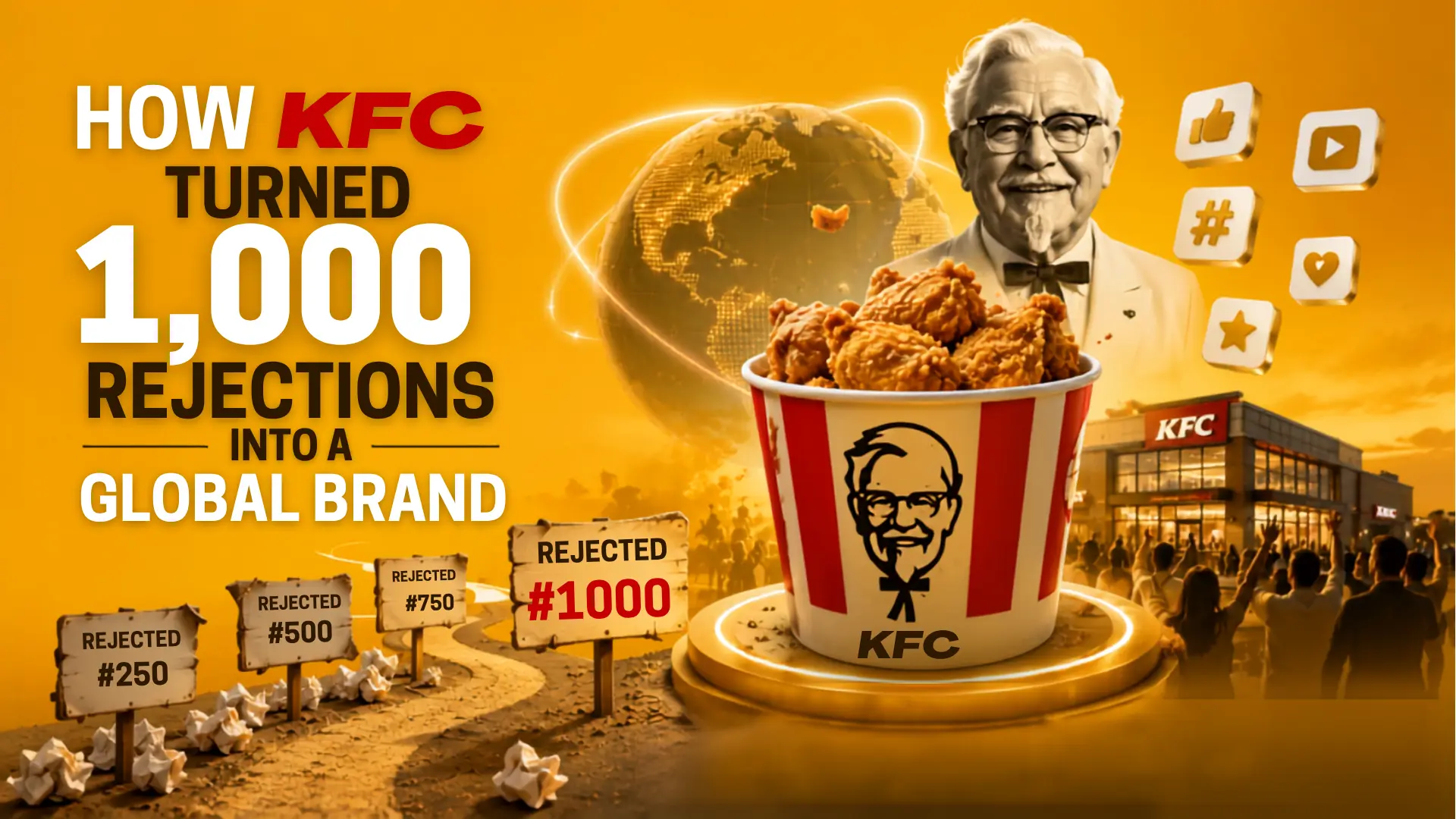
Imagine hearing “No” so many times that most people would have stopped counting. Colonel Harland Sanders apparently heard it more than 1,000 times.
And somehow, the man who couldn’t convince enough restaurant owners to sell his chicken eventually built a brand with 34,000 restaurants across 150+ countries and territories, generating $36.4 billion in system sales in 2025.`
Oh, and about 99% of those restaurants are franchised. That’s not just a comeback story. That’s a marketing case study hiding inside a bucket of fried chicken.
The popular version of the KFC story goes something like… Colonel Sanders had a recipe → People rejected him → He kept going → Eventually, someone said yes → KFC became huge.
Nice story… In fact, very inspirational. Also, way too simple. Because thousands of entrepreneurs have had great recipes, faced rejection, and refused to quit. They didn’t all end up with nearly 34,000 restaurants.
The interesting question isn’t “How did Sanders survive 1,000 rejections?” It’s “What did Sanders build that made the next yes scalable?”
That is where the real KFC marketing story begins.
First, Let’s Kill the Most Popular KFC Myth
You will often see the story repeated that Sanders was rejected 1,009 times before someone finally accepted his chicken. It’s a great number. It is also one we should treat carefully.
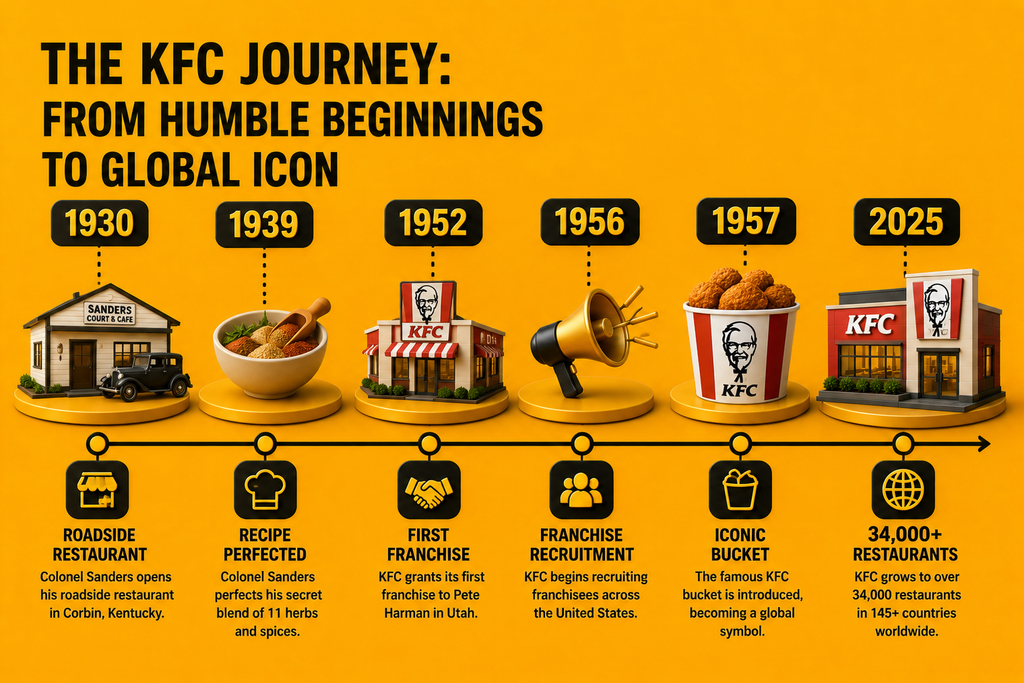
KFC’s official history confirms that Sanders went on the road in 1956 to recruit franchisees after selling his Corbin restaurant, and that the first KFC franchise opened near Salt Lake City in 1952. But KFC’s official timeline does not substantiate the exact “1,009 rejections” figure.
So for a serious case study, the better phrasing is “Over 1,000 rejections” rather than presenting 1,009 as an audited historical fact. And honestly, the exact number isn’t even the most interesting part.
Because rejection wasn’t the breakthrough. The system Sanders built after rejection was.
The First Marketing Lesson: A Great Product Is Not Enough
Sanders had something genuinely differentiated.
He had spent years developing his fried chicken recipe and eventually perfected the blend of 11 herbs and spices. KFC’s history dates the perfected recipe to 1939.
But having a differentiated product and having a scalable business are two completely different things.
“I only have two rules: Do all you can and do the best you can.”
–Colonel Harland Sanders
Imagine opening the greatest little burger restaurant in America. People love it, so they come back, you make money. Great.
Now try putting that exact experience in 500 cities.
Suddenly, you have problems. Who makes the burgers? How? With what ingredients? At what temperature? How much? What packaging? What does the restaurant look like? What happens if the customer orders it somewhere else? That’s where KFC’s story becomes a marketing story rather than merely a food story.
Sanders didn’t just have to convince people that his chicken tasted good. He had to make the chicken repeatable. That distinction is enormous.
A product can create a customer. A repeatable product can create a brand.
Sanders Wasn’t Really Selling Chicken
This is perhaps the biggest overlooked part of the story.
When Sanders started approaching restaurant owners, he wasn’t simply saying “Hey, I’ve got some really good chicken.” That wouldn’t be much of a business proposition.
He was effectively offering restaurant operators a way to add a proven product to their existing business. That’s a very different pitch.
Instead of “Come eat at my restaurant.” The model became “Let your restaurant sell my chicken.” And suddenly, the growth problem changed. Sanders didn’t need to personally own every restaurant.
Other people could provide the location, staff, investment, local knowledge, and day-to-day operation. Whereas KFC could provide the brand, product system, and operating model. That is the beauty of franchising. And the scale of that decision is visible today.
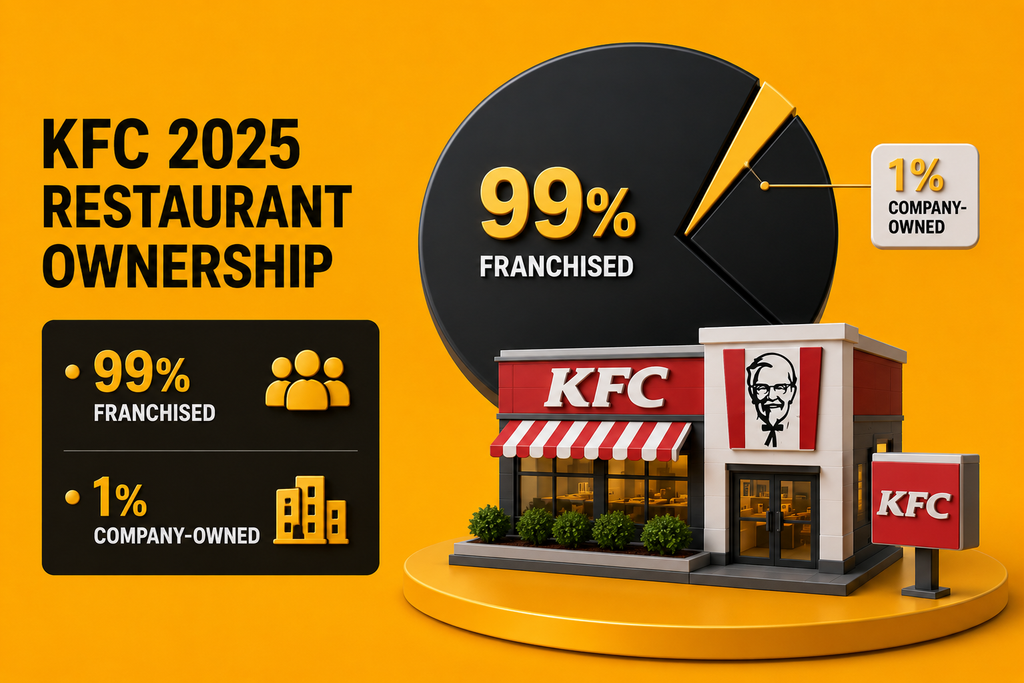
In 2025, 99% of KFC’s restaurants were franchised, with 90% of its units located internationally.
Think about what that means from a marketing perspective.
KFC didn’t just build an audience. It built a distribution network around the audience. That’s a very different way of thinking about growth.
Brilliant Idea of Sanders: He Became the Brand
Today, we call it personal branding. In the 1950s, it was basically “This guy looks memorable.” In 1950, Sanders adopted the white suit that would become inseparable from his public identity. KFC’s official history says he wore the suit whenever he appeared publicly.
Think about the decision. He could have marketed 11 herbs and spices. Instead, he also marketed a human being: a white suit, black string tie, goatee, glasses, southern gentleman persona, and Colonel Sanders.
Suddenly, the brand had a face. And faces are easier to remember than recipes. The Colonel turned a product story into a character story. That matters because people don’t naturally remember corporate entities. They remember people.
Think about the brands you can identify instantly. Sometimes it’s a logo, sometimes it’s a color, sometimes it’s a sound, and sometimes… it’s a person.
The Colonel became KFC’s human shortcut. You didn’t need to explain what KFC was every time. Show the Colonel and people instantly knew.
The Bucket
Now we get to one of KFC’s most underrated marketing moves.
The bucket.
In 1957, Sanders and early franchisee Pete Harman developed the takeout bucket concept. KFC says Harman purchased 500 paper buckets from another franchisee, then filled them with 14 pieces of chicken, five rolls, and a pint of gravy. The idea became an instant success and remained a signature part of KFC for decades.
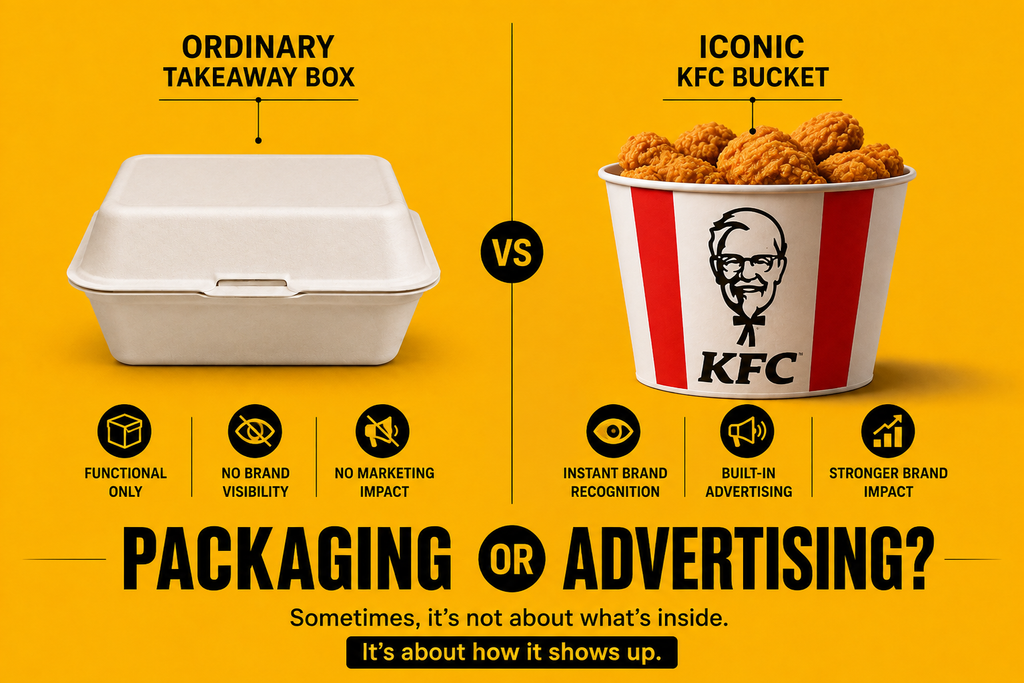
At first glance, this looks like packaging. But if you think a little too deeply, it wasn’t. It was media. Think about the difference.
A regular box goes from restaurant → customer → trash.
A bucket goes from restaurant → customer → car → home → dinner table → party → social gathering.
And when everyone sees it, the Colonel’s face is on it, the KFC branding is on it… Like the product is literally sitting inside it. The quantity is visible. The brand becomes part of the occasion.
KFC turned packaging into advertising that customers carried for free.
And there’s another clever psychological element. The bucket isn’t just a container for one person’s meal. It naturally suggests sharing. A bucket is bigger; a bucket goes in the middle of the table; a bucket says “We’re eating together.” That’s positioning.
KFC wasn’t simply selling individual pieces of chicken. It was gradually owning a social eating occasion. KFC Didn’t Just Sell Food. It Sold a Ritual.
This is where marketers should pay attention. Strong brands often become attached to behaviors. Starbucks isn’t only coffee. Nike isn’t only shoes. Apple isn’t only computers. And KFC isn’t only fried chicken.
It’s bucket + family + gathering + indulgence + recognizable taste + Colonel.
The customer isn’t necessarily thinking “I require precisely eight pieces of pressure-cooked chicken.” They’re thinking “Let’s get KFC.” That’s a completely different level of brand strength.
The brand becomes a verb-like shortcut for a decision. And once a brand owns a mental shortcut, competitors have a much harder job.
The Real Secret Was Consistency
Here’s where the story gets less glamorous and much more important. Branding gets the attention. Consistency earns the trust.
KFC’s Original Recipe isn’t simply a marketing claim. The company says its chicken is still prepared using its secret blend of 11 herbs and spices, hand-breaded and cooked using its established preparation process.
Why does this matter?
Because KFC was trying to create something that could travel. Kentucky, Utah, New York, London, Sydney, Dubai, and India. Different customers, different cultures, different employees, different restaurant owners, yet the customer should still feel “Yep. That’s KFC.” That’s the promise.
Consistency is what allows a brand to scale without becoming unrecognizable.
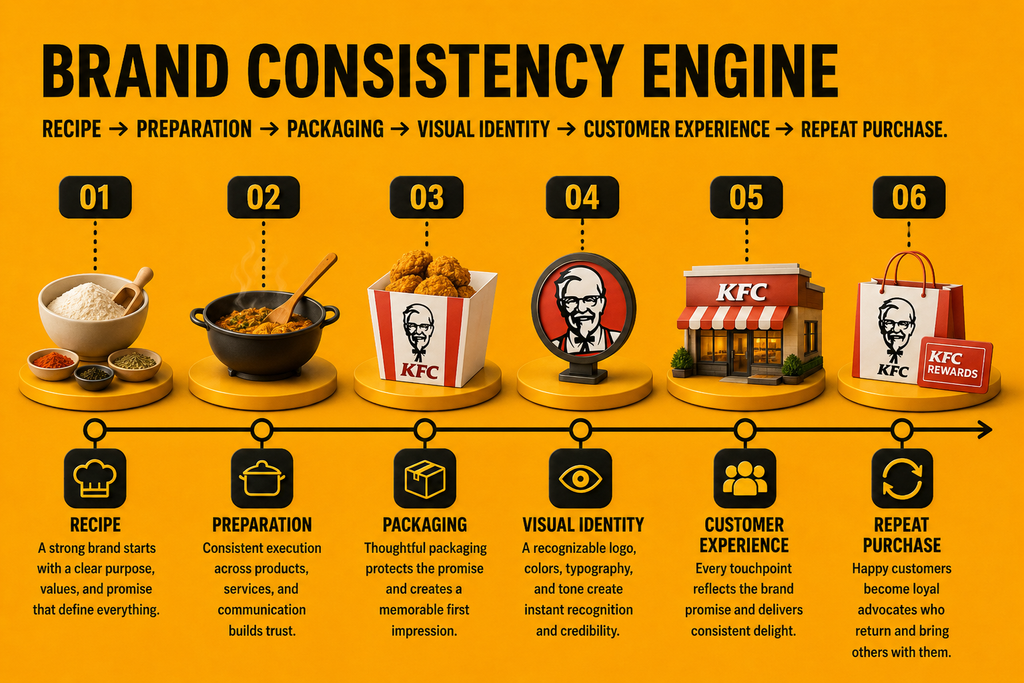
This is also why franchising and marketing are connected. A franchise system can’t survive if every restaurant interprets the brand differently. So the operational system becomes part of the brand.
Marketing makes the promise. Operations keep it.
KFC Faced the Hardest Marketing Problem of All
Going global.
Because America isn’t the world. A brand can be extremely successful domestically and still fail miserably overseas. Why? Because customers don’t leave their culture at the restaurant door.
Taste changes, food habits change, price expectations change, religious considerations change, occasions change, competition changes. So KFC had to solve a difficult equation…How do you remain KFC without making every market feel like America was copied and pasted into it? The answer has been global consistency with local adaptation.
KFC’s global platform highlights market-specific products and campaigns rather than treating every country as identical.
The core remains recognizable. The execution changes. That distinction is incredibly important. Global brands don’t win by being identical everywhere. They win by being recognizable everywhere.
The Numbers Make the Strategy Hard to Ignore
By the end of 2025, KFC had 34,000 restaurants, over 150 countries and territories, with 90% of its restaurants outside the U.S. and 99% franchised.
Its 2025 system sales reached approximately $36.434 billion. That’s the result of decades of brand building, distribution, franchising, and operational standardization.
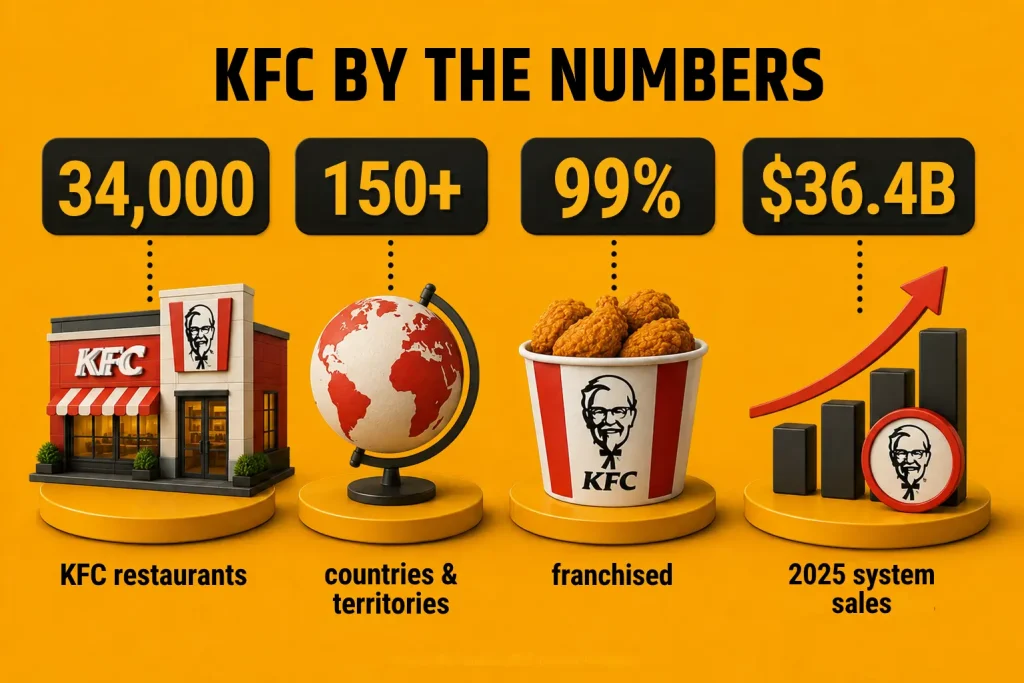
And there’s one number that should particularly interest marketers… 90% international. Because that means KFC didn’t merely create a successful American restaurant. It created a brand architecture capable of traveling.
Here’s Where Things Get Really Interesting
You might think that after becoming one of the world’s largest restaurant brands, KFC could simply sit back. Chicken sells, buckets sell, the Colonel is famous, and the job done… Nope.
In 2025, KFC U.S. launched what it called its “comeback era.”
The brand openly acknowledged fierce competition in the fried chicken category and returned the Colonel to advertising while emphasizing Original Recipe and improvements in taste and customer satisfaction.
Read that carefully.
A 75-year-old brand was talking about winning customers back. That’s fascinating. Because brand equity doesn’t make you permanently relevant. Competitors don’t care how famous you were in 1975. Consumers don’t owe you loyalty because your founder wore a white suit. And nostalgia only works until somebody else becomes more interesting.
KFC understood that. So the brand went back to one of its oldest assets… The Colonel. But it didn’t simply recreate old advertising.
It used the Colonel in a new cultural context, describing him as a “chefpreneur” and positioning the campaign around the brand’s pursuit of flavor.
That’s not nostalgia for nostalgia’s sake. That’s using heritage as a strategic asset.
Difference Between Heritage and Nostalgia
Nostalgia says “Remember when we were great?” Heritage says “Here’s what made us great. Now watch us use it again.” That’s a huge difference.
KFC’s 2025 comeback campaign leaned into its history while addressing a current competitive problem. This is something many legacy brands struggle with. They either become obsessed with their past… or become so desperate to look young that they abandon everything recognizable about themselves.
KFC’s challenge is more interesting… How do you modernize without deleting the reason people remember you? That is a branding problem. Not an advertising problem.
KFC’s Marketing Flywheel
If you strip away the Colonel jokes, secret recipes, and buckets, KFC’s growth starts looking like a very sophisticated marketing flywheel.
- Differentiated product
The 11 herbs and spices gave KFC a recognizable product story.
- Distinctive identity
The Colonel gave the product a human face.
- Scalable distribution
Franchising allowed other operators to bring KFC to new markets.
- Distinctive packaging
The bucket turned the product into a visible brand asset.
- Consistency
Standardized preparation helped maintain the recognizable KFC experience.
- Localization
Markets could adapt products and campaigns without abandoning the core identity.
- Continuous relevance
Advertising and new product launches keep the brand in culture.
- More demand
More demand makes the franchise model more valuable.
- More locations
More locations create greater availability.↓
- Greater brand visibility
And the flywheel starts again.
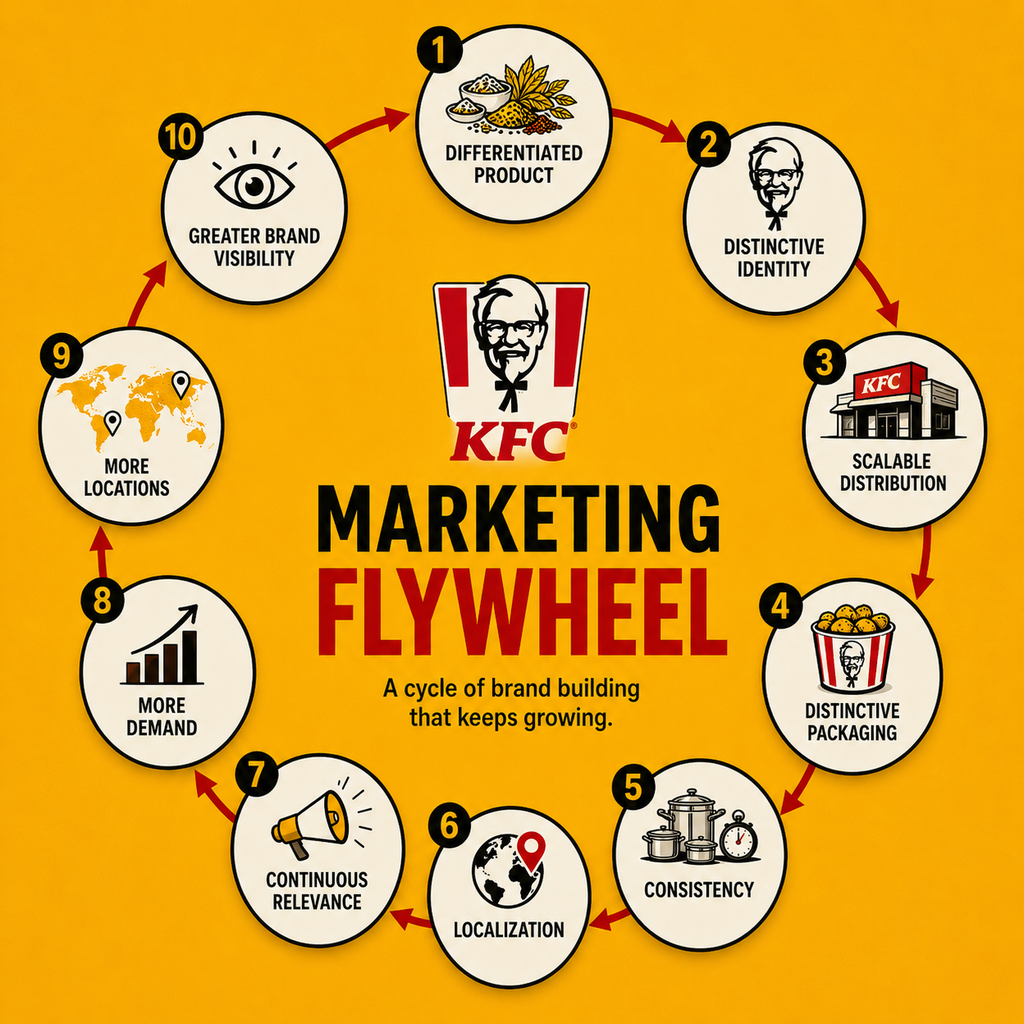
That’s the part the inspirational versions of the Sanders story leave out. Persistence is not a growth strategy. It only becomes one when you learn from every rejection.
The “No” Was Actually Market Research
Here’s another way to look at those famous rejections. Every rejection contained information.
“One has to remember that every failure is a step toward success.”
– Colonel Harland Sanders
Maybe the restaurant owner didn’t see the value, maybe the economics weren’t attractive, maybe the product wasn’t easy enough to integrate, maybe the pitch wasn’t compelling, maybe the restaurant didn’t trust the opportunity.
We don’t know the exact reason behind every rejection. But here’s the broader marketing lesson:
- A rejection is data. That’s true today.
- If customers don’t click, that’s data.
- If they click but don’t buy, that’s data.
- If they buy once but don’t return, that’s data.
- If franchisees don’t renew, that’s data.
- If a campaign gets attention but no sales, that’s data.
The worst response to rejection is “They just don’t understand.” The better response is “What exactly are they telling us?” The market isn’t always rejecting your idea. Sometimes it’s rejecting the way you’ve packaged it. That distinction can change an entire business.
KFC Has Never Been Afraid of Being Weird
This is another part modern marketers can learn from. KFC has repeatedly leaned into humor, absurdity, and pop culture. The brand has turned the Colonel into different versions of himself, used bizarre partnerships, and even created a campaign around RoboCop protecting the secret recipe.
Completely ridiculous? Yes. Completely random? Not really. The underlying asset stays the same… The Colonel + secret recipe + KFC. That’s why weirdness can work. The campaign changes, but the memory structure doesn’t, and that’s an important distinction.
Be unpredictable in the campaign. Be predictable in what the brand stands for. That’s how you can be funny without becoming forgettable.
So What Did KFC Actually Build?
KFC built a recognition machine. The product creates the first reason to try.
- The Colonel creates recognition.
- The bucket creates visibility.
- The franchise network creates availability.
- Consistency creates trust.
- Localization creates relevance.
- Advertising creates attention.
And all of it feeds back into the brand.
That’s why the company can operate at extraordinary scale without becoming a completely different brand every time you cross a border.
The Bigger Marketing Lesson
There is a dangerous misconception in marketing… If the product is good enough, people will eventually come. KFC’s history tells us something different. The product matters. But the product is only one piece.
You also need to answer: why should people notice you? Why should they remember you? Why should they trust you? Why should they choose you instead of the next chicken restaurant? Why should someone else want to distribute your product? Why should the brand still matter 20, 50, or 75 years later?
Sanders didn’t solve all of those questions at once. He built them over time. That’s what makes the story so valuable.
The Most Important Number Isn’t 1,009
It isn’t 34,000 either.
It isn’t $36.4 billion.
The most important number in the KFC story might actually be… 1.
One recipe, one recognizable character, one franchise model, one bucket, one consistent brand promise, and then scale. Because brands don’t become enormous by having thousands of disconnected ideas. They become enormous by making a few memorable ideas work thousands of times.
KFC didn’t win because it had more marketing. It won because more of its marketing pointed back to the same idea. That’s the difference between activity and brand building.
What Today’s Marketers Can Steal From KFC
Not the chicken. Obviously!.
Steal the thinking.
- Stop asking whether your product is good enough.
Ask whether your product is easy to understand and remember.
- Build something recognizable.
A color, a character, a phrase, a visual, or a format- something customers can identify before they see your logo.
- Turn distribution into part of your strategy.
A brilliant product nobody can access is still a small business.
- Make your brand operational.
If your marketing promises something your customer experience cannot deliver, advertising becomes expensive damage control.
- Don’t confuse consistency with boring.
KFC kept its core recognizable while continuously experimenting with products, campaigns, and cultural moments.
- Treat rejection as information.
The market is giving you feedback. Don’t waste it.
Why the Colonel’s Story Matters
The inspirational version of the story is “Colonel Sanders was rejected over 1,000 times and never gave up.” It’s a nice quote for a motivational poster. But it’s not the most useful lesson for a marketer.
The more interesting version is…
Sanders had a differentiated product.
↓
Then he created a recognizable identity.
↓
He found a scalable distribution model.
↓
He turned packaging into a brand asset.
↓
He built consistency into the experience.
↓
He adapted the brand across markets.
And decades later, KFC is still using its founder as one of its most powerful marketing assets.
Today, KFC has nearly 34,000 restaurants in 150+ countries and territories, with $36.4 billion in 2025 system sales and approximately 99% of restaurants franchised.
That’s what happened after the “yes.” And that is the part worth remembering.
The Xparro Takeaway
Most businesses ask “How do we get more customers?” KFC’s history suggests a better question: “How do we build a brand that makes distribution, recognition, and demand easier?”
Because when your product is recognizable… your marketing gets easier. When your brand is memorable… your advertising gets stronger. When your experience is consistent… your reputation compounds. When your distribution scales… your reach compounds.
And when all four work together? You don’t just sell more chicken. You build an icon. And somewhere in that story is a Colonel in a white suit, walking into another restaurant and hearing:
“No.” again, and again, and again. Until one “yes” became a system. Then the system became a brand. Then the brand became a global habit. That’s the real KFC story.