You walked into IKEA for a $79 bookshelf.
You walked out with the bookshelf, two cushions, a plant you have absolutely no idea how to keep alive, six glasses, a lamp, Swedish meatballs, and a tiny storage box whose only job is apparently to store the other things you bought at IKEA.
And the funniest part? You probably think you made all those decisions yourself. That is what makes IKEA’s marketing so interesting. It doesn’t need to scream BUY THIS.
Instead, IKEA builds an environment where buying feels like the natural conclusion of the experience.
And this isn’t some tiny retail experiment. In FY2025, IKEA generated €44.6 billion in global retail sales, while its stores welcomed 915 million visitors, up from 899 million the year before. Online sales accounted for another 28% of IKEA turnover.
In the U.S. alone, IKEA reported $5.3 billion in FY2025 sales, including $1.9 billion from e-commerce. Nearly 61 million people visited its U.S. stores, while more than 457 million visited IKEA online. Its IKEA Family loyalty program reached 25 million U.S. members, a 17% increase from the previous year.
So, yes, the furniture is doing some work. But the marketing system around the furniture is doing considerably more.
IKEA Doesn’t Put Products, It Puts Possibilities
Walk through a traditional furniture store and you might see a sofa. Walk through IKEA and you see a life involving the sofa.
The sofa isn’t sitting there looking lonely under fluorescent lights.
It’s surrounded by a coffee table, rug, cushions, lighting, books, plants and some suspiciously perfect-looking Scandinavian person-shaped absence.
Suddenly, you’re not evaluating a sofa. You’re imagining your living room. That’s a huge distinction in marketing.
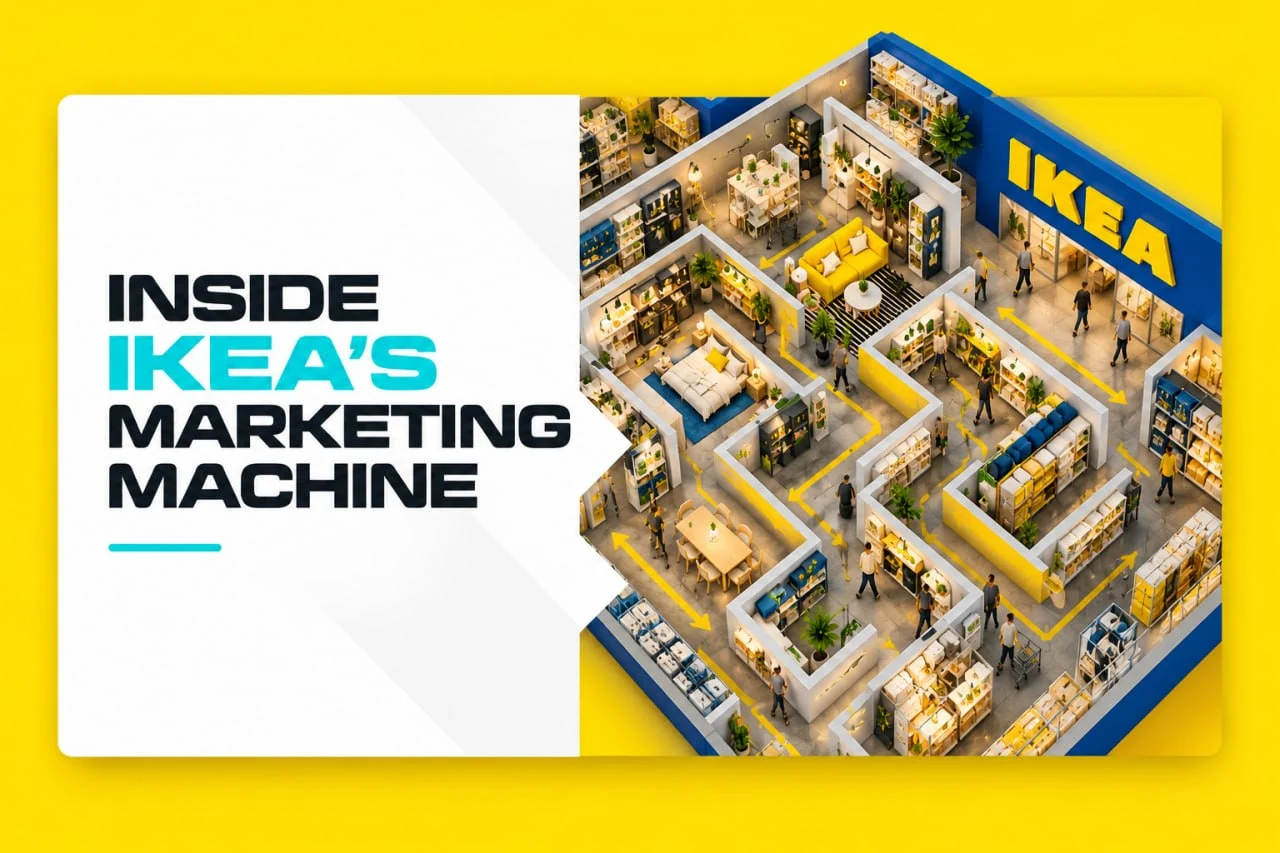
IKEA officially describes its showroom as a series of realistic room settings where shoppers can interact with products, sitting on sofas, opening drawers, pretending to cook, lying on beds and experiencing products as they would at home.
This is experiential merchandising. Instead of saying “Here’s a $399 sofa.” IKEA is effectively saying “Here’s what your Tuesday night could look like if your apartment stopped looking like a storage unit.” And that’s a much easier thing to sell.
The product becomes part of a desired lifestyle rather than an isolated object.
This matters because people don’t always buy products based purely on their functional specifications. They buy what those products represent.
A desk isn’t just a desk., it’s productivity. A dining table isn’t just a table, it’s dinner parties. A wardrobe isn’t just storage, It’s the fantasy that your clothes will finally stop living on that chair.
IKEA sells the after-picture.
The Showroom Is Basically a Physical Content Funnel
Here’s where IKEA gets particularly clever. Its store isn’t simply organized by product category.
The journey typically moves through Showroom → Market Hall → Self-Serve → Checkout. IKEA itself describes these as distinct parts of the store experience.
That’s essentially a physical marketing funnel.
Awareness – You enter the showroom and encounter ideas.
Consideration – You see products in actual rooms and start imagining them in your own home.
Intent – You remember a product number, price or location.
Conversion – You eventually reach the self-service area and pick up the flat-pack box.
Expansion – And then there are all those little products you’ve encountered along the way.
The genius is that IKEA doesn’t rush you toward checkout. It gives you more opportunities to develop reasons to buy. And this is where the famous IKEA “maze” becomes more interesting.
The long path isn’t necessarily just about confusing you, it’s about exposure. If you came in wanting a desk, IKEA has plenty of time to show you what else could go with that desk.
IKEA Turns Browsing Into a Series of Tiny Sales Pitches
Think about how many decisions happen during an IKEA visit.
You see a room, then a product, then another product that complements it, then you notice the price, then you touch it, then you imagine it at home, then you start thinking “Actually… I could use that.” That last sentence is marketing gold. Because the customer has now created the purchase rationale themselves.
IKEA doesn’t necessarily have to persuade you that you need a product. The environment helps you persuade yourself.
Research on store atmospherics supports this broader principle. A Journal of Retailing study found that pleasant in-store experiences were associated with shoppers spending more time in stores and spending more money than they had originally intended.
A more recent study of 683 supermarket shoppers similarly found that sensory marketing influenced dwell time and purchasing behavior, with emotional responses mediating part of that relationship.
IKEA’s version is more sophisticated because the sensory experience isn’t just about music, lighting or smell.
It’s visual storytelling.
The $5 Product Is Not Really About the $5 Product
This is one of the easiest IKEA tactics to overlook.
A customer might enter thinking “I need a wardrobe.” But along the journey, they encounter dozens of relatively inexpensive products. None of those products individually feels like a serious financial decision.
And that’s exactly why they are dangerous. A $3 impulse purchase doesn’t trigger the same mental resistance as a $300 purchase. But ten tiny decisions can quietly turn into a very non-tiny receipt.
This is basket expansion. Instead of increasing the price of the product you originally came for, IKEA increases the number of products in your basket. And IKEA’s huge product ecosystem makes that possible.
The customer isn’t just buying a wardrobe. They’re buying the wardrobe ecosystem.
IKEA Makes the Customer Part of the Product Story
Here’s where IKEA pulls off something most furniture brands would probably love to manufacture but can’t. It makes the customer work for the product. That sounds like terrible customer experience advice.
Usually, marketers spend their lives trying to remove friction. One-click checkout. Free delivery. No-questions-asked returns. Fewer forms. Fewer steps. Less effort.
IKEA went in a slightly different direction.
You find the product yourself.
You pick it up yourself.
You take it home yourself.
And then, armed with an Allen key and questionable confidence, you build it yourself.
Yet that effort can actually become part of the product’s value.
Researchers Michael Norton, Daniel Mochon and Dan Ariely famously called this the “IKEA effect” after finding that people who successfully assembled IKEA products tended to value their creations more highly. Their experiments weren’t limited to IKEA furniture either; participants assembled origami and LEGO creations, showing that the underlying effect was connected to the act of completing something yourself.
A 2025 meta-analysis took the idea further, analysing 55 studies involving 5,454 participants and finding a significant relationship between self-assembly and increased product valuation.
From a marketing perspective, that’s fascinating. Because IKEA isn’t simply handing customers a finished product. It’s giving them a story about the product.
That bookshelf isn’t just something you purchased on Saturday, you built it, and you remember where it nearly went wrong, you remember which screw mysteriously remained after you finished, you probably remember the exact moment you finally stood it upright.
And suddenly, the product has a little history attached to it. IKEA has turned assembly from an inconvenience into part of the brand experience. That’s a very different kind of customer engagement.
IKEA Doesn’t Just Sell Furniture. It Sells Permission to Redesign Your Life
There’s another reason IKEA’s marketing works so well. Its products rarely arrive with the emotional weight of a luxury purchase. You don’t need to convince yourself that buying a $6 storage box is a life-changing financial decision. And that matters.
IKEA has spent decades positioning functional design as something ordinary people should be able to afford. Its famous concept revolves around offering well-designed, functional products at prices accessible to as many people as possible.
That positioning creates an interesting psychological combination:
Design feels aspirational.
Price feels approachable.
And when those two meet, the customer doesn’t necessarily feel like they’re splurging. They feel like they’re being sensible. That’s a powerful position for a retailer.
Luxury brands often say “You deserve something special.” IKEA’s message is closer to “Why shouldn’t your everyday life look better?”
A better kitchen doesn’t have to be a luxury project., a nicer workspace doesn’t have to mean designer furniture, a more organised bedroom doesn’t have to require a massive renovation.
That expands the number of situations in which IKEA can enter a customer’s life.
And once you’ve accepted the idea that good design can be affordable, suddenly upgrading the boring parts of your home doesn’t feel extravagant. It feels overdue.
Then IKEA Gives You a Reason to Stay
Furniture shopping isn’t exactly known for being entertaining. Nobody wakes up on Saturday morning thinking, “Can’t wait to spend four hours comparing wardrobes.”
IKEA understood this problem early. So it turned the shopping trip into a destination. And this is where the food becomes far more important than it first appears.
The IKEA restaurant, Bistro and Swedish Food Market aren’t merely convenient places to grab something when you’ve been wandering around for too long.
They extend the IKEA experience beyond furniture.
The company’s food business has become enormous. IKEA says around 680 million customers experienced its food offer globally in 2019, while its famous food balls have become one of the brand’s most recognisable products. IKEA says it has sold around 1.4 billion food balls annually since introducing meatballs in 1985.
Think about what that does from a branding perspective. You don’t just remember the sofa, you also remember the meatballs, the cheap coffee, going there with your parents, wandering around the bedroom displays, even arguing about whether the lamp actually matches the curtains.
The brand becomes attached to an experience, not just a product category. And experiences are much harder for competitors to copy. A furniture company can copy a minimalist coffee table.
Copying decades of memories around meatballs, Swedish design, flat-pack furniture and Saturday shopping trips is considerably harder.
IKEA made the store itself part of the brand.
The Price Tag Is Doing More Marketing Than the Billboard
IKEA’s pricing strategy deserves its own attention because affordability isn’t just a financial decision for the company. It’s part of the brand identity.
In FY2025, IKEA said it had lowered prices by around 10% over the previous two years, with the company reporting that sales volumes and customer numbers both increased by around 3% during FY2025.
That tells us something important about how IKEA uses price.
The company isn’t simply trying to be cheap, it’s trying to make good design feel attainable and that is a different proposition.
Imagine seeing a beautifully styled room where almost everything has a price attached to it.
Instead of thinking “That whole room must cost a fortune,” you discover that the lamp is affordable. The chair is affordable, the side table is affordable, the storage is affordable, ssuddenly, the entire room feels achievable.
This is where IKEA’s room displays and pricing strategy reinforce each other.
The showroom creates desire.
The price removes resistance.
That’s much more powerful than either one operating alone.
The $4.99 Purchase Is Doing a Bigger Job Than You Think
There’s another clever consequence of IKEA’s pricing architecture.
Low-priced products lower the psychological stakes of experimentation. You’re much more likely to think “I’ll just try it.” When the price is small enough, the decision doesn’t feel like a serious purchase. And that’s where basket expansion starts happening.
You came for a wardrobe, then you see an organiser, then a laundry basket, then some hooks, then a little lamp, then something for the kitchen because, apparently, the kitchen has suddenly become part of this project too.
None of these decisions feels particularly dramatic, and that’s the point. IKEA doesn’t necessarily have to make every additional purchase exciting. It just needs to make each one easy to justify.
The customer’s internal conversation changes from “Do I really need this?” to “It’s only $5.”
Multiply that behaviour across hundreds of products and millions of shoppers, and tiny decisions become a very serious retail strategy.
IKEA Family Is Where the Shopping Trip Becomes a Relationship
Getting someone to buy a product once is acquisition. Getting them to come back is marketing with a longer memory. IKEA Family is central to that second part.
In the U.S., IKEA said its IKEA Family membership reached 25 million members in FY2025, representing a 17% increase from the previous year. The company also reported more than 61 million store visits and $5.3 billion in U.S. sales during the year.
But the interesting part isn’t simply the size of the loyalty programme. It’s what IKEA is doing with it.
In 2025, IKEA U.S. expanded its rewards programme so customers could earn points through activities across the journey, including shopping and planning, with rewards including discounts, delivery savings and free meals.
That changes the role of loyalty. The customer isn’t only valuable when they hand over money. Their relationship with the brand can begin while they’re planning what to buy. That’s a subtle but important shift.
IKEA is moving from “Come to our store when you need furniture.” toward “Come to us when you’re thinking about changing your home.” And that is a much larger piece of the customer’s decision-making journey.
IKEA Customers Started Doing the Marketing for IKEA
Here’s where the strategy gets even more interesting.
People don’t just buy IKEA products. They modify them, combine them, hack them, redesign them, post before-and-after photos, and show off their kitchens, wardrobes, desks and tiny-apartment transformations.
Search online for IKEA hacks and you’ll quickly discover that the internet has effectively created an unofficial IKEA content department. And IKEA gets something incredibly valuable out of that… people demonstrating what its products can become.
The company doesn’t have to publish every possible use case itself. Customers do it. One person turns a bookshelf into storage, another turns a cabinet into a vanity, someone else creates a home office from a combination of products.
The original product becomes the starting point for a much larger stream of content.
This is one of the strongest forms of marketing because the brand isn’t simply saying “Look what our product can do.” A customer is saying it. That difference matters. The customer has no reason to make the product look good for IKEA. They’re showing people what they actually did with it. And suddenly a basic furniture product becomes inspiration for someone else’s purchase.
IKEA doesn’t just sell furniture. It sells raw material for creativity.
The Giant Blue Box Is No Longer the Whole Strategy
For decades, the IKEA experience was built around one very specific ritual:
Drive somewhere, enter the giant blue building, walk approximately the length of a small country, buy furniture, eat meatballs, find your car, discover that the box is significantly larger than you remembered.
But IKEA knows consumer behaviour has changed.
In FY2025, IKEA opened 66 new sales locations globally, including smaller formats and Plan & Order Points.
In the U.S., IKEA added 14 new retail locations during FY2025, including smaller-format stores, while expanding Plan & Order Points. The company also reported $1.9 billion in U.S. e-commerce sales.
That’s important strategically. The customer no longer has to complete the entire IKEA journey inside the traditional store. They can discover online, plan online, visit a smaller location, order, pick up and then return to the ecosystem when they’re ready for the next project.
The physical store remains important.
But IKEA is increasingly building a connected customer journey rather than a single retail journey. And that’s a much more modern marketing strategy.
So, Does IKEA Really “Trick” You?
Not exactly. And that’s actually the most interesting conclusion. IKEA isn’t secretly manipulating customers into buying products they don’t want.
The customer is still making the decision.
The clever part is that IKEA spends enormous effort designing the environment in which those decisions are made.
It combines aspirational merchandising to create desire, accessible pricing to reduce resistance, product placement to encourage discovery, self-assembly to deepen involvement, food and store experience to create memories, loyalty marketing to encourage return visits, user-generated content to extend the brand beyond its stores, and digital and smaller-format retail to stay present throughout the buying journey.
None of those tactics alone explains IKEA.
Together, they create a retail system where buying feels like the natural next step which is much more powerful. And that’s the real lesson for marketers.
The strongest brands don’t always win by shouting louder about their products.
Sometimes they win by designing the journey so well that the customer arrives at the purchase decision almost naturally.
IKEA doesn’t need to tell you that you need another cushion.
It just needs to put the cushion next to the sofa, give it a beautiful room to live in, price it at $9.99, and let your brain finish the sales pitch.
And if that doesn’t work?
Well…
There’s always the meatballs.