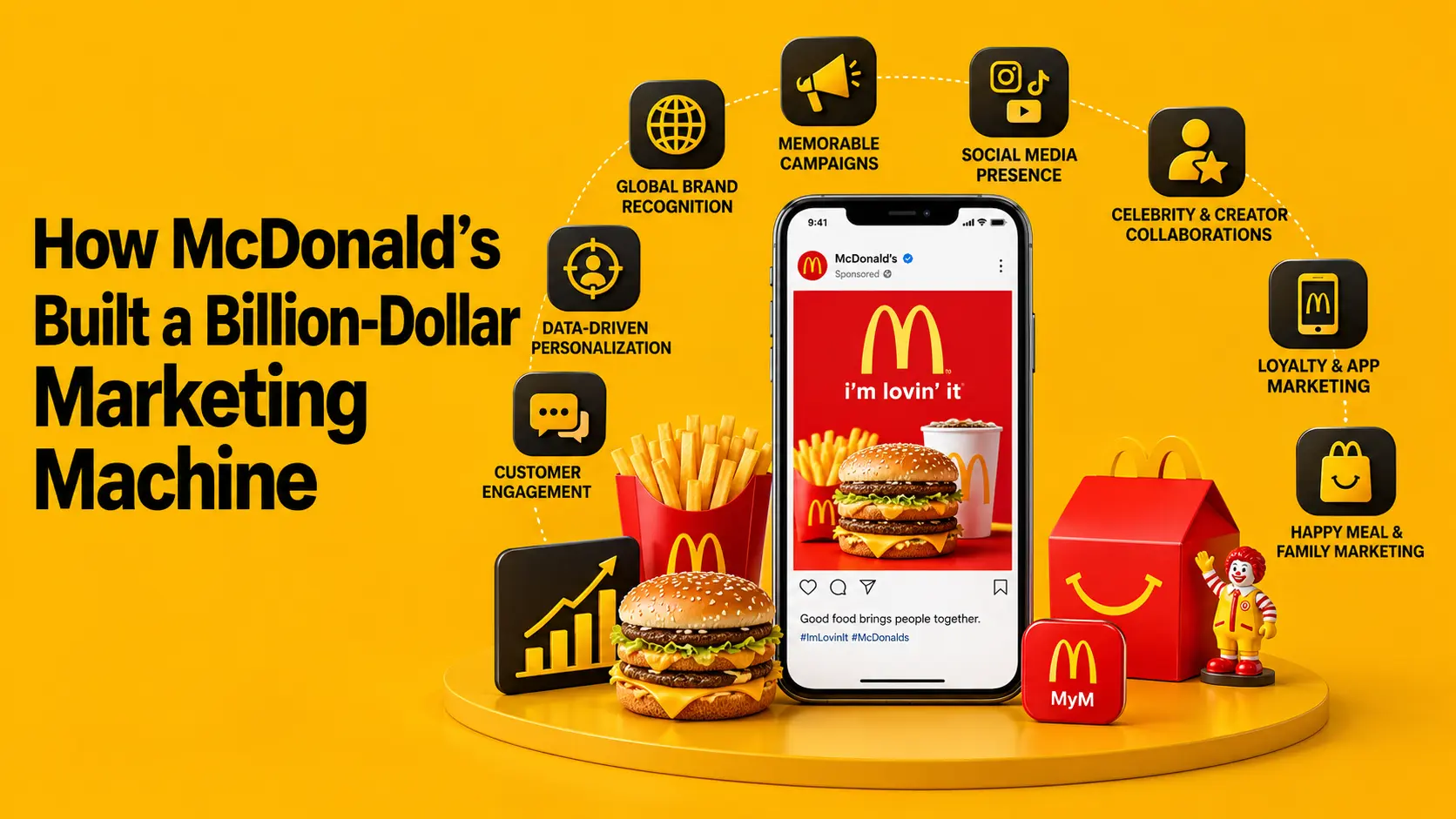
McDonald’s has spent decades convincing America that it is in the burger business. Guess what? It isn’t.
At least, that’s not where its real marketing genius lies. Because if McDonald’s were simply selling burgers, it would have been crushed by thousands of better burgers.
There is always a better burger.
A local diner has one. Your favorite neighborhood joint has one. Some chef in Brooklyn has probably spent six months making a burger that costs $27 and comes with a paragraph explaining the emotional journey of the onion.
And yet, when someone says “I’m hungry,” McDonald’s somehow still manages to show up in the conversation.
That’s the part worth studying.
McDonald’s didn’t build one of the world’s most recognizable brands by convincing everyone that its burger was the greatest burger ever made. It built the brand by making itself familiar, memorable, culturally relevant, and ridiculously easy to choose.
The burger was the product. The feeling of knowing exactly what you were getting was the marketing. And once you see McDonald’s that way, its entire advertising history starts to look very different.
McDonald’s Didn’t Sell Food. It Sold a Shortcut
Think about the last time you saw the Golden Arches. You probably didn’t stop and think, ‘Ah yes, a multinational foodservice corporation operating a vast franchise network.’ You thought McDonald’s.
That’s brand recognition doing its job. And McDonald’s has an absurd amount of it.
Interbrand valued the McDonald’s brand at $53 billion in its 2025 Best Global Brands ranking, placing it ninth among the world’s most valuable brands. Interbrand also estimates that McDonald’s serves more than 69 million people every day worldwide.
But here’s the interesting part…
People don’t recognize McDonald’s because someone repeatedly told them that McDonald’s is a good company. They recognize it because McDonald’s has spent decades putting the same handful of visual and verbal assets into their heads.
The arches, the red, the fries, the Big Mac, the “I’m lovin’ it” , the Happy Meal, the playground, the drive-thru, and of course the little yellow smile.
It is basically a marketing textbook disguised as a fast-food chain.
McDonald’s Didn’t Just Buy Land. It Bought Attention
Here’s where the McDonald’s story gets a little sneaky.
While everyone else was looking at the burger, Ray Kroc, the one who came into McDonald’s to sell milkshake machines, had an idea that changed the whole story of McDonald’s.
The land.
The popular version of the story says Kroc discovered that McDonald’s could make money by owning real estate and leasing restaurants to franchisees. That’s true. But for marketers, there’s a much more interesting question:
What did owning the locations do for the brand? Quite a lot. Because McDonald’s didn’t just use real estate to make money; it used real estate to make the brand visible, accessible, and ridiculously difficult to forget.
And that changes the way we should look at the Golden Arches.
The Restaurant Was Part of the Advertisement
Think about driving down a highway… You see the Golden Arches… you weren’t necessarily hungry five seconds ago, but now you’re thinking about fries.
That’s marketing.
But here’s the clever part: McDonald’s didn’t have to buy an advertising slot for that moment. The restaurant itself was doing the advertising.
McDonald’s has historically invested heavily in the real estate and buildings behind its franchised restaurants. Under its conventional franchise model, McDonald’s generally owns or controls the property and leases it to franchisees, who operate the restaurant and pay rent and royalties. The company says it manages site evaluation, acquires the property, and constructs the building for these locations.
So the physical restaurant isn’t just the place where the transaction happens.
It is also a giant, permanent brand asset sitting exactly where McDonald’s wants customers to see it.
A billboard says, “Remember us,” And a McDonald’s on your daily commute says, “I’m right here.” That’s a much better advertisement.
Kroc Understood Something About Franchising
The genius wasn’t simply putting other people in McDonald’s restaurants.
It was creating a system where the franchisee could run the restaurant while McDonald’s retained control of the property and brand.
The franchisee gets a business. McDonald’s gets rent, royalties, and a long-term presence in the location. And when the restaurant does well, everybody has a reason to keep it doing well.
In 2024, McDonald’s reported $10.017 billion in rent revenue from franchised restaurants, compared with $5.606 billion in royalty revenue.
That’s not pocket change from the couch cushions. It’s a significant part of the business.
McDonald’s also reported approximately $6.4 billion in land within its property and equipment associated with franchise arrangements at the end of 2024.
So while customers were debating whether McNuggets count as a proper meal, McDonald’s was sitting on a serious physical footprint. But the bigger marketing advantage was what that footprint allowed the brand to do.
Own the Location, Own the Visibility
Marketing is usually described as getting people to notice you. McDonald’s took that idea literally. If you control where your restaurants are located, you control where your brand appears.
Busy intersection? Golden Arches.
Highway exit? Golden Arches.
Shopping center? Probably Golden Arches.
Airport? You know the drill.
The more strategically placed locations a brand has, the more frequently customers encounter it.
And repeated exposure matters. You may not consciously think,
“I have now been exposed to McDonald’s branding for the fourth time this week.” Your brain doesn’t work like a media planner. It simply starts thinking, ‘McDonald’s is everywhere.’ And “everywhere” creates familiarity.
Convenience Became a Brand Message
McDonald’s has always sold convenience. Fast food, drive-thrus, quick meals, and easy ordering… but convenience isn’t only about how fast the kitchen works.
It’s also about how little effort it takes to find the restaurant.
If there is a McDonald’s near your home, another near your office, and another beside the highway you take on weekends, the brand becomes part of your routine. That’s powerful.
Because the strongest brands aren’t necessarily the ones customers spend the most time researching. They’re the ones customers can retrieve from memory in half a second. McDonald’s spent decades making sure the physical world reinforced that mental shortcut.
The Franchisee Became Part of the Marketing Machine
There’s another clever layer. McDonald’s could maintain a globally recognizable brand while giving local operators a stake in the business.
The company says approximately 95% of McDonald’s restaurants worldwide are owned and operated by local business owners. That matters because a global brand still has to behave like a local business.
The McDonald’s in Texas doesn’t necessarily need to speak to customers the same way as one in New York. And neither should have exactly the same marketing approach as one in India or Japan.
The brand stays recognizable. The local execution adapts, and that balance is one of McDonald’s greatest marketing advantages: global recognition and local relevance.
The Really Clever Part
The marketing pays for the real estate, and the real estate reinforces the marketing. This is where the model becomes a beautiful little loop. McDonald’s invests in locations.
The locations increase visibility and accessibility. While visibility creates familiarity, familiarity makes the brand easier to choose, and more customers create more sales. And that revenue supports the larger system that keeps expanding the brand.
So the restaurant isn’t simply the end of the marketing funnel. It’s part of the funnel.
McDonald’s Didn’t Just Put Restaurants Where People Were
McDonald’s put the brand where people were. That’s the real lesson hidden inside the real-estate strategy.
Most brands ask “How do we get our product into more places?” McDonald’s effectively asked, “How do we get our brand into more people’s routines?” That’s a much smarter question. Because once a brand becomes part of someone’s routine, advertising doesn’t have to work as hard.
The Golden Arches aren’t just a logo. They’re a location strategy you can see from the highway. And that may be the most overlooked part of McDonald’s marketing machine: It didn’t just spend decades putting McDonald’s into people’s heads.
It put McDonald’s in their path.
The First Trick: Make the Brand Impossible to Misunderstand
McDonald’s has never been particularly complicated, and that’s intentional.
A lot of brands want to sound intelligent. They create elaborate positioning statements, poetic taglines, and websites that require three scrolls just to figure out what they actually sell.
McDonald’s went the other way. Golden arches, red box, Big Mac, and fries? Done. That simplicity matters because attention is scarce. You don’t need a customer to remember your entire brand strategy. You need them to remember you.
McDonald’s has spent decades building what marketers today would call distinctive brand assets… recognizable elements that trigger the brand without needing the name spelled out.
And the Golden Arches are probably the best example. You can remove the word McDonald’s and leave the arches. People still know. That’s not decoration; that’s marketing infrastructure.
McDonald’s Gave Something More Powerful Than a Product
It gave people a personality to associate with the product.
Enter Ronald McDonald. Today, the character can look slightly surreal if you stare at him for too long. But the marketing idea was brilliant.
McDonald’s didn’t want to be just a restaurant. It wanted to be a place associated with childhood, fun, and family.
The Happy Meal did something similar. Instead of simply selling a children’s meal, McDonald’s wrapped the purchase in a little ritual:
- Food
- Toy
- Box
- Surprise
- Collectible
And, if you’re a parent, the possibility of getting through dinner without negotiating with a tiny dictator. That is clever product marketing. The product became an experience, and experiences are much easier to remember than ingredients.
The “I’m Lovin’ It” Move Was Much Smarter Than It Sounds
In 2003, McDonald’s launched its first global advertising campaign, “I’m Lovin’ It,” in Munich, Germany.
And look at what the tagline doesn’t do. It doesn’t say “Our burgers are delicious.” It doesn’t say “We use the finest ingredients.” It doesn’t say “Come experience our world-class culinary excellence.” Thank God.
It simply says “I’m lovin’ it.”
That’s not a food claim. It’s a feeling, and that distinction is huge. Because food claims invite comparison.
If McDonald’s says we make the best burger, someone can respond, ‘No, you don’t.’ And then the internet gets involved.
But if McDonald’s says I’m lovin’ it, there is nothing to fact-check. It’s emotional positioning. The brand isn’t asking you to agree that the burger is objectively superior. It’s asking you to associate McDonald’s with a good moment.
Music helped make that association even stronger. The five-note musical hook became almost as recognizable as the slogan itself.
And that is another lesson hiding in plain sight… The strongest brands don’t only create messages. They create memory triggers.
McDonald’s Doesn’t Always Advertise the Product
This is probably one of the biggest things marketers can learn from McDonald’s.
Look at its most memorable advertising. You don’t always see a giant burger sitting in the middle of the screen while someone explains why the bun is amazing.
Instead, you often see people hanging out, friends laughing, families eating, young people being young, music, humor, pop culture, a weirdly satisfying shot of fries.
Then, somewhere in the middle of all that, the arches- that’s deliberate.
McDonald’s often sells the occasion, not the food. Because the food is already understood. The marketing job is to create a reason to think about the brand. That’s a completely different objective.
McDonald’s Got Very Good at Showing Up in Culture
This is where the brand stopped behaving like a fast-food company and started behaving like a media brand.
McDonald’s has repeatedly inserted itself into moments people are already talking about. Like sports, music, movies, gaming, fashion, internet culture, celebrity collaborations, memes, and social media, instead of constantly saying “Hey! Remember that we sell burgers!”
It asks a more interesting question:n “What is America talking about right now, and how can McDonald’s participate?” That’s cultural marketing.
And it works because people don’t want more advertising. They want brands that understand the conversation they’re already having. McDonald’s doesn’t need to invent every conversation. It just needs to find the ones where it belongs.
The Travis Scott Meal Wasn’t Really About the Meal
Take the 2020 Travis Scott collaboration. On paper, it was simple:e, a celebrity, a meal, and a promotion. But strategically, it was much more interesting.
McDonald’s turned a menu order into a piece of culture. Suddenly, the purchase wasn’t just “I’ll have a Quarter Pounder.” It was “I’ll have the Travis Scott Meal.” That’s a completely different psychological frame. The product became a cultural object.
And that is the power of collaboration marketing.
You don’t always need to build attention from scratch. Sometimes you can borrow attention from somebody who already owns it. That’s a lesson brands across industries can steal. A collaboration isn’t valuable merely because two logos appear together.
It’s valuable when one brand transfers some of its cultural relevance to the other.
McDonald’s Started Turning Customers Into Participants
For years, traditional advertising was basically:
McDonald’s → message → customer.
Then social media changed the game. Because now it became:
McDonald’s → customer → internet → everyone else.
That’s a much more powerful loop because customers don’t just consume McDonald’s marketing.
They remix it, post it, joke about it, complain about it, and even turn it into memes. So basically the audience becomes part of the media engine. And McDonald’s has become exceptionally good at operating inside that environment.
Localization: Same Brand, Different Conversation
Here’s another piece of McDonald’s marketing strategy that deserves more attention.
Global brands have a problem. If you standardize everything, you become boring. If you localize everything, you stop feeling like the same brand.
McDonald’s has spent decades walking the line between the two.
The Golden Arches stay. But the conversation, products, campaigns, and cultural references change. That’s why McDonald’s can feel unmistakably American in the U.S. while still creating products and campaigns that make sense in other markets.
The company itself gives examples, including the McArabia in the Middle East, McAloo Tikki in India, and Teriyaki McBurgers in Japan.
From a marketing perspective, that’s not simply “localization.” It’s “One global identity + thousands of local conversations.” And that is much harder to execute than simply translating an advertisement.
The Brand Started Listening
Here’s where McDonald’s marketing story gets really interesting.
In 2015, McDonald’s USA announced a new brand vision that explicitly described a shift from “billions served” to “billions heard.” That sentence tells you a lot about how marketing was changing.
For decades, brands talked, and customers listened. Then social media, mobile technology, and digital commerce flipped the relationship. Customers started talking back. So McDonald’s had to become more than a broadcaster. It had to become a listener.
And eventually, listening became data.
The App Quietly Changed the Marketing Game
This might be one of McDonald’s least glamorous but most important marketing moves.
The app.
Because an advertisement can tell you that someone likes McDonald’s, an app can show you what they actually buy. That’s a massive difference.
By the end of 2024, McDonald’s reported more than 175 million active loyalty users across 60 markets. Those loyalty members generated approximately $30 billion in systemwide sales in 2024, up 30% from the previous year.
Now think about what that means from a marketing perspective. McDonald’s isn’t just hoping you remember it. It has a direct digital relationship with you. It can offer promotions, encourage repeat purchases, personalize offers, create loyalty, learn purchasing behavior, and turn a one-time customer into an identifiable relationship.
The Golden Arches got people to recognize the brand. The app gives the brand a chance to recognize the customer. That’s a very different level of marketing.
What Marketers Should Actually Steal From McDonald’s
Not the arches. Please don’t put yellow arches on your SaaS website.
The lesson is deeper.
- Stop trying to explain everything.
If customers need a five-minute explanation to understand your brand, your marketing has work to do. McDonald’s can communicate its identity in a few seconds.
That’s power.
- Build things people can remember.
A tagline, a color, a sound, a visual, a recurring format, or a recognizable personality. The goal isn’t simply consistency.
It’s recognizability.
- Sell the moment, not just the product.
McDonald’s doesn’t need to explain what a burger is. It sells the reason you might want one right now. Your brand should ask the same question:
What situation makes someone need us?
- Borrow culture instead of constantly creating it.
You don’t need to manufacture every trend. Find the conversations where your brand naturally belongs.
Then participate intelligently.
- Give people a reason to come back.
The first purchase proves the product works. The second purchase starts becoming a habit.
Loyalty programs, personalized offers, and digital experiences turn that habit into a relationship.
- Don’t confuse being loved with being remembered.
This may be the biggest lesson of all. You don’t need every customer to tattoo your logo on their arm. You need them to remember you when the need appears.
McDonald’s Didn’t Win the Burger War
It won the memory war. McDonald’s built a brand that lives inside people’s everyday mental shortcuts.
Interbrand’s $53 billion brand valuation is a useful reminder of just how valuable that mental real estate has become.
And the company’s 2024 numbers show where that brand is heading next: more than 175 million active loyalty users, approximately $30 billion in loyalty-member sales, and more than $130 billion in global systemwide sales.
The burger may get the credit. The marketing deserves the investigation because McDonald’s didn’t spend decades asking America to believe that it had the world’s best burger.
It spent decades making sure that when America thought about fast, familiar, affordable, convenient food, McDonald’s was already sitting somewhere near the front of the list. And that might be the most important marketing lesson hidden behind those ‘Golden Arches.’
You don’t always win by convincing people you’re the best. Sometimes, you win by becoming the brand they remember first.