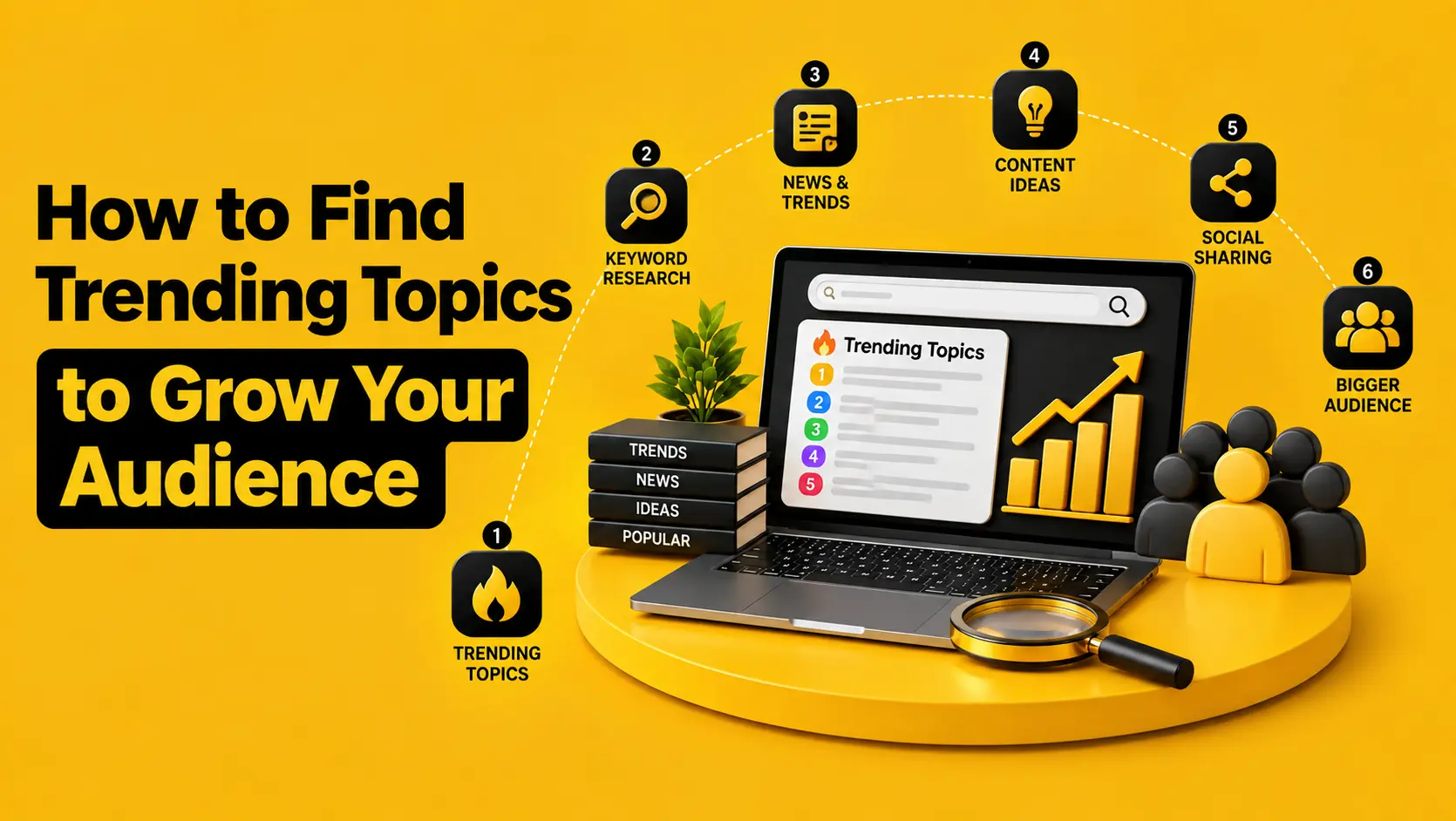
Ever spent hours writing a blog, hit publish, and then watched the traffic numbers sit there as they have absolutely no idea who you are?
Your writing may not be the problem. Your topic might be.
Content created based on trending topics has a higher chance of catching your audience’s attention since the topics are already being searched for, talked about, and shared. But before diving straight into finding out which topics are hot right now, there are some aspects of doing research on trending topics that need to be considered.
Let’s get into the basics first.
Key Takeaways
- Find rising searches, related queries, and emerging topics using Google Trends.
- Discover new conversations, questions, and trends via social media and Reddit.
- Verify trending keywords through search volume, intent, competition, and relevance to business.
- Create content based on trends by identifying niches, offering unique insight, and generating content when demand is growing.
What Are Trending Topics?
Trending topics are subjects getting more attention than usual over a specific period.
Increased visibility may include:
- Sudden spike in Google searches
- Rise in social media conversations
- Increased number of news articles covering the topic
- More discussions on Reddit
- Increase in the number of video views
- New questions about a certain topic
- Increased searches for keywords related to the topic
Some trends appear unexpectedly. Others build slowly over weeks or months.
For example, tax filing trends every year, but a new tax rule can suddenly create a wave of specific searches. That’s the important distinction. You’re not simply looking for popular topics. You’re looking for topics where interest is increasing.
How to Find Trending Topics Online
You don’t need 14 monitors or five subscriptions. A few reliable tools can give you useful signals.
- Start With Google Trends
If you’re wondering how to find trending topics online, Google Trends should be one of your first stops. It shows how search interest changes over time and lets you compare topics and search terms. You can explore interest over time, regions, related topics, and rising searches.
The Rising section is especially useful because it highlights queries experiencing significant growth. Google says searches marked “Breakout” have grown by more than 5,000%. That’s not exactly a gentle nudge. That’s the internet yelling, “LOOK AT THIS.”
Here’s the smarter way to use it.
Don’t search only for your exact target keyword.
Let’s say you create content for a fitness brand. Instead of searching only for “fitness,” try “strength training,” “home workouts,” “protein intake,” or “running recovery.” Then check the related queries. You might discover that “fitness” is stable while “strength training for beginners” is suddenly gaining attention. That’s a much more specific content opportunity.
Compare seven days, 30 days, 90 days, 12 months, and five years. A topic can look huge over five years while actually declining today.
And remember: not every spike is a trend. Sometimes it’s just Thanksgiving being Thanksgiving.
- Check Google’s Trending Now
Want to know what’s trending right now?
Google Trends’ Trending Now section is designed for that. It tracks trending searches across more than 100 countries and regions and lets you explore recent trends across short time periods. This can help with breaking news, industry developments, events, reactive content, and commentary. But don’t turn every trending search into a blog.
A celebrity breakup might be trending. That doesn’t mean your B2B cybersecurity company needs a 1,500-word article about it. Trending doesn’t automatically mean relevant.
Always ask: “Does my audience actually care about this?” If not, let the internet have its moment.
How to Find Top Trending Keywords
A trending topic and a trending keyword aren’t quite the same thing. A topic is the broader idea. A keyword is the specific phrase someone types into a search engine.
For example:
Topic: Artificial intelligence
Potential keywords:
- AI tools for businesses
- AI marketing tools
- AI search optimization
- AI productivity tools
- AI content detection
Google Trends can help you identify related searches and rising queries. Take promising keywords into your preferred SEO tool.
Look at:
- Search volume
- Keyword difficulty
- Search intent
- Cost per click
- SERP competition
- Traffic potential
This is where trend research becomes useful for SEO.
You’re no longer asking “What’s popular?” You’re asking “Which keywords around this growing topic are worth targeting?” That’s the better question.
How to Find Social Media Trends
Google tells you what people are searching for. Social media can tell you what people are talking about. And sometimes, those conversations start before search demand catches up.
If you’re trying to figure out how to find social media trends, start with the platforms where your audience actually spends time.
According to Pew Research Center in 2025, 84% of American adults use YouTube, 71% use Facebook, 50% use Instagram, 37% use TikTok, and 26% use Reddit.
Choose social media that matters to your audience.
TikTok
TikTok Creative Center allows discovering the most popular hashtags, videos, music, creators, and other trend signals.
It’s possible to look for industry-related trends and trends per time period, rather than spending two hours scrolling and calling it market research.
What to look for:
- Questions asked repeatedly
- New phrases being used
- Popular content format
- Product mentions
- Repeated complaints
- Industry talks
Reddit can become quite helpful in finding real problems to solve. Visit relevant subreddits and look for questions that keep appearing. If several people are asking different versions of the same question, you’ve probably found a content opportunity.
Don’t focus only on upvotes. Look for patterns. One viral post can disappear tomorrow. A recurring problem can become a reliable content topic.
Follow Industry News
Not every trend starts with a Google search. A new regulation, product launch, algorithm update, technology announcement, or major industry event can create an entire wave of searches afterward.
That’s why trend research should also include industry publications, news sites, competitor blogs, trade publications, LinkedIn, YouTube, podcasts, and company announcements. You’re looking for new developments entering the conversation.
For example, if a major search engine announces a significant change, don’t wait three months until everyone has published:
“Everything You Need to Know About Google’s Latest Update”
Look at the questions people are asking immediately. That’s where timely content has an opportunity to win.
Use Trend Discovery Tools
Tools such as Exploding Topics can help identify subjects that are gaining momentum. These tools are useful when you’re looking for emerging trends rather than topics that are already everywhere. Think of it as finding the party before everyone starts posting pictures from it.
Combine trend-discovery tools with Google Trends to validate whether an emerging subject has meaningful search interest. The important word is validate. Use multiple signals before deciding that a trend deserves your time.
How to Find Trending Topics for a Blog
Finding a trend is easy. Finding a good blog topic from that trend is where things get interesting.
Use this five-step process.
Step 1: Start With Your Industry
Begin with topics your business already understands.
For an SEO company:
SEO → AI search → AI Overviews → AI search visibility
For a SaaS company:
Productivity → remote work → AI productivity tools
Start with relevance, not virality.
Step 2: Find Growing Subtopics
Use Google Trends, social media, Reddit, news, and trend platforms.
Look for rising searches, new questions, emerging terminology, new products, growing complaints, and industry debates.
You’re looking for the smaller wave forming around the bigger topic.
Step 3: Validate Search Demand
A topic might be exploding on TikTok but have almost no meaningful search demand. That might make an excellent social post.
But if you’re spending hours creating an SEO-focused article, check its search potential first.
Look at search volume, search trend, search intent, keyword difficulty, and SERP competition. Don’t build a 2,000-word article around a keyword searched by approximately your cousin and three bots.
Step 4: Check Business Relevance
Ask one simple question:
“If this article ranks, do I actually want these people visiting my website?”
If the answer is no, reconsider the topic. Traffic is nice. Relevant traffic is much nicer.
Step 5: Find the Content Gap
Search the topic yourself and study the current results.
Then ask:
- What’s missing?
- Are the examples outdated?
- Is the information too generic?
- Are important questions unanswered?
- Can you provide original data?
- Can you explain the topic better?
Google recommends creating people-first content that provides original information, research, analysis, or meaningful value rather than simply rewriting what already exists.
In other words, don’t just be first. Be useful.
A Simple 30-Minute Trend Research Routine
You don’t need to spend all morning hunting for the next big thing.
Try this:
- 10 minutes: Check Google Trends and Trending Now
- 5 minutes: Search through social sites
- 5 minutes: Go through Reddit or industry-specific forums
- 5 minutes: Scan industry news
- 5 minutes: Confirm your best ideas using keyword research
Keep your ideas in a simple spreadsheet with columns for topic, source, growth, relevance, competition, and content angle.
Now you’re not collecting random ideas. You’re building a content opportunity list.
Don’t Chase Every Trend
A topic trending today doesn’t automatically deserve a blog tomorrow.
Before jumping on a trend, ask:
- Is it relevant? Does your audience care?
- Is interest growing? Are search, social, or news signals increasing?
- Can you compete? Are you early enough to have an opportunity?
- Can you add something useful? Do you have expertise, data, examples, or analysis?
If you can’t answer “yes” to at least three, skip it. Your calendar will survive.
The Bottom Line
Finding trending topics isn’t about endlessly scrolling social media and hoping inspiration smacks you in the face.
It’s about watching where attention is moving.
Use Google Trends to understand search behavior. Scan social media to find discussions early on. Check out Reddit to get actual questions and concerns. Follow industry news for new trends. Afterward, validate your ideas by checking the search demand, competition, audience relevance, and business intentions.
Above all else, do not mistake viral for valuable. The best trending topic for your business is where growing audience interest meets your expertise. That’s the sweet spot.
And yes, it’s usually more useful than publishing your 47th article titled “10 Tips to Improve Your Marketing.”
FAQs
- How do I find trending topics online?
Go to Google Trends first, then have a look at social media, Reddit, and industry blogs. Find those topics which are becoming popular, not those which are already everywhere.
- How do I know if a trending topic is worth blogging about?
Think about three points: Is my audience interested in this topic? Is their interest increasing? Do I have something valuable to add? Yes? Well, you have found a great topic.
- How can I find trending topics for my blog before they become too competitive?
See early indicators such as a rising number of Google searches, repeating questions on Reddit, growing social buzz, and new industry developments. Spot trends early rather than waiting till everybody writes about it.