Publishing great content is only half the SEO battle. If nobody credible is linking to that content, getting it in front of competitive searchers can be much harder.
That is the problem many businesses run into. Even when they publish on a regular basis, optimize their pages, and target the right keywords, they still see other companies outranking them.
The missing piece is often authority.
That is where the right link building strategies can make a difference. However, good link building cannot mean building hundreds of irrelevant backlinks. Good link building means creating relevant and credible links to your site from sites that already have authority in your field.
In this guide, we will discuss the different strategies and techniques of link building for U.S. based businesses in 2026.
What Makes a Backlink Valuable?
Before building links, it helps to understand what you’re actually trying to acquire.
A backlink is simply a link from another website to yours. But two backlinks can have completely different value depending on where they come from and why they exist.
Consider these two examples.
A respected U.S. marketing publication references your original SEO research and links to the study.
Another website you’ve never heard of publishes a page containing thousands of unrelated links, including yours.
Both technically give you a backlink. They are not remotely the same opportunity. When evaluating a link, look at relevance, authority, editorial context, and potential referral traffic. Relevance is particularly important.
Links from websites covering your industry would make more sense than links from unrelated sites that might have high third-party authority.
Google also recommends using descriptive and relevant anchor text and stresses that links are meant to be helpful rather than being used for manipulative purposes.
This is why a proper link building strategy always prioritizes quality over quantity.
- Create Original Research That People Want to Reference
One of the strongest link building techniques is also one of the most useful forms of content marketing: original research.
Think about the articles you read online. When writers mention a statistic, they often link to the original study, report, or dataset.
That is exactly the behavior you want to create.
For example, a U.S. digital marketing agency could survey 1,000 small businesses about their 2026 marketing budgets and publish the results as:
“2026 U.S. Small Business Marketing Budget Report.”
Now you have something other websites can cite.
A business publication might use one of the statistics in an article. A marketing consultant could reference the report in a presentation. Another agency might link to it from an industry guide.
The asset earns links because it provides information that other publishers don’t already have.
Useful formats include:
- Original surveys
- Industry benchmarks
- First-party datasets
- Annual reports
- Consumer research
- Market studies
- Trend reports
Semrush’s research on link building identifies original research and data-driven content as effective linkable assets because other publishers have a reason to reference them.
The important part is originality. Rewriting statistics from five other websites isn’t original research.
If you want links from research, give publishers something new to cite.
- Use Digital PR to Earn Editorial Links
Traditional outreach often sounds like this:
“Hi, we have an amazing website. Would you like to link to us?”
Unsurprisingly, it doesn’t always work.
Digital PR takes a different approach. Instead of asking publications to link to your website, you give them a reason to talk about your company, research, experts, or findings.
For example, a cybersecurity company could release research about the most common security mistakes among U.S. small businesses.
That creates a story.
A journalist can report the findings. An industry publication can discuss the implications. A business website can reference the research.
The backlink becomes part of the editorial coverage rather than the entire purpose of the conversation.
Other PR-friendly assets include:
- Original surveys
- Industry predictions
- Trend reports
- Consumer studies
- Proprietary data
- Expert commentary
- Annual rankings
- Market comparisons
This approach works particularly well when the research is timely and connected to something people are already discussing.
Instead of asking, “Who will give us a backlink?”, ask:
“What information could we publish that a journalist would actually want?”
That question usually produces better campaigns.
- Find Competitor Backlink Gaps
Your competitors have already done some of the research for you.
If another company consistently ranks above you, examine its backlink profile and look for websites linking to them but not to you.
Suppose three competitors all have links from the same industry publication.
That’s worth investigating.
It implies that the website you are investigating already covers your business niche and is ready to mention your business.
Pay attention to:
- Industry publications
- Resource pages
- Business associations
- Expert interviews
- Industry roundups
- Research citations
- Guest contributions
- Partner pages
It does not mean that you need to try to get all the backlinks from your competitors’ list. Some of them might be irrelevant, expired, or simply low-quality backlinks. Try to look at the patterns.
When several competitors have a backlink from one reliable website, it might be a true link opportunity.
Such an approach will help you become more targeted when sending out link requests since you start from the websites that are interested in your niche.
- Reclaim Unlinked Brand Mentions
Sometimes another website has already talked about your company but forgot to link to you.
That’s one of the easiest link opportunities to overlook.
Imagine a publication writes “Xparro recently published a report on SEO trends.” The brand is mentioned, but there is no hyperlink.
You can reach out to the publisher and politely ask whether they would consider linking the mention to the original report or relevant company page.
The conversation is much easier because the publisher has already decided that your brand is worth mentioning.
The same principle applies to links pointing to outdated URLs.
A website may still link to an old article that has been moved, deleted, or replaced. If the old URL now returns a 404, you can either redirect it to a highly relevant replacement page or contact the publisher and suggest the correct URL.
This is known as link reclamation. It isn’t glamorous. But SEO doesn’t always need to be glamorous. Sometimes the best backlink opportunity is simply one you already earned and forgot to maintain.
- Use Broken Link Building
Broken link building works because you’re solving a problem for another website.
First, you need to find websites that have relevant pages with broken external links.
For instance, let’s take an industry website that has a resource page with a dead link to SEO research conducted long ago.
If you happen to know about your company’s recent SEO research on the same topic, then you should contact the owner of the website and suggest replacing the broken link.
The crucial point here is relevancy. It’s not enough to simply write an article on a certain topic just because you’ve found a broken link.
The new resource must be as useful as the previous one.
An effective outreach email could look like this:
“I noticed that the research link on your website in the SEO resources section is leading to a 404 page. I’ve recently conducted updated research on the same topic. Maybe you will find it useful to replace the broken resource with ours.”
This is much better than saying, “Please, link us on your site.” You’re identifying a problem and offering a solution.
- Build Linkable Assets, Not Just Blog Posts
Not every article you publish needs to attract backlinks.
But if link acquisition is one of your goals, some content should be deliberately designed to earn citations.
A linkable asset gives another website a reason to reference your page.
That could be:
- An original statistics page
- A calculator
- A research report
- A downloadable template
- An industry database
- A detailed benchmark
- An interactive tool
- A comprehensive resource
For example, an SEO agency could create a free SEO ROI calculator for U.S. businesses.
A business owner might use it, a marketing consultant might recommend it, or a publication writing about SEO budgets might link to it.
The asset works because it provides something useful beyond another 1,500-word article.
Before creating an asset, ask one simple question: “Why would another website link to this?” If you don’t have a good answer, the asset probably needs more originality or utility.
- Contribute Expert Content to Relevant Publications
Guest posting can still be useful when it is approached as an expert contribution, rather than a backlink manufacturing system.
Google has warned against large-scale article campaigns created primarily to manipulate rankings through links.
That doesn’t mean contributing an article to an industry publication is automatically a problem.
The difference is whether you’re providing genuine value. A cybersecurity executive could explain how small businesses should respond to ransomware risks. A SaaS founder could discuss lessons from reducing customer acquisition costs.
An SEO strategist could explain what businesses should actually do after a major search update.
These are useful contributions because they come from experience and expertise.
Choose publications based on:
- Audience relevance
- Editorial quality
- Industry reputation
- Organic visibility
- Topic relevance
Don’t select websites simply because a third-party tool gives them a high Domain Rating. Third-party metrics are useful for prospecting, but they aren’t Google ranking factors.
And don’t force exact-match anchor text into every contribution.
Natural, descriptive anchor text is much more appropriate. Google specifically recommends concise and relevant anchor text rather than keyword stuffing.
- Turn Expertise Into Journalist Links
Journalists regularly need credible sources.
They need someone who can explain a new development, interpret data, provide an expert opinion, or comment on an industry trend.
That creates another link-building opportunity.
If your company has genuine subject-matter experts, make them accessible.
For example, if Google introduces a significant search change, an experienced SEO professional can provide commentary about what businesses should watch.
If a new AI technology changes advertising, a marketing strategist can explain its practical implications.
When journalists use that expertise, the resulting article may include the expert’s name, company, website, or supporting research.
The value goes beyond the backlink. You’re building brand authority, expert visibility, and relationships with publishers at the same time. This is one reason link building and digital PR increasingly overlap.
- Strengthen Internal Links After Earning External Links
External backlinks bring authority into your website. And internal links are needed to establish a connection between the authority and other pages.
Assume that some marketing magazine links to your guide on SEO strategy.
In this case, your guide is supposed to link users to other pages of your website, like service pages, research, etc.
Google suggests linking the most important pages through other relevant pages with descriptive anchor text. But this does not imply linking every page. It implies having a structured website.
If your pages that are valuable from a commercial point of view are disconnected from the other pages of your website, it creates problems both for visitors and for the search engines.
So whenever you earn an important backlink, review the page receiving it.
Ask which related pages this page should naturally link to. That small step can make your broader link building strategy more effective.
How to Build a Link Building Plan
A successful link-building plan should be based on your website’s actual competitive position.
Start with a backlink audit.
Identify your:
- Referring domains
- Best backlinks
- Unlinked backlinks
- Broken backlinks
- Most linked pages
- Anchor texts
Conduct a competitor gap analysis by looking at your competitors’ websites. Find out what websites are linking to your competitors but not to you.
From here, create categories of prospects including:
- Editorial opportunities – Media and industry publications.
- PR opportunities – Journalists and media sites.
- Resource opportunities – Resource pages, guide pages, and industry lists.
- Reclamation opportunities – Unlinked mentions and lost links.
- Content opportunities – Websites that could cite your research, tools, and reports.
This will provide your team with a process rather than a spreadsheet full of websites. Now it is possible to develop campaigns using different tactics on a monthly basis.
One month could involve research and PR; the next month could involve link reclamation and broken link building, etc.
How to Measure Link Building Success
Don’t judge a campaign solely by the number of backlinks acquired.
A campaign that produces 200 irrelevant links isn’t necessarily better than one that earns 15 highly relevant editorial links.
Track metrics such as:
- New referring domains
- Relevant referring domains
- Editorial placements
- Links to priority pages
- Referral traffic
- Ranking changes
- Organic traffic
- Assisted conversions
- Organic leads
You should also look at the quality of the websites linking to you.
If your campaign is consistently earning links from websites that have genuine audiences, strong editorial standards, and relevance to your industry, you’re building something valuable.
If the report is full of strange websites you’ve never heard of, it’s time to ask some uncomfortable questions.
Link Building Strategies to Avoid
Some tactics can create more problems than opportunities. Avoid buying links specifically to manipulate search rankings. Google classifies this as link spam.
Be cautious with:
- Automated backlink software
- Mass directory submissions
- Link farms
- Private blog networks
- Excessive reciprocal links
- Comment spam
- Irrelevant guest posts
- Keyword-stuffed anchor text
- Large-scale low-quality link campaigns
Google also identifies automated link creation and excessive link exchanges among practices that can violate its spam policies.
And if someone promises thousands of backlinks overnight, remember that a large backlink number isn’t the same thing as authority.
Final Takeaway
The best link building strategies don’t begin with the question, “How many backlinks can we get?” They begin with “What can we create that another credible website would genuinely want to reference?”
That could be original research, a useful tool, expert insight, proprietary data, or a genuinely valuable resource.
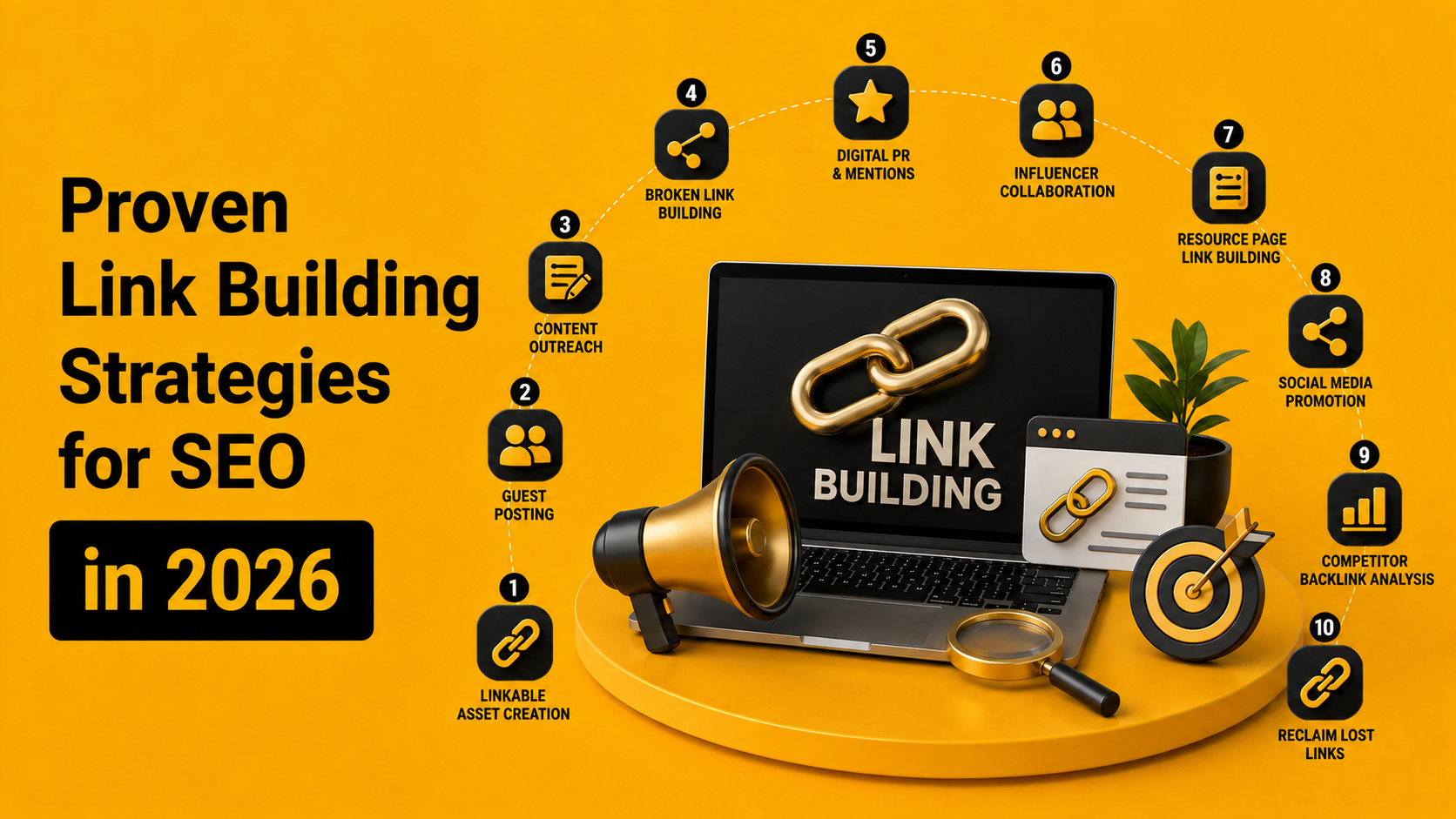
From there, competitor research, digital PR, broken-link building, link reclamation, expert outreach, and targeted content contributions can help turn those assets into real authority.
The strongest link building strategy is ultimately a combination of good content, smart prospecting, relevant outreach, and genuine relationships.
Don’t chase links just because they’re available. Chase the links that make sense. Because one relevant editorial backlink from a trusted website can be far more valuable than a spreadsheet full of links nobody would ever click.