You know that annoying SEO situation where your page ranks on page two for a keyword you really want? It’s close enough to give you hope. Far enough down that almost nobody sees it. That’s where search engine positioning matters.
Instead of treating SEO as one giant checklist, positioning looks at individual pages and asks a much more useful question: Why isn’t this page ranking higher, and what can we change?
What Is Search Engine Positioning?
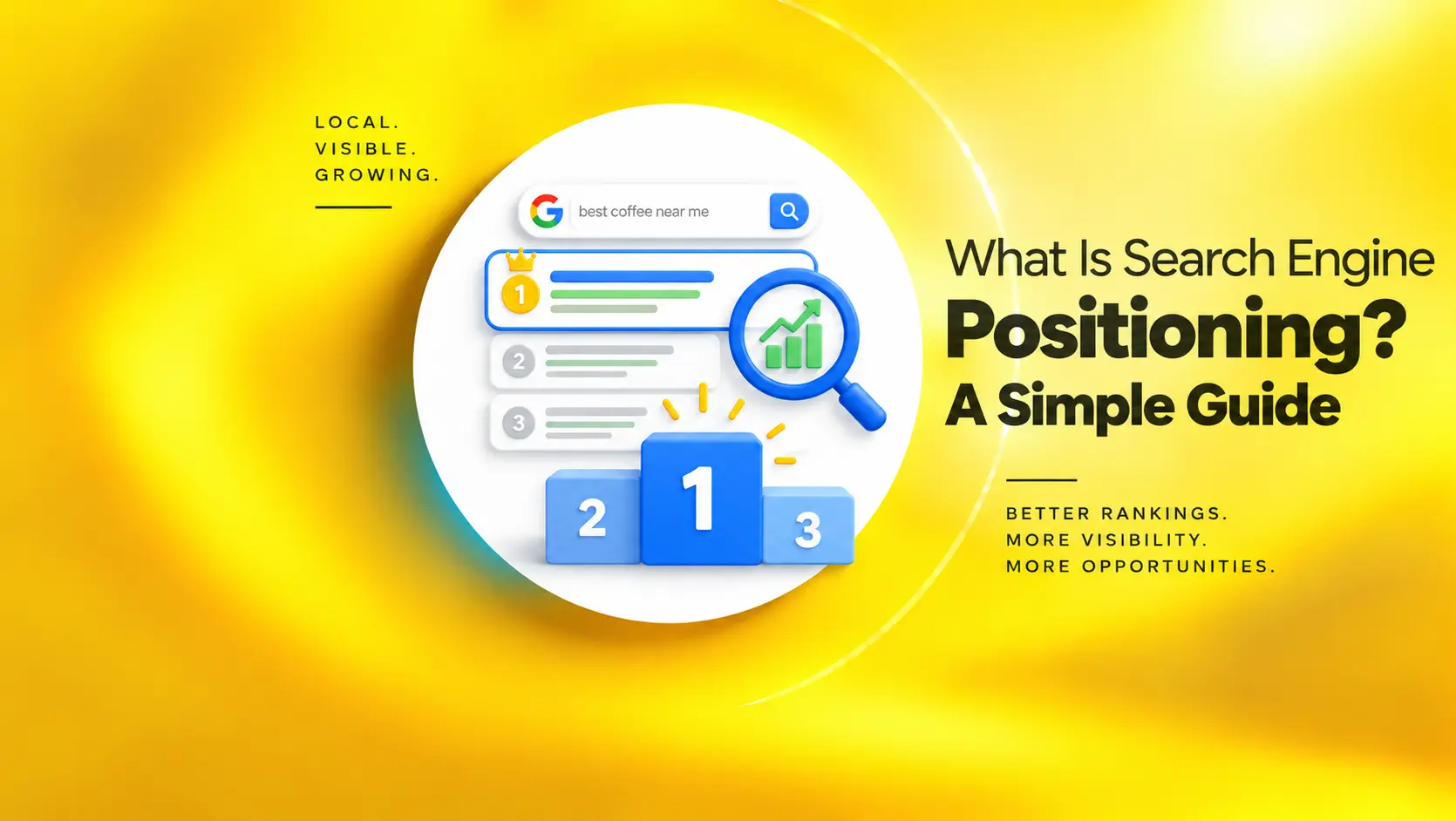
So, what is search engine positioning?
Simply put, it’s the process of improving a webpage’s position in search results for specific queries.
Say your software company has a landing page ranking #9 for “project management software for small business.” You already have some visibility. But there’s a pretty big difference between being #9 and being #3.
That gap is where positioning work happens.
SEO positioning is not a replacement for SEO. SEO is the bigger umbrella covering everything from technical optimization and content to links, site architecture, and user experience.
Positioning is more focused. You take a page that already has potential and work on the things holding it back. And yes, those positions matter.
A Backlinko analysis of more than four million Google search results found that the first organic result received an average 27.6% click-through rate, while the first three results accounted for 54.4% of clicks.
The study isn’t a current 2026 benchmark, but it clearly shows why moving upward in the SERP can be valuable.
Why Does Search Engine Positioning Matter?
Because “we rank on Google” isn’t really a business goal. Ranking for the right searches is.
Imagine you run a U.S.-based accounting firm.
Ranking for “accounting” would look impressive on a report. But ranking for something like “tax accountant for small business in Texas” could be far more useful because the searcher has a much clearer need.
This is the part of search engine positioning that often gets overlooked.
You’re not trying to push every page to position #1 for every possible keyword. You’re trying to put the right page in front of the right person at the right point in their search.
Better positioning can mean:
- More qualified organic traffic
- Greater visibility against competitors
- More clicks from high-intent searches
- More opportunities for leads and sales
- Stronger visibility for important products or services
The ranking is the visible part. The business result underneath it is what actually matters.
Search Engine Positioning vs SEO
Here’s where things can get confusing. SEO is the whole operation. Search engine positioning is one part of it.
SEO might involve:
- Technical SEO
- Keyword research
- Content strategy
- Link building
- Site architecture
- Structured data
- Page experience
- Internal linking
Search engine positioning gets much more specific.
Let’s say your service page ranks #8 for “PPC agency for SaaS companies.” You don’t necessarily need to build an entirely new website or publish 30 more blogs.
First, look at the page.
Does it actually answer what SaaS companies want to know? Is the service clear? Does it demonstrate expertise? Is the content stronger than what’s ranking above it? Are there relevant internal links pointing toward it? Is the page technically sound?
That’s positioning. You’re not starting from scratch. You’re figuring out why the page isn’t winning yet.
How to Improve Site Position in Google
There isn’t a secret “rank me higher” button hiding inside Google Search Console. Sadly. But there are several things you can do when a page is already showing signs of potential.
- Find Your Almost-Winners
Start with pages that are already ranking somewhere between positions 4 and 20 for valuable queries. These are interesting because Google already understands the page well enough to show it.
Open Google Search Console and look at:
Performance → Search results → Queries
Image: Screenshot of the GSC Performance report showing Clicks, Impressions, CTR and Average Position.
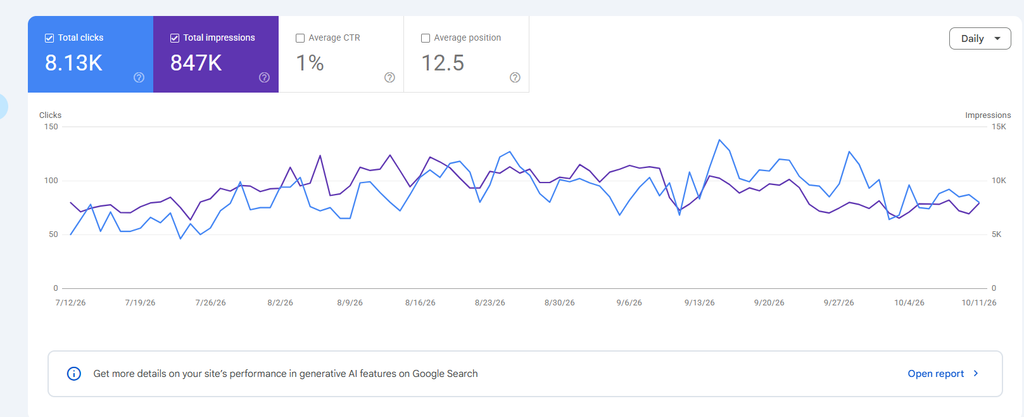
Then check which pages are getting plenty of impressions but aren’t generating enough clicks.
Google Search Console lets you analyze clicks, impressions, CTR, and average position at the search-performance level.
A page getting 20,000 impressions and barely any clicks deserves attention. So does a valuable commercial page sitting at position 11. Don’t automatically rewrite everything. Find the pages that have something to work with.
- Look at the SERP Before Touching the Page
This sounds obvious. It isn’t done nearly enough. Search your target query and actually study what’s ranking.
If Google is showing comparison pages, a generic service page probably isn’t going to have an easy time. If the SERP is dominated by product pages, publishing another 2,000-word educational article may not solve the problem either.
Look at:
- Search intent
- Content format
- Topics covered
- Page depth
- SERP features
- Competitor positioning
- Questions being answered
Then ask:
“What does the searcher get from the top results that my page doesn’t provide?” That’s a much better starting point than stuffing the keyword into another heading.
Image
- Improve the Information, Not the Word Count
One of the easiest SEO traps is believing that longer automatically means better. It doesn’t. Google itself says there is no preferred word count for its ranking systems.
So don’t turn a useful 1,200-word article into a bloated 3,500-word monster just because a competitor has 3,487 words.
Instead, look for gaps.
Maybe competitors don’t include current pricing information.
Maybe their examples are weak.
Maybe nobody has original data.
Maybe the explanations are full of jargon.
Maybe your page answers the main question but completely ignores the follow-up questions people naturally have.
Fix those things. Useful beats long.
- Give Google and Users Better Internal Connections
Internal linking isn’t exciting. Your SEO spreadsheet might disagree, but that’s the truth. Still, it matters.
If your website has a strong page about SEO services, you can naturally connect it to relevant pages about technical SEO, local SEO, content marketing, or SEO audits.
Those links help users move through your website and give search engines additional context about how your pages relate to each other.
The trick is relevance. Don’t add 14 internal links to a paragraph because you discovered the hyperlink button. Link where it actually helps. And use anchor text that tells people what they’re clicking.
- Don’t Ignore Technical SEO
Sometimes the page isn’t failing because the writing is bad. Sometimes the website is simply making life harder than it needs to be.
Check the basics:
- Is the page indexable?
- Is the canonical correct?
- Does it work properly on mobile?
- Are there broken links?
- Is the page painfully slow?
- Are redirects causing problems?
- Are important pages accidentally blocked?
- Does the page have usability issues?
Google’s page experience guidance recommends paying attention to Core Web Vitals, mobile usability, HTTPS, intrusive elements, and the overall experience users get from a page.
Great content can’t do much if users land on a page and immediately regret it.
- Build Supporting Content Around Important Pages
One page shouldn’t have to carry your entire SEO strategy on its back.
If you’re targeting “PPC services for SaaS companies,” you can build related content around topics such as:
- SaaS PPC strategy
- Google Ads for SaaS
- PPC landing page optimization
- SaaS conversion tracking
- PPC vs. SEO for SaaS
- SaaS Google Ads benchmarks
Then connect those pages naturally.
Over time, you’re building a network of useful content around the subject rather than hoping one landing page magically becomes an authority overnight.
How Do You Measure Search Engine Positioning?
This is where you need to resist the temptation to stare at rankings all day. A ranking is useful. It just isn’t the entire story.
Track:
- Average position: Where your pages generally appear for relevant searches.
- Impressions: How often your page appears in search results.
- CTR: How frequently searchers click your result.
- Organic clicks: The actual visits generated from search.
Image: A simple dashboard containing:
Average Position | Impressions | CTR | Organic Clicks
Then underneath:
Rankings → Traffic → Leads → Revenue
Google Search Console provides these metrics through its Search results performance report.
But there’s another metric that matters even more:
What happened after the click?
If a page moves from #12 to #5 and brings in more qualified leads, that’s a meaningful improvement. If it moves from #12 to #5 and attracts thousands of people who have absolutely no interest in your product?
Cool screenshot. Not necessarily a great business result.
The Real Goal of Search Engine Positioning
Search engine positioning isn’t about chasing the #1 spot just so someone can put a screenshot of it in a monthly SEO report.
It’s about making valuable pages more competitive for searches that can actually contribute to your business. So if your page is sitting at #13, don’t immediately panic and publish another article.
Look at the pages above you.
- Study the SERP.
- Find the gaps.
- Improve the page.
- Strengthen its internal connections.
- Fix the technical issues.
Then measure what changes. Because the better SEO question isn’t “How do I rank higher?” It’s “What would make this page the better result?”
That’s the question that can move a page from page two to page one and turn search visibility into something your business can actually use.
Want your existing pages to work harder? Xparro helps businesses turn SEO positioning into a strategy built around visibility, qualified traffic, and conversions, not just better-looking ranking reports.
FAQs
- What is search engine positioning?
Search engine positioning is basically about getting your web pages to show up higher for the searches that matter to your business. Better positions can mean more visibility, clicks, and potential customers.
- How can I improve my site position on Google?
Start with pages that are already ranking but could do better. Check the search intent, improve the content, strengthen internal links, fix technical SEO issues, and look at what the pages above you are doing differently.
- Is search engine positioning the same as SEO?
Not quite. SEO covers the bigger picture of improving your website’s search visibility. Search engine positioning is more focused on moving specific pages higher for specific searches.