You rank well on Google. Then someone asks ChatGPT for the best companies in your industry… and your brand is nowhere to be found. That’s the problem with relying only on traditional rank tracking now. Search has changed, and your SEO reporting needs to catch up.
Google’s AI Overviews alone reached more than 1.5 billion monthly users in Q1 2025. And people are also turning to ChatGPT, Gemini, Perplexity, and other AI tools to research products, compare services, and decide what to buy.
So, yes, you still need to track your Google rankings. But you should also know what AI is saying about your brand. That’s where AI online rank tracking tools come in.
Key Takeaways
- AI rank tracking shows whether ChatGPT, Gemini, and Google AI mention, recommend, or cite your brand.
- Compare 7 AI and traditional rank tracking tools based on features, AI coverage, and use cases.
- Learn which metrics matter, from AI mentions and citations to competitor visibility and share of voice.
- Find out how to start tracking AI rankings and whether Gemini deserves a place in your SEO strategy.
What Is AI Rank Tracking?
Traditional rank tracking is pretty straightforward. You enter a keyword, and the tool tells you where your page appears in Google. AI search doesn’t work quite that neatly.
Ask ChatGPT, “What are the best accounting software options for a small business?” and you won’t get a numbered list of 100 blue links. You’ll get an answer with brands, explanations, and sometimes citations to websites.
AI rank tracking tools monitor those answers.
Depending on the platform, you can track things like:
- How often your brand is mentioned
- How often your website is cited
- Which competitors appear alongside you
- Your share of voice
- How AI describes your brand
- Which pages are being cited
Coalition Technologies tested several AI rank tracking platforms using about 2,700 prompts across ChatGPT, Perplexity, Google AI Overviews, and Google AI Mode.
So this isn’t just another shiny “AI SEO” label slapped onto an old rank tracker. There’s a real shift happening in how visibility is measured.
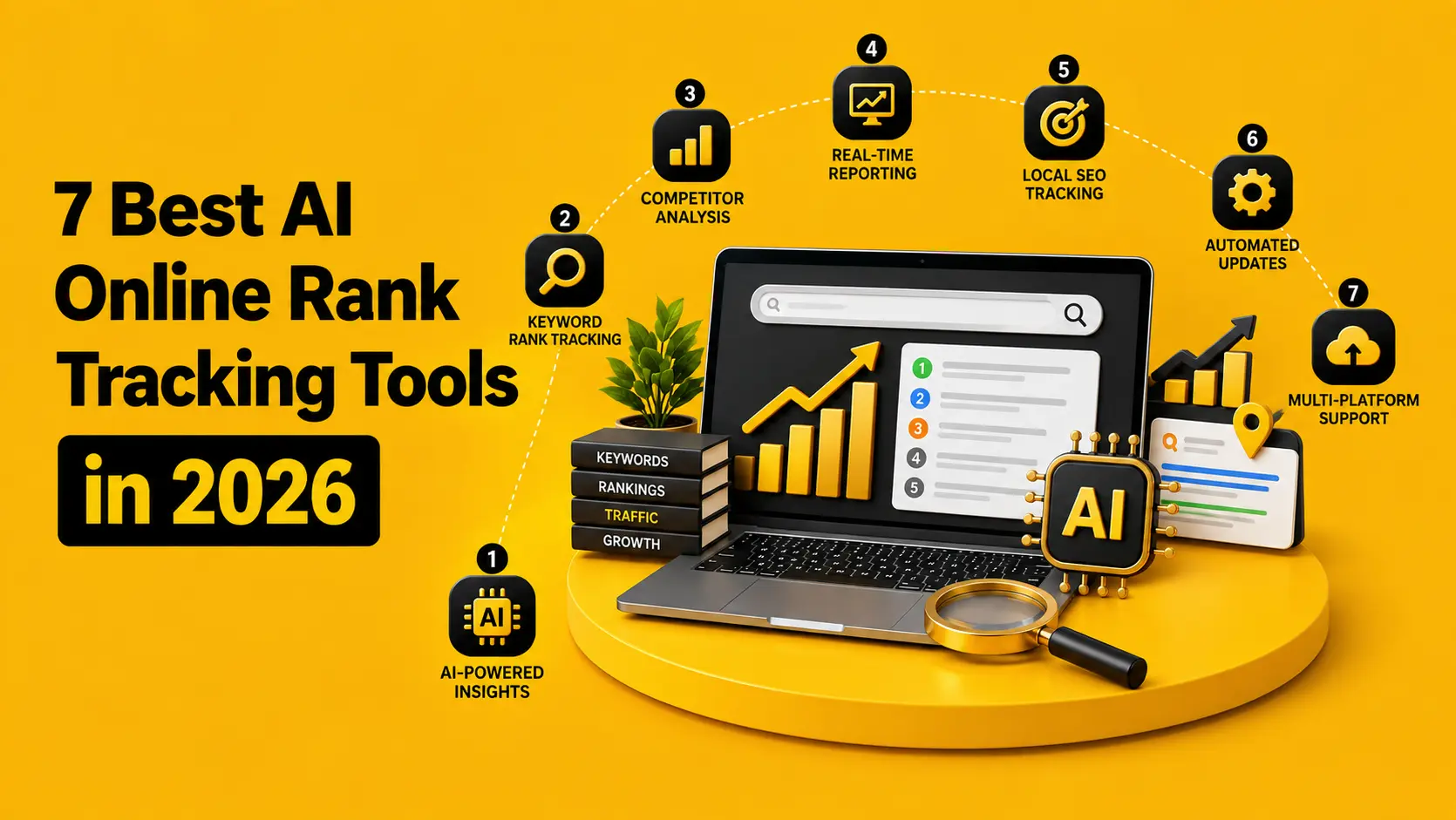
7 Best AI Online Rank Tracking Tools
- Semrush- Best Overall
If you’re already using Semrush for SEO, this is probably the easiest place to start.
You can keep tracking your traditional Google rankings while also monitoring AI visibility. Semrush’s AI features cover areas including Google AI Overviews, Google AI Mode, ChatGPT, and Gemini.
That’s useful because you don’t want your SEO team jumping between five different dashboards just to answer one question.
Best for: SEO teams, agencies, and businesses that want traditional SEO and AI tracking together.
Why pick it: It’s an easy transition if Semrush is already part of your workflow.
Our take: Probably the safest all-round choice for teams that don’t want to overcomplicate their SEO stack.
- Ahrefs Brand Radar – Best for Seeing Who Gets Cited
Ahrefs has taken its usual “let’s give SEO people more data” approach to AI search. Its Brand Radar tracks visibility across ChatGPT, Gemini, Perplexity, Copilot, and Google AI Overviews.
What makes this particularly useful is the focus on mentions and citations.
Because here’s something worth remembering: Getting mentioned is nice, but getting cited as a source is better.
If an AI answer repeatedly uses one of your articles to support its recommendation, that’s a pretty useful signal about the content you’re producing.
Ahrefs also helps you compare your visibility with competitors and investigate the prompts behind AI results.
Best for: SEO teams, content marketers, and competitor research.
Our take: Great if you’re less interested in a single “AI visibility score” and more interested in figuring out why one brand keeps getting cited while another doesn’t.
- Rankscale – Best AI Rank Tracker for LLMs
Rankscale is built around AI search tracking rather than treating it as a tiny add-on.
Coalition Technologies tested it across approximately 2,700 prompts and reported near-100% accuracy for brand mention and citation detection in its evaluation. The testing covered ChatGPT, Perplexity, AI Overviews, and AI Mode.
It also tracks several AI platforms, including ChatGPT, Gemini, Claude, Copilot, Grok, Perplexity, Google AI Overviews, and AI Mode. That’s a lot of coverage.
And that’s exactly why it’s more appealing to agencies and larger SEO teams than someone who just wants to check whether their company appeared in ChatGPT twice this month.
Best for: Agencies, enterprise SEO teams, and serious LLM monitoring.
Our take: One of the better options if you want to get deep into prompts, citations, competitors, and sentiment.
- Peec AI – Best for Prompt Tracking
Peec AI puts a lot of emphasis on what people are actually asking AI.
It supports prompt-level monitoring, competitor analysis, source attribution, and tracking across multiple AI platforms. And prompt tracking matters.
Your customer might Google “best CRM software,” But ask ChatGPT “What CRM would you recommend for a 50-person SaaS company with a small sales team?”
Same general topic. Completely different search behavior. That’s the kind of difference AI-focused tracking needs to capture.
Best for: AI SEO teams, agencies, and brands focusing on conversational search.
Our take: Worth considering if your SEO strategy is moving beyond keywords and into real-world customer questions.
- Profound – Best for Enterprise Teams
Profound is built for companies that have a lot going on.
We’re talking large prompt sets, multiple markets, multiple AI platforms, and teams that actually need to turn AI visibility data into reports and workflows.
Its platform includes Answer Engine Insights, Prompt Volumes, and Agent Analytics, along with enterprise features such as SSO and SOC 2.
For a small business, that may be more than you need. For a large brand trying to understand AI visibility across markets, it makes considerably more sense.
Best for: Enterprise SEO and marketing teams.
Our take: Powerful, but don’t buy an enterprise hammer to fix a two-page website.
- Nightwatch – Best Hybrid Option
Maybe you aren’t ready to build a whole new AI SEO workflow. Fair enough.
Nightwatch is worth considering because it combines traditional keyword rank tracking with AI and LLM visibility capabilities. Coalition Technologies included it among the platforms that bridge conventional SEO tracking and newer AI monitoring.
That makes it a practical option if you still care heavily about Google rankings but want to start watching what happens in AI search.
Best for: Agencies and SEO teams making the move toward AI tracking.
Our take: A good middle ground if you don’t want to completely overhaul your existing SEO process.
- SEOptimer – Best for Simple SEO Rank Tracking
SEOptimer isn’t as AI-focused as some of the tools above. And that’s okay.
Its Keyword Ranking Tool tracks keyword positions, search volume, estimated traffic, competition, and ranking URLs. It also supports location-based tracking across more than 70 countries.
Why include a traditional rank tracker in an AI-focused list?
Because Google isn’t going anywhere. AI visibility should complement your SEO reporting, not replace it. You still need to know whether your important keywords are climbing, falling, or sitting stubbornly on page two.
Best for: Small businesses, agencies, and teams focused mainly on traditional SEO.
Our take: A straightforward option if you want solid rank tracking without building an unnecessarily complicated setup.
What Should You Actually Track?
This is where people can easily go overboard. You don’t need to track every possible question someone could ask an AI. Start with the questions that could actually make you money.
Say you run a cybersecurity company.
Instead of tracking hundreds of random prompts, start with things like:
- Best cybersecurity software for small businesses
- Best endpoint security platforms
- Cybersecurity tools for Microsoft 365
- Best cybersecurity companies in the US
- Alternatives to [competitor]
- How much does cybersecurity software cost?
Then watch what happens.
| Metric | What you’re looking for |
| Mention rate | How often AI talks about your brand |
| Citation rate | How often your website is used as a source |
| Recommendation rate | How often you’re suggested |
| Share of voice | How you compare with competitors |
| Sentiment | Whether AI describes you positively or negatively |
| Cited pages | Which content is earning visibility |
That’s much more useful than staring at a giant “AI score” and hoping it goes up.
And it’s why AI Overviews SEO rank tracking tools are becoming useful for SEO teams. They help connect the dots between the search query, the AI-generated answer, the sources being cited, and the competitors getting visibility.
How to Pick the Best AI Rank Tracker Tool
Before you pull out the company card, check a few things. Does it track the AI platforms you care about?
At minimum, consider:
- Google AI Overviews
- Google AI Mode
- Claude
- ChatGPT
- Gemini
You don’t necessarily need all of them. You need the ones your audience actually uses.
Can you track your own prompts?
This is important.
A tool giving you a broad visibility estimate is useful for benchmarking. But custom prompts tell you what’s happening with your customers and your commercial topics.
Does it track citations?
Look beyond mentions.
If AI keeps mentioning your brand but cites someone else’s content, that’s a very different situation from AI repeatedly using your website as a source.
Can you see competitors?
Always compare.
A 40% visibility rate sounds fantastic until you discover your competitor has 70%. AI search is competitive too.
Does it store historical data?
AI answers change. Sometimes quickly.
Ahrefs found a 70% probability that an AI Overview changes between observations, while cited content had an average lifespan of around 2.15 days in its research.
That means today’s AI answer isn’t necessarily tomorrow’s answer. Historical tracking helps you spot those changes instead of treating every result as permanent.
What About ChatGPT Rank Tracking Tools?
Here’s the trick: you cannot use the traditional “rank #3” when it comes to ChatGPT.
That means you have to think of something else for ChatGPT rank tracking tools to measure.
Things like:
- Brand mentions
- Recommendations
- Citations
- Competitor mentions
- Prompt-level visibility
- Sentiment
- URL sources
And then analyze the patterns. When ChatGPT keeps recommending your competitors whenever someone asks about solutions in your industry, that’s something you should look into.
The Bottom Line
SEO hasn’t suddenly become irrelevant because people started asking AI questions.
You still need strong technical SEO, useful content, backlinks, topical authority, and a website that deserves to rank.
But there’s another layer now. It is vital that you understand whether AI technologies mention your company, suggest your product, and utilize your material as their sources.
For comprehensive SEO settings, Semrush will be a good choice. Ahrefs will do well for visibility and citation analysis. RankScale and Peec AI would work better for LLM monitoring. Profound is geared toward enterprise teams, while Nightwatch offers a useful bridge between traditional and AI rank tracking.
And whichever tool you choose, don’t obsess over one shiny AI visibility number.
Ask the questions that actually matter, like: Are we showing up? Who is showing up instead? Why are they being cited? And what can we do about it? Because ranking #1 on Google is still great.
But if your customers are asking AI for the answer, you want your brand to be part of that answer too.
FAQ
What is the fastest way to start tracking rank in AI?
Don’t start by tracking thousands of prompts. Start with 20-50 high-value prompts related to your products, services, competitors, and commercial topics.
Track them across the AI platforms that matter to your audience and record your starting point for mentions, citations, recommendations, and competitor visibility. Once you understand those patterns, expand.
Is Gemini rank tracking worth prioritizing right now?
Yes, but it depends on your audience.
If your customers spend a lot of time in Google Search and Google’s AI ecosystem, Gemini and AI Overviews should be on your radar.
If your audience uses ChatGPT heavily for product research, ChatGPT may deserve more attention. Don’t chase every AI platform just because it’s popular. Track where your customers are.