You’ve built a website. The design looks great. The pages load fast. The content is polished. And yet your traffic dashboard looks like a ghost town.
You are not alone. Countless businesses create their websites, hoping traffic will just start coming from nowhere. But this is not how the internet works. In 2026, traffic generation for websites will mean a clear plan that includes SEO, content marketing, AI visibility, distribution through social media, paid acquisition, and conversion optimization.
The good thing about this is that it does not require millions of dollars for marketing. It only requires the right sources for traffic, correct implementation, and enough time.
This guide explains how to get traffic on your website in simple terms based on data.
Why Website Traffic Matters More Than Ever
Traffic isn’t just a vanity metric.
More qualified traffic means:
- More leads
- More selling opportunities
- More visibility for your brand
- More data on your customers
- More money
As per research conducted in the industry, the companies that frequently publish optimized content receive a lot more organic traffic and leads than those that do not.
But there’s a twist. All traffic is not equal.
What would you like:
100,000 visitors? Or 5,000 highly qualified visitors who are ready to purchase from you?
You would definitely pick the second one. Increasing traffic is not the purpose. Increasing qualified traffic is the goal.
Start With Search Intent Before Anything Else
All businesses make this mistake. They write content based on keywords. Intelligent marketers write content based on intent.
There are four types of intent for all searches:
Informational Intent
People are looking for answers.
Examples:
- What is technical SEO?
- How does Google indexing work?
- How to increase the speed of your website?
Navigational Intent
They already know the brand name.
Examples:
- Xparro SEO services
- Hubspot CRM
- Shopify pricing
Commercial Intent
They are comparing the options.
Examples:
- Best SEO firms in the USA
- Ahrefs vs Semrush
- Marketing automation tools comparison
Transactional Intent
They are prepared to purchase.
Examples:
- Hire an SEO agency
- Purchase CRM software
- Website audit service
The best converting traffic generally comes through commercial and transactional keywords.
But 90% of companies write informative content.
It is just like running a restaurant and providing only appetizers.
Build a Search-First Content Engine
Content is still one of the most scalable sources of traffic. But the approach “write blogs and hope for the best” is outdated.
The modern content marketing strategy needs:
Topic Clusters
Not only write any posts, but also organize them into clusters.
Example:
Pillar Page:
SEO Services
Additional Articles:
- Technical SEO Audit
- Local SEO Optimization
- Link Building Tactics
- Keyword Research Strategy
- Core Web Vitals Optimization
It builds semantic relevance.
Google knows what you are an expert in. Rankings improve faster. Traffic compounds over time.
Cover the Entire Buyer Journey
Top Funnel
- Guides
- Industry news
- Beginner material
Middle Funnel
- Comparisons
- Examples
- Frameworks
Bottom Funnel
- Services pages
- Pricing pages
- Demo pages
Most sites have an abundance of top funnel material and lack material to convert customers.
Dominate Google AI Overviews
Traditional SEO is not enough anymore. Google AI Overviews provide the answers to many queries right in the search results page. If your content is not referenced by AI algorithms, you will be missing out on exposure.
Tips to increase AI Overviews:
Answer Questions Immediately
Don’t do:
Too long introductions with stories.
Do:
Answers within the first 50 words.
Use Structured Formatting
AI algorithms love:
- Lists
- Tables
- Numbers
- Definitions
- Processes
Demonstrate Experience
Google favors:
- Original insights
- Examples from the real world
- Case studies
- Commentaries by experts
Content made only for the search engines will be overlooked.
Add Entity Signals
Refer to:
- Tools
- Technologies
- Frameworks
- People
- Brands
It helps to establish topic authority.
The future is reserved for those who optimize for people and AI algorithms.
Win Technical SEO Before Competitors Do
While many organizations allocate substantial budgets for their content while overlooking important technical factors that can negatively impact their rankings.
This is like pouring water into the bucket through which there is already a hole.
Work on:
Core Web Vitals
Track:
- Largest Contentful Paint (LCP)
- Interaction to Next Paint (INP)
- Cumulative Layout Shift (CLS)
Bad results decrease the user experience and affect organic performance.
Crawl Efficiency
Make sure you have:
- A working XML sitemap
- An optimized robots.txt file
- Broken links are removed
- Redirect chains are solved
Indexing Management
Look for:
- Indexed pages
- Duplicate pages
- Canonical tags
- Noindex tags
Many sites unintentionally disallow their pages to be indexed by search engines.
Structured Data
Add schema to:
- Articles
- Frequently Asked Questions (FAQs)
- Products
- Reviews
- Organizations
Schema improves search visibility and increases click-through rates.
Capture Featured Snippets and SERP Features
Being ranked #1 is no longer enough.
Search results now include:
- AI Summary
- Featured snippets
- People Also Ask blocks
- Video sliders
- Local pack
- Image pack
Most of the time, these SERP features drive more traffic than standard rankings.
For featured snippets, create:
Create Definition Sections
“For example,
What is technical SEO?”
And write a short answer containing 40-60 words.
Use Question-Based Headings
- “How does website indexing work?”
- “Why is page speed crucial?”
- “Why do rankings fall?”
Include Lists and Tables
They are used by Google as featured snippets.
The easier your content is to extract, the better your chances of getting featured.
Turn LinkedIn Into a Traffic Machine
LinkedIn may be the most underutilized traffic source for B2B brands. Most organizations write posts that nobody cares about.
Instead,
Publish Contrarian Opinions
Like,
“Traffic isn’t the issue you have; the conversion rate is.”
This drives engagement.
Repurpose Blog Content
Take one blog post and turn it into:
- Carousel posts
- Videos
- Polls
- Text posts
- Thought leadership series
A single blog post can be turned into 10-20 pieces of content.
Use Curiosity Gaps
Instead of saying,
“Read our blog on SEO.”
Say,
“Companies struggle to maintain rankings because of this technical reason. This is how you solve it.”
Curiosity drives clicks. Not boring company posts.
Use Programmatic SEO for Scalable Growth
Programmatic SEO allows you to create hundreds or thousands of landing pages catering to long tail keywords.
Example Keywords:
- SEO services in Chicago
- SEO services in Dallas
- SEO services in Austin
Or:
- CRM software for healthcare
- CRM software for law firms
- CRM software for real estate
Pros:
- Coverage of numerous keywords
- Growth of organic traffic
- Reduced costs of creating content
But there’s a catch. Nothin’ but thin pages will not help you. The page needs to add value.
Build Authority Through Digital PR
Backlinks are one of the top signals used by Google for ranking websites. But paying for links might be harmful. Digital PR is the answer.
Some ways are:
Publish Original Research
Journalists love stats.
Write an industry report using:
- Survey results
- Insights from customers
- Analysis of the market
Create Data Studies
Examples:
- AI adoption trends
- Benchmark marketing performance
- Specific industry reports
Provide Expert Commentary
Respond to media inquiries.
Provide insights. Get links through natural mention. A single quality backlink can outperform dozens of low-quality links.
Leverage Video SEO Before Everyone Else Does
Video consumption is growing rapidly. And Google is becoming more and more video-centric.
Use videos to:
- Educate
- Demos
- Analyze industry
- Do case studies
Optimize:
- Video titles
- Video descriptions
- Video transcripts
- Video chapters
- Video thumbnails
Embed videos in your blog articles.
It will increase:
- Engagement rate
- Time on page
- Visibility in search engines
Moreover, the same video may be used on several platforms.
Invest in Paid Traffic Strategically
Growth through organic channels will take time.
Paying for traffic will accelerate it. The trick is to pay for traffic wisely.
Google Search Ads
Good fit for:
- High intent keywords
- Service-oriented businesses
- Lead gen campaigns
LinkedIn Ads
Perfect for:
- B2B
- Decision makers
- Enterprise-level campaigns
Meta Ads
Suitable for:
- Retargeting campaigns
- Brand awareness
- Nurturing leads
Retargeting Campaigns
Most of the time, people do not convert on the first visit. That is where retargeting comes in. With a much lower cost per lead.
The smartest companies leverage SEO and paid media together rather than competing with them.
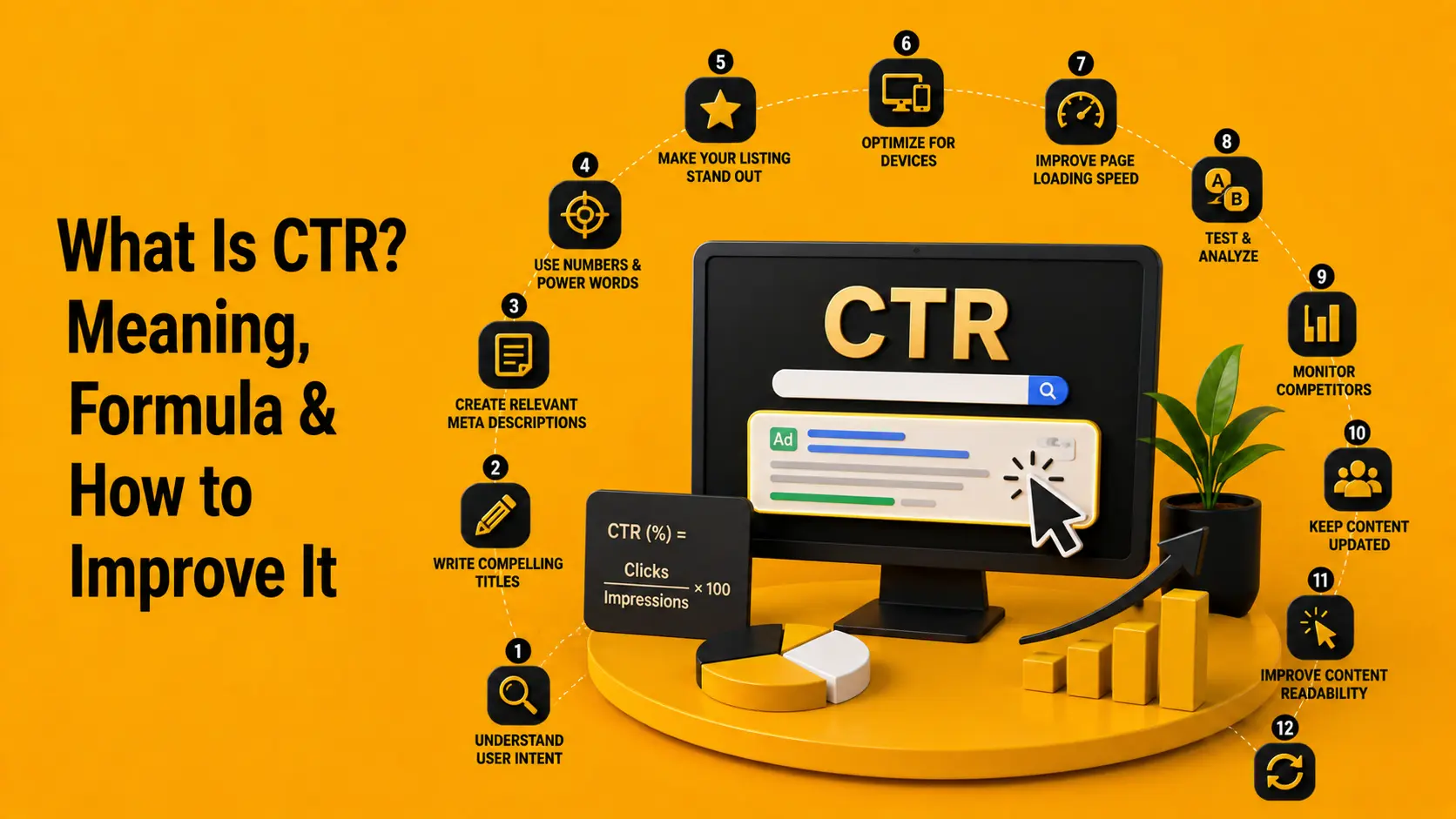
Optimize for Click-Through Rate (CTR)
Ranking does not automatically mean clicks. Your search listing needs to be unique.
Increase your CTR with:
Strong Title Tags
Bad – SEO Guide
Good – Technical SEO Checklist: 25 Fixes That Will Improve Your Rankings
Compelling Meta Descriptions
Highlight the benefits. Not keyword stuffing.
Emotional Triggers
Samples:
- Proven
- Step-by-Step
- Complete
- Data-Backed
- Beginner-Friendly
Higher CTR usually translates to more organic traffic, even when your ranking stays the same. This is free traffic. Everybody loves free traffic.
Build an Email Traffic Flywheel
Most companies spend countless resources trying to attract visitors.
Very few concentrate on retaining them.
Email still represents one of the most profitable marketing methods.
Make:
Lead Magnets
Samples:
- Templates
- Checklists
- Reports in your industry
- Calculators
Email Sequences
Engage your subscribers with:
- Educational materials
- Case studies
- Product updates
- Offer
Newsletter Delivery
Each piece of content needs to be delivered to your subscribers.
This way, you get instant traffic signals.
And unlike social media, where your audience could vanish overnight because of some algorithm change, your subscribers are still yours.
Use Analytics Like a Growth Marketer
You can’t fix what you can’t measure.
Measure:
Traffic Metrics
- Sessions
- Visits
- Referral traffic sources
- Engagement rate
SEO Metrics
- Ranking
- Impressions
- Click-through rates
- Indexed pages
Conversion Metrics
- Leads
- Revenue
- Cost per acquisition
- Customer lifetime value
Behavioral Metrics
- Heatmap
- Scroll Depth
- Session Recordings
Software such as GA4, Search Console, Microsoft Clarity, and Looker Studio offer data points to discover growth.
Data must drive your decisions. Not gut feeling.
The Traffic Strategy Most Businesses Should Follow in 2026
Here is how to get started:
Phase 1: Foundation
- SEO audit
- Analytics
- Conversion tracking
- Optimization for speed
Phase 2: Organic Growth
- Keyword research
- Topic clusters
- Creating content
- Internal linking
Phase 3: Authority Building
- Digital PR
- Link building
- Collaboration within the industry
Phase 4: Distribution
- Promotion on LinkedIn
- Email marketing
- Video content
Phase 5: Acceleration
- Paid search
- Retargeting
- Conversion optimization
Most businesses skip straight to Phase 5.
It explains why their advertising budget gets depleted quicker than the office donuts at work on a Monday morning.
Conclusion
Learning how to drive traffic to your website isn’t about finding a secret hack. It is about developing multiple traffic sources that play together.
The fastest-growing websites are leveraging technical SEO, high-intent content, AI Overview optimization, digital PR, social distribution, e-mail marketing, and paid acquisition
Every tactic supports the other tactics. Traffic becomes consistent. Lead generation becomes scalable. Growth no longer relies on chance. Those who win in 2026 will not be looking for hacks. They will be building systems.
If you want to have consistent website traffic, begin with search intent, develop high-value content, optimize for AI searches, and distribute aggressively. Because on the internet, it pays to get visibility. But consistency is more valuable.