Getting an ad in front of someone isn’t the hard part. Getting the right person to click, land on your website, trust your business, and take action? That’s where your money is either doing its job or quietly disappearing.
For businesses in the US, where competitors are bidding on the same keywords and customers have plenty of options, a few poorly managed campaigns can get expensive fast. Let’s look at what paid search actually involves, where businesses tend to lose money, and what you should expect from a campaign that claims to deliver results.
Key Takeaways
- Paid search marketing puts your business in front of people actively searching for your products or services.
- Smart keyword targeting, relevant ad copy, and landing pages help cut wasted ad spend.
- Track CPC, conversion rate, CPA, and ROAS to see whether your campaigns are actually paying off.
- The right paid search marketing agency can improve campaign performance, generate qualified leads, and make your ad budget work harder.
What Is Paid Search Marketing?
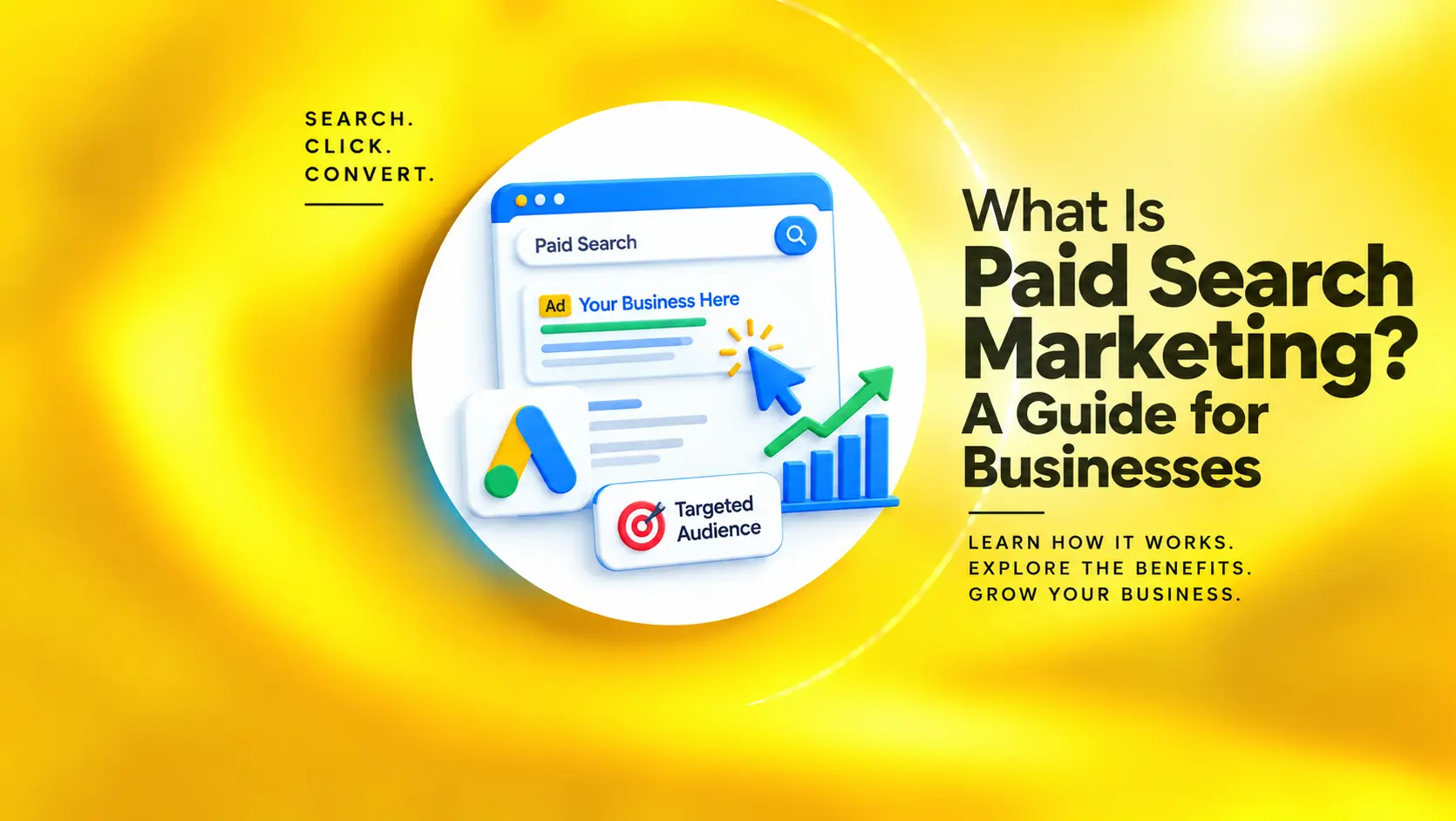
Paid search marketing is when a business pays to display ads on search engine results pages (SERPs). These ads usually appear when someone searches for a particular product, service, or solution.
Say someone in Dallas searches for “emergency AC repair near me” in the middle of a Texas summer. They’re probably not interested in reading a 2,000-word article about how air conditioning works. They need a technician, and they need one soon.
A well-targeted search ad can put your HVAC business in front of that person right when they’re looking for help. That’s the appeal of paid search advertising.
Businesses commonly use platforms such as:
- Google Ads: For reaching people searching on Google and its advertising network.
- Microsoft Advertising: For accessing Microsoft’s search audience, including Bing.
- Amazon Ads: For retailers looking to reach shoppers searching for products on Amazon.
Paid search generally operates on a pay-per-click (PPC) model, meaning advertisers pay when someone clicks an ad. PPC is a broader category, though, and also includes advertising outside search engines.
One important thing to remember: paying for a click doesn’t mean you’re paying for a customer. Those are two very different things.
Why Are Businesses Spending Money on Paid Search?
Because waiting for customers to find you organically isn’t always an option.
A new business might need leads before its SEO strategy gains traction. An established company might be entering a new city. An online store might want to promote a product while demand is high. Paid search can help in all three situations.
But there’s a catch. Competition can make clicks expensive, and not every visitor is worth the same amount.
According to WordStream’s 2026 Google Ads benchmarks, which analyzed more than 13,000 US search advertising campaigns across 23 industries, the average cost per click was $5.42, while the average conversion rate was 8.18%.
Those figures are industry-wide benchmarks, not a promise of what your campaign will achieve. A law firm competing for valuable legal keywords could face very different costs from a local bakery promoting custom cakes.
Still, the takeaway is worth paying attention to. When clicks cost real money, sending the wrong people to your website isn’t a minor inconvenience. It can become a budget problem.
Paid search can help your business:
- Reach people actively searching for your products or services.
- Generate leads while your organic visibility develops.
- Target customers in specific US cities, states, or service areas.
- Test offers and advertising messages without waiting months for organic traffic.
- Find valuable search terms that can inform your SEO and content strategy.
The goal isn’t to get the biggest number of clicks. It’s to attract visitors who have a reasonable chance of becoming customers.
How Does Paid Search Marketing Work?
Every search triggers an ad auction when eligible advertisers are competing for placement. But the highest bidder doesn’t automatically win the top spot.
Google considers factors including bids, ad quality, the search context, competition, and the expected impact of ad assets. Its official Ad Rank documentation explains how these factors affect ad placement.
So, what does this mean when you’re actually running a campaign?
- Find Keywords People Use When They’re Ready to Act
Keyword research isn’t just about finding phrases with high search volume. It’s about figuring out what someone wants when they type those words.
Take a commercial cleaning company in Chicago.
Someone searching for “how to clean office carpets” might be looking for a DIY solution. Someone searching for “commercial office cleaning services Chicago” is much closer to contacting a provider.
The second search is likely to have stronger commercial intent.
That doesn’t mean informational searches are worthless. It means you shouldn’t treat every search as if the person is ready to buy.
Use broad, phrase, and exact match strategically. Then check your search terms report to see what people actually typed before clicking your ads.
- Write Ads That Give People a Reason to Choose You
“High-Quality Services. Affordable Prices. Contact Us Today.” You’ve probably seen some version of that ad a thousand times. It tells the reader almost nothing.
Try being more specific.
- Commercial Cleaning Services in Chicago
- Flexible cleaning schedules for offices
- Customized service plans
- Request a free cleaning estimate
Use the details that genuinely distinguish your business. If you offer same-day appointments, say so when relevant. If you serve only certain areas, make that clear.
Your ad copy should also match the keyword and landing page. Someone searching for commercial cleaning shouldn’t click an ad and end up on a page about residential housekeeping.
It sounds obvious. Yet message mismatches happen all the time.
- Stop Sending Every Click to Your Homepage
Your homepage has a job. It introduces your business and helps visitors explore what you offer.
A landing page has a more immediate job: persuade a specific visitor to take a specific action.
If you’re advertising “commercial roofing contractors in Phoenix,” send people to a page about commercial roofing. Show the services you provide, the areas you cover, relevant project experience, and a clear way to request a quote.
Keep the contact form sensible, too. Asking for a name, email, phone number, company, project budget, business address, and the name of the visitor’s first pet might be a little much for an initial inquiry.
Make the page mobile-friendly, load it quickly, and remove anything that distracts from the next step. Your ad got the person there. Don’t make the website give them a reason to leave.
Paid Search vs. SEO: Do You Need Both?
Paid search and SEO often get treated like competing strategies. In reality, they can work together quite nicely.
| Factor | Paid Search | SEO |
| Visibility | Can start after ads are approved and launched | Usually builds over time |
| Main costs | Advertising spend and campaign management | Content, technical improvements, and ongoing optimization |
| Traffic | Depends on budget, competition, and search demand | Depends on rankings, search demand, and click-through rates |
| Control | More direct control over bids, targeting, and ad messaging | Less direct control over rankings |
| Best use | Capturing existing demand and testing offers | Building sustainable organic visibility |
Imagine you’re launching a new service in the US. Your website has barely started ranking, but potential customers are already searching for what you offer.
Paid search can help you get in front of those people while your SEO work progresses. Meanwhile, the search terms and conversion data from your campaigns can show you which topics and services deserve more attention in your organic strategy.
There’s no need to turn this into an either-or decision. The right balance depends on your budget, competition, and how quickly you need results.
Which Paid Search Metrics Actually Matter?
Let’s talk about the numbers, because this is where a campaign can look successful without actually being successful.
A report showing 20,000 impressions and 1,500 clicks might look impressive. But if those clicks don’t lead to meaningful actions, what exactly are you celebrating?
Here are the metrics worth watching.
Click-through rate (CTR): The percentage of ad impressions that result in clicks. If CTR is low, your ad might not match the search intent, or your messaging may need work.
Cost per click (CPC): The average amount you pay for each click. Lower isn’t automatically better if cheaper clicks bring visitors who never convert.
Conversion rate: The percentage of measured interactions that result in a desired action, such as a purchase, qualified lead, or booked appointment.
Cost per acquisition (CPA): How much you spend to generate a conversion. Make sure you’re measuring something valuable. A paying customer and someone who downloads a free checklist shouldn’t automatically count as equivalent acquisitions.
Return on ad spend (ROAS): The revenue attributed to your ads divided by advertising spend. A 4:1 ROAS means $4 in attributed revenue for every $1 spent on ads. It doesn’t mean you’ve made $3 in profit.
That last distinction matters. You still have product costs, salaries, fulfillment, agency fees, and other expenses to account for.
For tracking, configure Google Ads conversion tracking and Google Analytics 4 where appropriate. If you’re running lead generation campaigns, connect your forms and phone calls to your CRM whenever possible. This helps you see which campaigns generate qualified opportunities and which ones produce leads that go nowhere.
Otherwise, you might spend another month optimizing for the wrong result. Nobody needs that kind of surprise in their monthly report.
When Does Hiring a Paid Search Marketing Agency Make Sense?
Managing your own campaigns isn’t necessarily a bad idea. If you have the right expertise, time, and resources, an in-house team can handle paid search effectively.
The trouble starts when campaigns grow more complicated and nobody has enough time to look beyond the surface-level numbers.
Maybe your ad spend keeps increasing, but qualified leads aren’t following. Perhaps you’re getting clicks from irrelevant searches, or your tracking setup counts the same conversion twice. You might even have several campaigns competing for similar keywords without a clear reason.
That’s when paid search management services can be useful.
A good paid search marketing agency should help with keyword research, campaign structure, negative keywords, bidding strategies, ad testing, conversion tracking, and ongoing performance analysis. Depending on your needs, it may also recommend landing page changes and work with your sales team to understand lead quality.
Before hiring anyone, ask a few direct questions:
- Who owns the Google Ads account and campaign data?
- How do you decide which keywords deserve more budget?
- How do you track qualified leads and actual sales?
- How frequently do you review search terms and add negative keywords?
- What are your management fees, separate from advertising spend?
- How will you report results against our business goals?
Pay attention to how the agency answers. You should be able to understand what it’s doing and why, even if the technical details aren’t your specialty.
And be careful with guarantees. An agency can’t promise a specific ranking, lead volume, or return on ad spend without knowing the circumstances, and even then, market conditions and customer behavior remain outside its control.
Ready to Get More From Your Advertising Budget?
Paid search advertising can put your business in front of people who are already looking for what you sell. But clicks alone won’t keep the lights on.
If your campaigns are generating plenty of traffic without enough qualified leads or sales, it’s worth taking a closer look at your keyword strategy, landing pages, tracking, and overall campaign performance.
At Xparro, we believe advertising budgets deserve more than a campaign launch and a monthly report full of green arrows. So talk to Xparro about paid search marketing services built around your business goals. Let’s figure out where your advertising budget is working, where it’s leaking, and what deserves attention next.
FAQs
What is paid search marketing in simple terms?
It’s a way to pay for ads that appear when people search for relevant products or services. Advertisers commonly pay when someone clicks an ad, rather than simply because the ad appeared.
How much does paid search advertising cost in the US?
It depends on the industry, keyword, location, competition, and campaign setup. WordStream’s 2026 benchmarks reported an average Google Ads CPC of $5.42 across its analyzed campaigns. Your actual costs could be much lower or considerably higher.
How long does paid search take to produce results?
Ads can start appearing after approval and launch, but figuring out whether a campaign is profitable takes longer. You’ll need enough reliable conversion data to evaluate performance and make sensible adjustments.