Your website might be competing against… itself. You invested months of effort writing SEO content. You chose important keywords and even created backlinks. You did everything right, but still, your ranking is not improving.
One post ranks this week. Another one takes its place the next week. None makes it into the top three. Does that sound familiar? There could be many reasons behind it, and it might not be Google’s algorithm.
It might be SEO keyword cannibalization.
There are thousands of websites out there creating several pages for the same keyword intent. That doesn’t boost their SEO authority; rather, it dilutes it. Google finds it hard to determine which page deserves a higher ranking, backlinks lose their effectiveness, click-through rate falls, and organic traffic stops flowing.
The worst thing is that most businesses have no idea it’s happening. If you’ve written a lot of content in the past months or even years, chances are you’ve already encountered this problem.
Let’s solve it then.
What Is Keyword Cannibalization in SEO?
If you’ve ever wondered what keyword cannibalization is in SEO, here’s the simplest explanation.
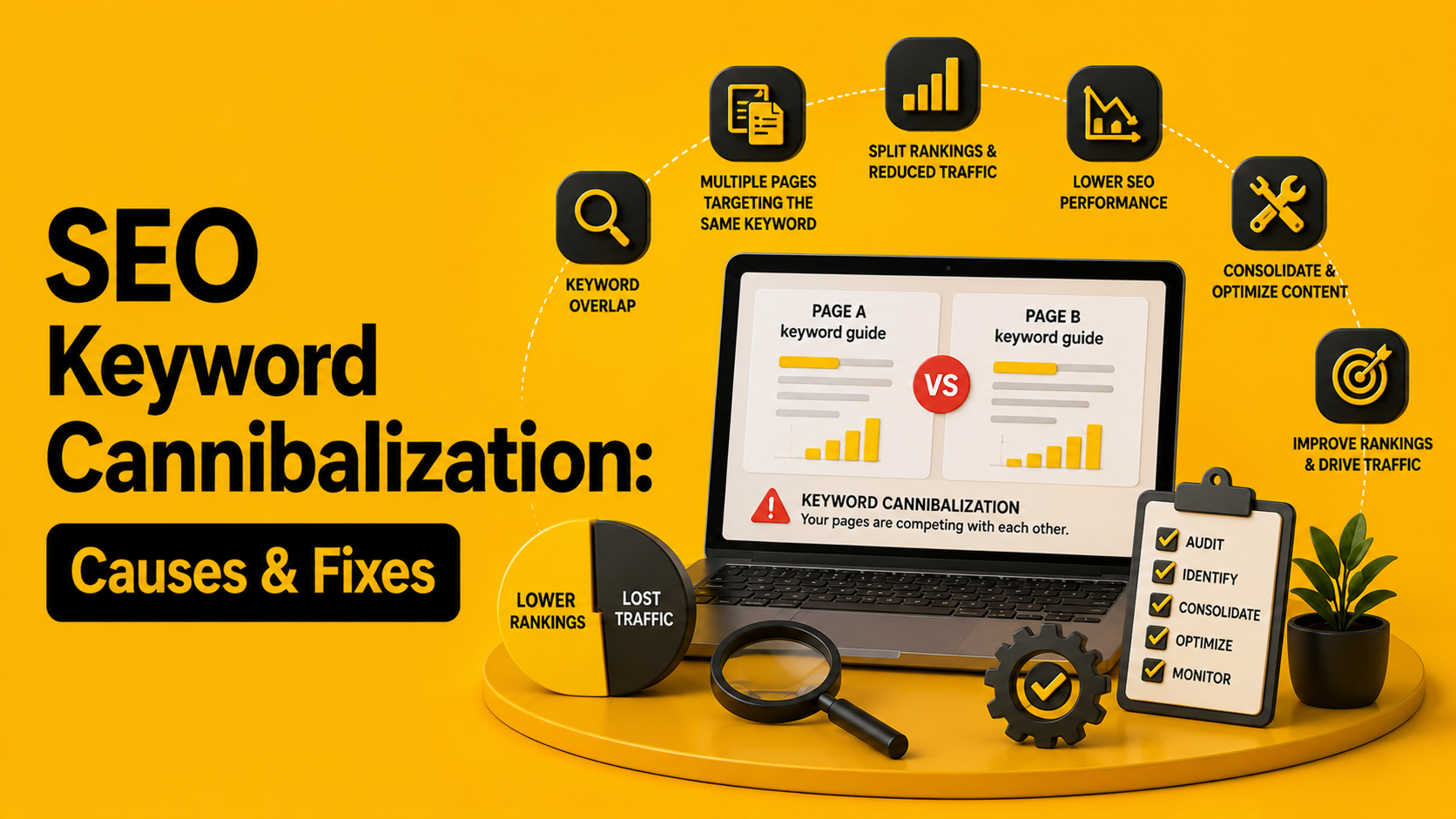
When you are creating more than one web page on the same website targeting the same keyword or search intent, you will face the problem of keyword cannibalization.
Instead of providing Google with one option, you are giving them several.
Google will have to choose:
- Which page is more relevant?
- Which page deserves backlinks?
- Which page should appear in search results?
As a result, it starts alternating between these pages or ranks them poorly.
Think about sending three athletes from the same team in the qualifying round in the sport where only one can qualify.
It is not going to increase your chances, but, on the contrary, will make your runners lose points to each other. That’s exactly what keyword cannibalization does.
Consider an example of a digital marketing agency that has been publishing these blogs for over two years.
- Complete SEO Guide
- SEO for Beginners
- SEO Basics
- Learn SEO
- Beginner’s Guide to SEO
All articles target:
- SEO guide
- learn SEO
- SEO basics
- beginner SEO
Content similarity reaches 80%. Thus, Google does not understand which of them is worth ranking on Page One.
Because of that, one powerful page ranked #2. You now have five average pages ranking between #28 and #60. Nobody wins.
Why Keyword Cannibalization Happens
Most websites do not create duplicate content on purpose. This is a consequence when content grows.
Reasons may vary:
Publishing Without a Keyword Strategy
Some businesses assign topics to individual writers without creating a keyword map.
A few months later, another writer uses the same keyword without realizing that someone else is doing the same thing.
Creating Content for Every Tiny Variation
Individuals tend to consider these variations as unique topics:
- Best CRM software
- CRM software comparison
- Top CRM platforms
For Google, these keywords mean the same intent.
Updating Old Content With New Articles
Marketers publish another blog instead of optimizing an old one.
Now there are two pages that compete.
Location-Based Duplication
There are many businesses that publish dozens of identical pages:
- SEO Services Texas
- SEO Services Houston
- SEO Services Dallas
Google will be challenged if the content is barely different.
Poor Internal Communication
SEO agencies, marketing departments, freelancers, and content writers all create content independently.
Without documentation, duplication becomes inevitable.
How Does Keyword Cannibalization Affect SEO?
A lot of people wonder, what is the effect of keyword cannibalization on SEO? It is much deeper than rankings.
- Google Gets Confused
Search engines always seek one single answer.
When several webpages meet the intent equally well, Google is confused. Instead of giving credit for authority, it begins by checking other websites.
As a result, there is fluctuation.
- Link Equity Gets Split
Consider the following example:
Page A gets 25 links. Page B gets 18 links. Page C gets 12 links.
None of these webpages will become authoritative individually; however, if all 55 links were pointed at one single webpage. There is a good chance that the page would rule.
Link equity dilution is one of the most serious indirect costs associated with keyword cannibalization.
- Lower Click-Through Rates
Google keeps alternating the pages from time to time.
So, users will see various titles, various meta descriptions, and various URLs. As a result, CTR is reduced.
- Crawl Budget Gets Wasted
There is a limited amount of crawl budget from Google.
If there are several pages that are similar, then crawlers waste time crawling the same information rather than finding new, valuable pages.
Large e-commerce sites tend to experience reduced efficiency when using duplicate keyword targeting.
- Rankings Become Unstable
Ever seen rankings like this?
Monday → Position 9
Wednesday → Position 23
Friday → Position 15
Sunday → Position 31
That may indicate cannibalization. Google continues to experiment with various pages.
- Conversions Drop
Not all of the competing pages convert the same way.
Sometimes Google shows:
- an outdated blog
- a thin article
- an informational guide
instead of your highly optimized service page. Traffic comes, but conversions don’t.
Signs Your Website Has SEO Keyword Cannibalization
There are several warning signs that appear before rankings collapse.
Multiple URLs Ranking for One Keyword
Type in Google:
site:yourdomain.com “keyword”
When you see several relevant pages, it’s time to dig deeper.
Google Keeps Swapping URLs
In Google Search Console, the same keyword begins to show various landing pages. It’s usually not a coincidence.
Rankings Plateau
Even after creating backlinks, enhancing content, and gaining authority, your ranking still doesn’t change.
Organic Traffic Is Spread Across Similar Pages
Traffic Generated Organically is Distributed Among Similar Web Pages
Not one page = 20,000 visits, but five pages = 4,000 visits per page.
Overall, traffic is satisfactory. Authority of individual pages declines.
How to Identify Keyword Cannibalization
A professional SEO team uses multiple ways.
Google Search Console
Consider these elements:
- Queries
- Landing Pages
- Average Position
When one keyword redirects impressions to several pages, investigate further.
Ahrefs
Use Organic Keywords reports. Filter the keyword. Check how many pages are ranked for the keyword.
Semrush
The Position Tracking Cannibalization Report automatically recognizes URLs competing for the same positions.
This method is among the fastest.
Screaming Frog
Export the following:
- Titles
- H1 Tag
- URLs
- Number of Words
The keyword cannibalism will be detected immediately.
Manual Keyword Mapping
Make a table with the following columns:
| URL | Primary Keyword | Search Intent | Status |
| /seo-guide | SEO Guide | Informational | Ok |
| /seo-basics | SEO Guide | Duplicate | Merge |
| /learn-seo | SEO Guide | Duplicate | Redirect |
Big agencies always have keyword maps before creating content.
How to Fix Keyword Cannibalization in SEO
So let’s solve the problem that everyone wants solved: How to solve keyword cannibalization in SEO?
Merge Similar Content
Imagine you have:
- SEO Guide
- Beginner SEO
- SEO Tutorial
And merge them into one single page. Then, do a redirection of the weaker pages. And it would lead to instant improvement in rankings.
Use 301 Redirects
If a duplicate page holds no unique content, make it redirect permanently. The 301 redirects pass all the link equity to the main page.
Canonical Tags
In case there is a need for having several pages…
Like, for instance:
- Options for printing in colors
- Various product types
Utilize canonical tags to show your preference.
Differentiate Search Intent
Two similar keywords are not necessarily looking for the same thing.
Example:
SEO pricing vs SEO services
One is geared towards research. The other is geared towards purchase. Use the content differently.
Enhance Internal Links
Make sure that your internal links always go back to the same page. Do not use similar anchor text on competing pages.
Internal linking can help Google find the topic relevance.
Rewrite Overlapping Sections
In some cases, the common content only makes up 40%.
Revise:
- Headers
- Examples
- FAQs
- Target Audience
- Use Cases
Ensure the topical uniqueness of your content.
Consolidate Thin Content
Instead of 15 blogs of 700 words, consider three resources over 3,000 words.
How to Avoid Keyword Cannibalization SEO Problems
Figuring out how to avoid keyword cannibalization SEO problems will be much easier than solving them.
Build a Keyword Map
Use:
One keyword, one URL, one intent, always check the map before publishing.
Research Existing Content First
Do not start writing anything until you search your website.
You may find an article about it. Make changes to it.
Focus on Search Intent
Keywords can be similar, but intent is different.
Ask:
What does the user want to do?
- Learn something?
- Compare?
- Buy?
- Hire?
- Download?
The intent defines whether the page should be created or not.
Create Topic Clusters
Create not a bunch of isolated blogs, but rather create pillar pages with cluster articles.
For example:
- Pillar
- SEO guide
Supporting Content
- Technical SEO
- Local SEO
- On-page SEO
- Schema markup
- Link building
Each page serves a unique purpose.
Perform Quarterly SEO Audits
Check:
- Rankings
- Duplicate topics
- Outdated blogs
- Thin content
- Internal links
Keyword cannibalization problems usually develop over time.
Keyword Cannibalization vs Duplicate Content
These concepts are frequently misunderstood.
Yet they’re separate.
| Keyword Cannibalization | Duplicate Content |
| Multiple pages rank for the same keyword | Content is the same on multiple pages |
| Can have unique content | Often has the exact content |
| Affects rankings | Causes indexing issues |
| Resolved by strategy | Resolved by canonicals/redirects |
One can exist without the other.
It’s possible to have keyword cannibalization without duplicate content and duplicate content without keyword cannibalization.
Does Google Penalize Keyword Cannibalization?
No. Google doesn’t manually penalize keyword cannibalization. What it does is, it has trouble figuring out which page is the best.
which results in:
- Ranking fluctuations
- Lowered authority
- Weakened backlinks
- Decreased exposure
Effectively a penalty without actually being one.
A Simple Framework Used by SEO Agencies
Professional SEO agencies normally do this:
Step 1
Find competing URLs.
↓
Step 2
Determine search intent.
↓
Step 3
Choose one primary page.
↓
Step 4
Combine or redirect weaker pages.
↓
Step 5
Update internal links.
↓
Step 6
Refresh content.
↓
Step 7
Monitor 6-8 weeks ranking.
This process does not cause any trouble to your website’s authority.
Common Mistakes Businesses Make
Even the most experienced marketers make these mistakes:
- Publishing a new blog post rather than revising an old one.
- Trying to target all keyword variations on a new page.
- Ignoring search intent due to differences in keywords.
- Allowing different teams to develop similar content.
- Failing to change internal links in case of page redirections.
- Developing city pages with the same content.
- Focusing on content volume and not on its results.
Not making such mistakes may save you from months of SEO problems.
Final Thoughts
SEO keyword cannibalization is one of the biggest overlooked reasons why sites fail to achieve their potential rankings.
It is not usually a result of bad quality content; rather, it is a consequence of an excessive amount of similar content fighting for the same chance.
The cure does not include writing more articles but organizing, consolidating, and optimizing content.
Knowing what keyword cannibalization is in SEO, being aware of how keyword cannibalization affects SEO, and applying methods on how to fix keyword cannibalization in SEO and how to avoid keyword cannibalization SEO problems, will provide a signal to search engines about which of the webpages should be ranked.
For companies trying to rank in competitive U.S. search engine results, this will make the difference between page three and page one.
At Xparro, we focus on creating SEO through content architecture and not only keyword optimization. Each page is created with a certain goal, identified search intent, and has a place in the bigger topical context. This is how successful rankings and organic growth are made.