You can get 10,000 ad impressions and still wonder, “Why is nobody clicking?” That’s where CTR comes in.
CTR, or click-through rate, tells you what percentage of people who saw your ad actually clicked it. It’s one of the quickest ways to judge whether your ad, keyword targeting, and audience are working together, or simply taking up space on the SERP.
But there’s a catch: a “good” CTR isn’t one universal number.
A 3% CTR might be disappointing for one campaign and excellent for another.
So, what is CTR, how do you calculate it, and what should your business actually aim for? Let’s break it down.
Key Takeaways
- CTR measures ad engagement: The CTR formula is (Clicks ÷ Impressions) × 100, showing how often people click after seeing your ad.
- There’s no universal “good CTR”: A strong CTR depends on your industry, advertising channel, keywords, audience, and search intent.
- Search and display CTRs are different: Search ads typically have higher CTRs because users already have intent, while display ads reach people who may not be actively searching.
- Don’t optimize for clicks alone: A high CTR means little if those clicks don’t generate conversions, qualified leads, revenue, or a strong ROAS.
What Is CTR?
CTR stands for Click-through rate. This is the ratio of impressions to clicks, which means when your Google ad is seen 1,000 times and 50 people clicked on it, the CTR will be 5%.
As per Google, CTR is the number of clicks made against the number of times the ad appears. It uses CTR to help advertisers understand how relevant and appealing their ads are to users.
CTR is applied in many areas of digital marketing like:
- Google search ads
- Google display ads
- Social media ads
- Email marketing campaigns
- Organic search engine listings
- Other online campaigns
The important thing to note here is what is being measured. A search ad and a display banner have completely different jobs, so comparing their CTRs directly is like comparing a pickup truck to a bicycle because both have wheels.
CTR Formula: How to Calculate Click-Through Rate
The CTR formula is straightforward:
CTR = (Clicks ÷ Impressions) × 100
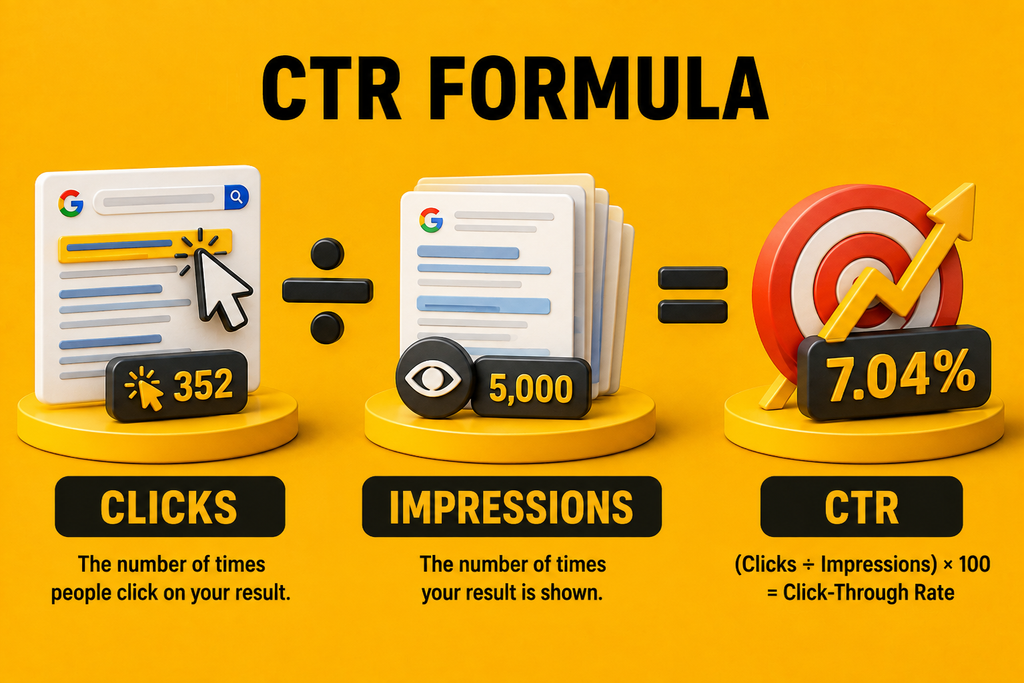
For example:
Your ad receives:
200 clicks
5,000 impressions
Your CTR would be:
(200 ÷ 5,000) × 100 = 4%
So, your CTR is 4%.
Google uses the same basic calculation for advertising CTR.
You usually won’t need to calculate it manually. Platforms such as Google Ads automatically report CTR for campaigns, ad groups, keywords, and individual ads.
Why impressions matter
An impression simply means your ad was shown. A click means someone interacted with it. CTR connects those two numbers and gives you a percentage that answers a useful question:
“Of the people who saw this, how many were interested enough to click?”
That makes CTR particularly useful when you’re diagnosing ad performance.
Why Does CTR Matter?
CTR gives you an early signal about whether your advertising message matches what people are looking for.
A low CTR may point out issues with:
- Keyword targeting
- User intention
- Ad message
- Headline
- Offers
- Audience targeting
- Ad placement
- Customer expectation
For instance, say you offer emergency plumbing services, targeting the keyword “24-hour plumber near me.”
An ad that says:
“Professional Plumbing Services | Find Out More”
Surely is not urgent enough.
Compare that with:
“24/7 Emergency Plumber | Same-Day Service | Call Now”
The second ad directly addresses the user’s likely intent. That’s the point of CTR optimization: not getting random clicks, but getting the right people to click.
Google also notes that CTR can contribute to expected CTR, which is one component of Ad Rank. More relevant keywords and ads can therefore play an important role in paid-search performance.
What Is a Good CTR?
Here comes the answer marketers love to hate:
It depends.
There isn’t one industry standard click-through rate that works for every business, keyword, audience, and advertising network.
A branded search campaign might generate a very high CTR because the user already knows the company. A broad, non-branded keyword can naturally have a much lower CTR. The advertising format matters, too.
For example, people searching Google for “best HVAC company near me” already have a reason to click.
Someone reading an article and casually seeing a banner for an HVAC company? Different situation entirely.
That’s why search CTR and display advertising rates should be evaluated separately.
Average CTR for Google Search Ads
Current benchmark data gives you a useful starting point.
WordStream’s 2026 PPC benchmarks analyzed more than 13,000 U.S.-based campaigns running from April 2025 through March 2026. Across industries, the average Google Ads search CTR was 6.64%.
That means roughly 6 to 7 clicks for every 100 impressions, on average. But industry differences are significant.
Some 2026 search CTR benchmarks include:
| Industry | Average Search CTR |
| Arts & Entertainment | 13.10% |
| Sports & Recreation | 9.19% |
| Shopping, Collectibles & Gifts | 8.92% |
| Real Estate | 8.43% |
| Finance & Insurance | 8.33% |
| Travel | 8.73% |
| Health & Fitness | 7.18% |
| Business Services | 5.65% |
| Legal Services | 5.97% |
| Dental Services | 5.44% |
These figures come from WordStream’s 2025 benchmark dataset, while its newer 2026 report puts the overall search average at 6.64%.
So if you’re running a legal campaign with a 6% CTR, that’s a very different story from a campaign in an industry where 9% or 10% is common.
Your industry benchmark is more useful than a random “good CTR” number you found on Google.
What About Display Advertising Rates?
Display ads are a completely different animal.
Unlike search advertising, display advertising typically reaches people while they’re browsing websites, reading content, watching videos, or using apps. They may not be actively looking for what you’re selling.
That’s why display CTRs are usually much lower.
Older industry benchmarks cited by WebFX put average CTR at 0.46% for display advertising and 3.17% for search advertising. WebFX’s industry table also shows display CTR varying considerably by sector, for example, around 1.08% for real estate and 0.39% for technology.
The lesson isn’t that display advertising is “bad.”
It’s that display ads have a different objective and user context. Search ads capture existing intent. Display ads often create or reinforce awareness before someone has decided to search. So don’t look at a 0.5% display CTR and panic. Look at what happened after the click, too.
Is a Higher CTR Always Better?
No.
And this is where CTR gets misunderstood. A high CTR can be great, but only if those clicks are valuable. Imagine two campaigns.
Campaign A
100,000 impressions
8,000 clicks
8% CTR
0.5% conversion rate
Campaign B
100,000 impressions
4,000 clicks
4% CTR
5% conversion rate
Campaign A looks fantastic if you’re staring only at CTR. But Campaign B generates far more conversions.
That’s why you should evaluate CTR alongside metrics such as:
- Conversion rate
- Cost per click (CPC)
- Cost per acquisition (CPA)
- Return on ad spend (ROAS)
- Revenue
- Lead quality
A campaign can have a spectacular CTR and still be terrible for your business if the clicks don’t turn into customers.
In fact, WebFX notes that a higher CTR is valuable when it also supports stronger conversion performance.
What Can Cause a Low CTR?
If your CTR is below your industry benchmark, don’t immediately rewrite everything.
Start with the basics.
- Your keywords don’t match intent
Someone searching “buy running shoes online” has commercial intent. Someone searching “how to clean running shoes” probably isn’t ready to buy.
If your ad targets both with the same message, your CTR and eventually your conversion rate can suffer.
- Your ad copy is generic
“High-Quality Products. Great Service. Shop Now.” Congratulations. You sound like approximately 47,000 other advertisers.
Instead, highlight something specific:
- Free shipping
- Same-day service
- Pricing
- Discounts
- Location
- Warranty
- Availability
- A clear differentiator
- Your offer isn’t competitive
Sometimes the copy isn’t the problem.
If competitors advertise “Free Consultation” and you’re offering “Contact Us for More Information,” the problem isn’t exactly mysterious.
- You’re targeting the wrong audience
A perfectly written ad shown to the wrong audience will still flop.
Review your location targeting, demographics, audiences, keyword match types, and search terms.
- Your ad doesn’t match the landing page
CTR gets people through the door. Your landing page needs to convince them they walked into the right building.
If the ad promises “$99 Emergency Plumbing,” but the landing page says nothing about $99 pricing, users are likely to bounce.
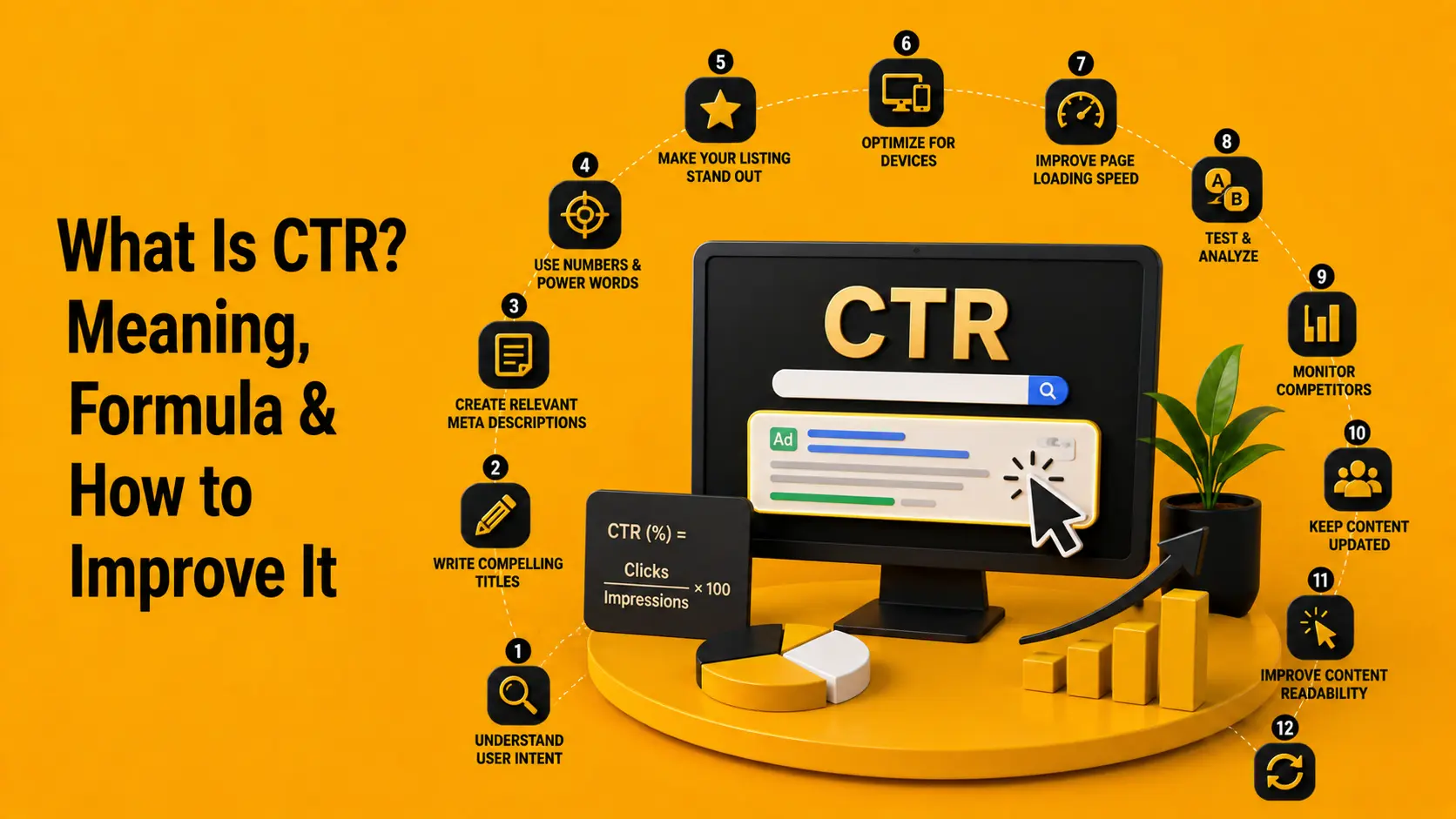
How to Improve CTR
Improving CTR isn’t about stuffing more keywords into your headline and hoping Google rewards you with a parade.
Focus on relevance.
Use the exact language your audience searches
Review your search-term data and identify phrases that consistently generate clicks and conversions.
Then use those insights in your headlines and descriptions.
Match the ad to search intent
Separate campaigns or ad groups based on meaningful intent differences.
Someone searching “commercial insurance quote” should see a different message from someone searching “what is commercial insurance.”
Test your headlines
Run multiple variations.
Test:
- Benefit-focused headlines
- Price-focused headlines
- Location-specific headlines
- Problem/solution messaging
- Strong calls to action
- Specific offers
Don’t decide the winner after two days and 37 impressions. Give the data enough time to become useful.
Improve your targeting
CTR often improves when your ads are shown to people who actually have a reason to care.
Google itself recommends strong keyword and ad relevance as a way to improve clicks and CTR.
Watch CTR with conversion data
This is the big one.
If CTR rises but conversions fall, you may have optimized for curiosity instead of intent.
That’s not a victory. That’s a more efficient way to attract the wrong people.
What Is a Good CTR for My Industry?
Use this three-step approach:
- Find your channel benchmark.
Search and display advertising have different CTR expectations.
- Compare against your industry.
A 3% CTR isn’t automatically good or bad. Compare it with businesses competing for similar audiences and keywords.
- Compare against your own historical performance.
If your CTR was 3.5% last quarter and is now 5.2% while conversion rate and CPA are also improving, that’s meaningful progress, even if another website says “good CTR” starts at 6%.
Benchmarks provide context. Your own performance data provides the verdict.
The Bottom Line
CTR is useful. But at the end of the day, it’s just one number.
You don’t need thousands of people clicking your ads if none of them is actually interested in what you sell. What you really want are the right clicks, the ones that turn into leads, sales, and real business. That’s where Xparro can help.
We look beyond the CTR and dig into what’s actually driving results, from targeting the right audience and tightening your ad copy to improving keyword relevance and making sure your landing page delivers what the ad promised.
Because getting people to click is only half the job. Getting them to stay, convert, and come back? That’s the part that matters.
Frequently Asked Questions
What is a good CTR?
There is no specific number that you can refer to. What constitutes a good CTR largely depends on your industry, the platform where you run ads, your campaign type, your ad targeting and the intent behind the users’ search.
What is the average CTR for Google Search ads?
The average Google Search Ads CTR according to the current 2026 benchmark by WordStream is 6.64%. However, the industry varies widely, and therefore you should take this average as an overall benchmark without trying to hit it like a nail on the head.
Is a higher CTR always better?
No. A high CTR will only be beneficial to you in case the clicks you receive are relevant to your campaigns and are helping you generate sales or leads.
What is a good CTR for my industry?
You first have to find out the benchmark of your industry, and then you can measure it against your own past results. The benchmarks differ greatly by industry; for example, search CTR benchmarks currently stand at around 5% for some industries, while others reach up to 13% in the Arts & Entertainment industry.