You’ve got the keywords, content, and even the technical SEO part… So why isn’t your website getting the visibility you expected?
Sometimes, the missing piece is credibility.
Google wants to surface content that people can actually rely on—not pages that simply happen to mention the right keywords 15 times. That’s where EEAT comes into the picture.
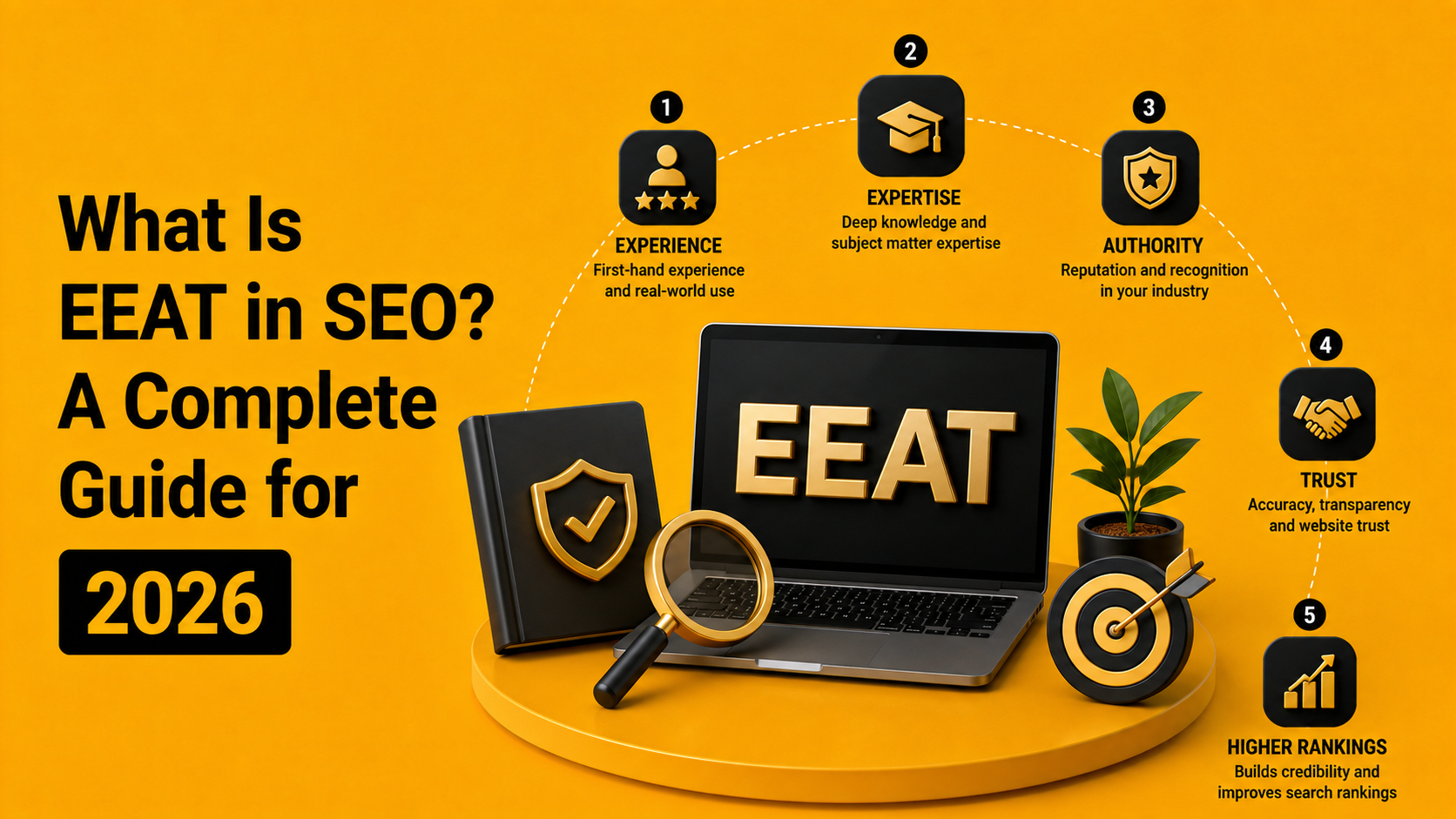
E-E-A-T stands for Experience, Expertise, Authoritativeness, and Trustworthiness. It’s not a rating system used by Google to assign scores to your website. E-E-A-T simply refers to the criteria that Google uses when assessing how useful and reliable content is. According to Google, Trust is the most critical component of all these criteria.
So, what does E-E-A-T actually mean for your SEO strategy? More importantly, what can you do about it? Let’s get into it.
What Is E-E-A-T?
E-E-A-T stands for:
Experience – Have you actually done or experienced what you’re talking about?
Expertise – Do you know the subject?
Authoritativeness – Do other credible people or organizations recognize that knowledge?
Trustworthiness – Can people rely on the information you’re providing?
The framework used to be called E-A-T. Google added the extra E for Experience in December 2022 because firsthand experience can make a huge difference depending on what someone is searching for.
And honestly, it makes sense. Say you’re looking for “best CRM for a small business.” Would you rather read an article that lists 10 CRMs after summarizing their websites?
Or one written by someone who actually tested them, struggled with integrations, compared onboarding times, and can tell you which platform became frustrating after the first month?
The second article has something the first one doesn’t… Experience.
The Four Parts of E-E-A-T
1.Experience: “Have you actually done this?”
Experience is about firsthand knowledge.
This is increasingly important because the internet has no shortage of articles written by people who have never actually used the product, visited the location, run the experiment, or performed the process they’re explaining.
If you’re reviewing software, show what happened when you used it. If you’re writing about SEO, talk about campaigns you’ve actually worked on. If you’re publishing a product comparison, explain how the products were tested.
Screenshots, original photographs, case studies, testing notes, customer experiences, and real results can all help demonstrate experience.
There’s a big difference between “Personalized emails can increase conversions.” and “We tested three subject-line variations across 20,000 subscribers and saw X% more opens with the personalized version.”
The second gives the reader something to work with.
Just make sure the data is real. Making up “firsthand experience” because it sounds good is a spectacularly bad content strategy.
2.Expertise: “Do you actually know your stuff?”
Experience and expertise aren’t quite the same thing.
You can have firsthand experience without being an expert. You can also have deep expertise without personally experiencing every situation you write about.
The level of expertise you need depends on the topic.
A casual restaurant review doesn’t require the same credentials as an article explaining U.S. tax law. A blog about cybersecurity should ideally be written or reviewed by someone who understands cybersecurity beyond what they found in three Google searches.
That’s why author information matters.
Instead of an author bio that says “John is a passionate digital marketing expert who loves helping businesses grow.” Tell readers something useful “John has 10 years of experience in technical SEO and has led organic growth programs for B2B SaaS companies across the U.S.”
Now there’s context.
Readers know where the writer’s knowledge comes from, and the website isn’t asking them to take a stranger’s word for everything.
3.Authoritativeness: “Do other people recognize your expertise?”
This is when the role of reputation comes into play.
It doesn’t matter how much you know about your niche. The key point is whether people outside of your site acknowledge your expertise.
Backlinks can do the trick here, as well as mentioning your site in relevant publications and in expert interviews, writing for respected websites, conducting your own research, and so on.
Don’t confuse “the more backlinks = the more authority.”
If you’re a U.S. cybersecurity company, one relevant mention from a respected technology publication is more meaningful than a pile of random links from websites nobody in your industry cares about.
Authority is built through relevance and reputation, not link-counting gymnastics.
4.Trustworthiness: “Can I actually believe you?”
This is the big one.
Google’s guidance identifies trust as the most important part of E-E-A-T. Experience, expertise, and authority all help establish that trust. And trust isn’t limited to your blog articles.
Look at your website as a customer would. Can they tell who runs the business? Is there a real contact page? Are your claims supported by credible sources? Are your authors identifiable? Is important information current? Do you clearly disclose affiliate relationships or sponsored content? Does the website use HTTPS?
These might sound like small details, but together they answer a very important question:
“Why should I trust this website?”
If your website sells financial services, healthcare products, legal services, or anything else that can significantly affect someone’s life or money, that question becomes even more important.
Why Does E-E-A-T Matter for SEO?
Because Google search doesn’t work the way it used to.
Not everyone is still relying on ten blue links. Google is more and more often providing answers right out of the box using artificial intelligence-based search experience.
According to Pew Research Center’s analysis of 68,879 Google searches conducted in March 2025, 18% of searches contained AI-generated summaries. When such a summary was provided, the user only clicked on the regular search results link 8% of the time, compared to 15% when no AI summary was provided.
A considerable change indeed.
Not only do you want your content to be ranked well, but you also want to be recognized as a credible source of information worthy of citation.
According to Google’s guidelines on succeeding in AI search, the key to success is creating unique and valuable content, not just another page designed for search traffic. In other words, “another article explaining the same thing” probably isn’t going to set your website apart.
How Can You Improve E-E-A-T?
You don’t need to redesign your entire website tomorrow. Start with the pages that matter most to your business.
Put real people behind your content
Take a look at the authors writing your important pages.
Do they actually understand the subject? Can you show their experience? For specialized topics, consider having qualified subject-matter experts review the content before publication.
And give those people proper author profiles. A name alone doesn’t tell readers much.
Give readers something original
This is probably the biggest opportunity for most websites.
Search your target keyword. Read the top results. Then ask “What can we add that these pages don’t already have?”
Maybe it’s original research or customer data or a real experiment or an expert interview. Maybe it’s simply a much more honest explanation of what works and what doesn’t.
If your article could be produced by copying the top five search results into an AI tool, that’s a warning sign.
Use better sources
If you’re making a factual claim, especially one involving statistics, don’t cite another blog that cites another blog that cites another blog. Go to the original source.
For U.S. audiences, that might mean government agencies, research institutions, universities, industry organizations, or the company that originally produced the data.
Readers notice when research is sloppy. Search engines are getting better at it too.
Build authority around a subject
Publishing one great article doesn’t make your website an authority. Consistency matters.
If you’re a cybersecurity company, build meaningful coverage around cybersecurity. If you’re a SaaS company specializing in project management, develop content that genuinely demonstrates knowledge of that space.
Think in topics, not isolated keywords.
For example:
Ransomware → prevention → employee security → incident response → backups → recovery → compliance
Those topics naturally connect. Together, they demonstrate much more subject knowledge than 20 unrelated articles written simply because the keywords had search volume.
Keep your content fresh
Nothing kills trust quite like an article published as “The Best SEO Tools for 2026” that recommends a product discontinued two years ago.
Review important pages regularly.
Check:
- Statistics
- Links
- Product information
- Screenshots
- Recommendations
- Industry regulations
- Examples
- Dates and terminology
And don’t just update the date at the top, ‘actually’ update the content.
Does AI-Generated Content Hurt E-E-A-T?
Here’s the short answer: not automatically.
Google has said that using AI to create content isn’t inherently against its guidelines. What matters is the quality and purpose of that content.
The problem starts when AI becomes a shortcut for producing hundreds of pages that say absolutely nothing new.
AI can help you brainstorm, organize research, create an outline, or clean up a rough draft. But someone still needs to bring the experience and judgment.
What did you actually learn? What happened when you tried the strategy? What surprised you? What failed? What would you do differently? Those details turn generic content into something people might actually bookmark, share, cite, or remember.
Is E-E-A-T a Google Ranking Factor?
Not exactly. This is an important distinction.
Google says E-E-A-T itself is not a specific ranking factor. Its Search Quality Rater Guidelines use E-E-A-T as a framework for assessing the quality of search results, while Google’s ranking systems use many different signals.
So don’t treat E-E-A-T like an SEO checklist:
- Add author bio
- Add three backlinks
- Add some citations
- Congratulations, you’re trustworthy
It doesn’t work that way. Instead, think of E-E-A-T as a way to pressure-test your content.
- Is it written by someone who knows the subject?
- Does it contain firsthand knowledge?
- Does anyone credible recognize that expertise?
- Can readers trust the information?
If the answer is yes, you’re moving in the right direction.
Final Takeaway
E-E-A-T isn’t about making your website look credible. It’s about giving people a genuine reason to trust it.
Show what you’ve actually experienced. Put knowledgeable people behind important content. Back up claims with solid sources. Build a reputation in your industry. Keep your information accurate.
And don’t be afraid to sound human. The internet already has enough articles that say, “In today’s rapidly evolving digital landscape…”
What it needs is someone who can say “We tried this. Here’s what happened. Here’s what worked. And here’s what we’d do differently next time.”
That’s the kind of content that earns trust and increasingly, that’s the kind of content worth building your SEO strategy around.
FAQs
- What is E-E-A-T in SEO?
E-E-A-T stands for experience, expertise, authoritativeness, and trustworthiness. These are features that Google associates with helpful content.
- What is the difference between E-A-T and E-E-A-T?
Initially, E-A-T meant expertise, authoritativeness, and trustworthiness. Google introduced the concept of experience in 2022 to acknowledge the significance of experience.
- Is E-E-A-T a ranking factor?
Google does not use E-E-A-T as an individual ranking factor but considers various factors when creating rankings for websites. E-E-A-T is a structure that defines qualities of good content.
- How can I improve E-E-A-T on my website?
Focus on qualified authors, firsthand information, original research, references to reputable sources, relevant backlinks and mentions, clear company data, and frequent updates of the content.
- Does AI-generated content hurt E-E-A-T?
No, it does not. The usage of AI does not influence Google rankings. The bigger concern is low-quality content produced primarily to manipulate search rankings rather than genuinely help users.